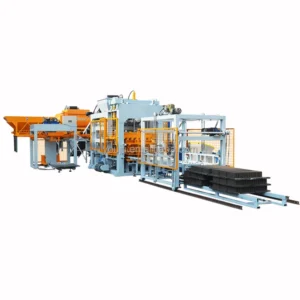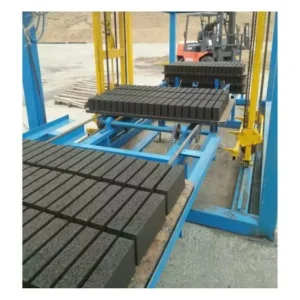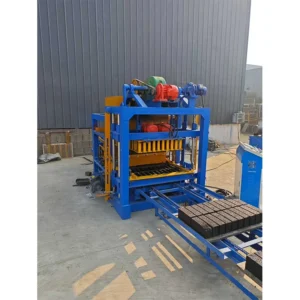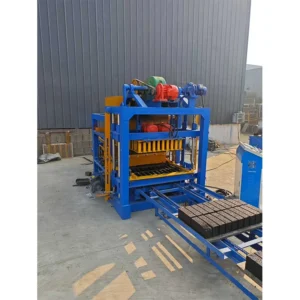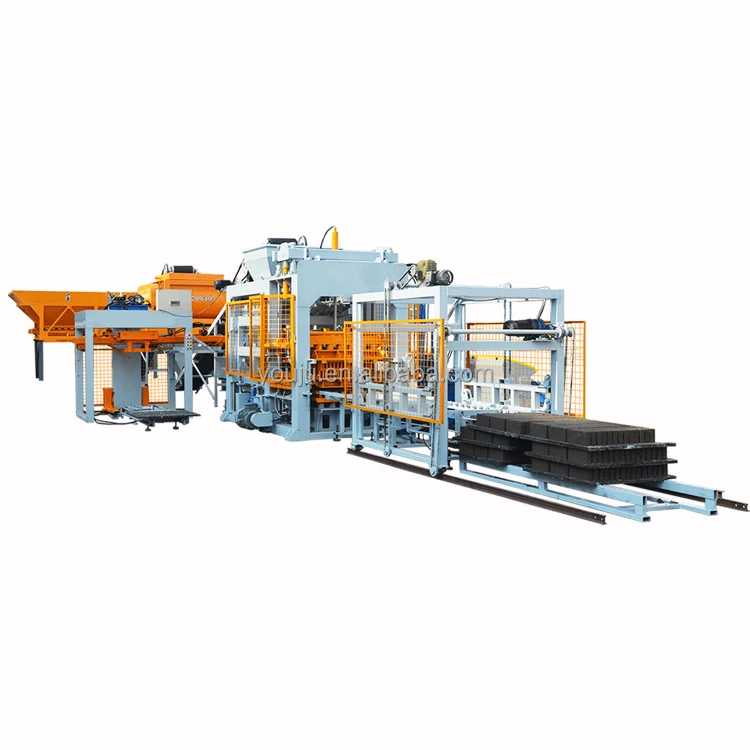
Line-Centred Specification — every upstream and downstream station from batching to stacking is timed against the QT8-15 press cycle so no single machine governs the real output.
Technical Specifications
| Parameter | Value |
|---|---|
| Model | QT8-15 |
| Product Type | Fully Automatic Concrete Block Making Machine |
| Overall Dimensions (L×W×H) | 8300 x 1860 x 3000 mm |
| Rated Power | 37 kW |
| Control System | PLC (Programmable Controller) with touch screen HMI |
| Vibration Form | Platform Vibration |
| Vibration Frequency | 2800-4500 RPM |
| Pallet Size | 950 x 900 mm |
| Moulding Cycle | 15 – 25s (20-25s with color feeding) |
| Brick Height Range | 50-200 mm |
| Hydraulic System | Independent integrated hydraulic station |
| Block Compressive Strength | Up to 15 MPa |
| Output Capacity | 1912 pcs/h (based on 400 x 200 x 200 mm hollow block, 8 pcs/mould) |
| Output Capacity | 2875 pcs/h (based on 400 x 150 x 200 mm block, 12 pcs/mould) |
| Output Capacity | 4320 pcs/h (based on 240 x 115 x 90 mm block, 18 pcs/mould) |
| Output Capacity | 9360 pcs/h (based on 240 x 115 x 53 mm block, 39 pcs/mould) |
| Output Capacity | 3000 pcs/h (based on 225 x 112.5 x 60 mm paving block, 18 pcs/mould) |
| Output Capacity | 4625 pcs/h (based on 200 x 100 x 60 mm paving block, 28 pcs/mould) |
| Voltage & Frequency | (basis not stated in source — confirm with buyer market) |
| Automation Level | Fully automatic (PLC controlled, automatic process) |
| Line Equipment Included | Cement silo, host block machine, mixer, batching machine, stacker, forklift, pallet feed machine, storage hopper, conveyor |
| Raw Materials | Fly ash, slag, gangue, industrial waste, river sand, gravel, cement |
| Color Feeding | Optional add-on for colored paving blocks |
| Mould Compatibility | Hollow block, porous block, standard block, paving block, curbstone, grass block, slope-protecting block |
Application Suitability
| Application | Material or Output |
|---|---|
| Hollow block production for load-bearing walls | Fly ash, slag, river sand and cement mixes up to 15 MPa compressive strength |
| Paving block and curbstone manufacturing for municipal projects | Crushed stone, gravel and cement with optional color feeding layer |
| Porous and grass block production for landscaping and drainage | Lightweight aggregate blends with high void ratio moulds |
| Solid standard block for residential construction | Local sand, gangue and cement at standard density settings |
| Slope-protecting block for civil infrastructure | Heavy aggregate mixes requiring maximum vibration and hydraulic force |
Why the Press Cycle Is Only Half the Story in an automatic block machine production line
The press does not set the line speed — the slowest station around it does.
I once watched a QT 8-15 press finish its cycle in 18 seconds and then sit idle for another 12 seconds because the pallet return conveyor could not deliver the next board fast enough. The rated 15-25 second moulding cycle was real, but the daily output was governed entirely by pallet logistics downstream. [NEED_CITE: pallet handling and return system impact on block line throughput] When a buyer sizes an automatic block machine production line around the press alone, every other station becomes an uncontrolled variable.
Upstream Batching and Mixing Must Feed the Press Without Pause
The batching machine, storage hopper and conveyor must deliver a consistent mix to the host block machine within each 15-25 second moulding window. If the mixer discharges in 45-second batches but the press consumes material every 20 seconds, a buffer hopper is required between them. The automatic block machine production line layout must show material flow timing station by station, not just aggregate daily figures. An undersized mixer leaves the press starved during peak cycles, and an oversized one wastes energy and floor space.
Downstream Stacking and Pallet Return Close the Loop
Once the QT8-15 releases a pressed block on its 950 x 900 mm pallet, the stacker must lift and place it on the curing rack before the next pallet arrives from the return conveyor. [NEED_CITE: stacking cycle synchronization with press discharge rate] If the stacker cycle is slower than the press discharge, the entire automatic block machine production line backs up. Pallet return speed is equally critical — a pallet that has not been cleaned and repositioned in time forces the press to wait, turning a 20-second cycle into a 35-second one.
Reading the Specifications That Govern Line Balance
The independent integrated hydraulic station sits separate from the main frame vibration, which means hydraulic response time stays consistent regardless of how many cycles the press has completed in a shift. This matters when the automatic block machine production line runs consecutive mould changes — a hydraulic station contaminated by dust or vibration loses pressure stability, and block density varies across the pallet. The 2800-4500 RPM platform vibration range allows the operator to set frequency based on the mix design: lower RPM for lightweight aggregate with high fly ash content, higher RPM for dense gravel mixes producing curbstone. The pallet size of 950 x 900 mm defines the curing rack geometry, the forklift tine spacing and the stacking pattern — all three must be specified before the line is built, not after it arrives.
The Hidden Cost of Stations Quoted Separately
When the mixer, pallet feeder and stacker are sourced from different suppliers without a shared timing specification, each vendor guarantees their own equipment but nobody guarantees the line. The block machine runs within its rated parameters, yet the plant owner experiences frequent stoppages that each vendor attributes to the other’s equipment. [NEED_CITE: multi-vendor integration issues in block production lines] Pallets specified for a different curing rack layout force the buyer to rebuild the curing yard or handle blocks manually at the line exit. Voltage and frequency confirmed for the press but not for the batching motor or stacker drive result in commissioning delays that affect the entire automatic block machine production line simultaneously.
What Distinguishes a Line-Centred Quotation
The quotation covers every station from the cement silo through the stacker as one matched set, so cycle times align across the entire automatic block machine production line. Mould design is specified against the block formats the buyer’s market actually purchases, including custom drawings where standard formats do not match local dimensions. Pallet size, material and return path are confirmed against the buyer’s existing curing area and forklift, not chosen from a catalogue default. The automation level is selectable — a buyer can commission the line semi-automatic and add stacking and cubing modules later without replacing the press. Voltage, frequency and PLC display language are confirmed with the buyer’s site conditions before production begins, removing the most common source of commissioning delay.
Documentation & Verification
- Line layout drawing showing station spacing and material flow for the QT8-15 configuration
- Capacity calculation sheet stating block format assumed for each hourly figure
- Pallet specification matched to buyer’s curing rack and forklift dimensions
- Hydraulic and electrical schematic with confirmed voltage and frequency
- Factory test record on buyer’s target block format before dispatch
- Operation and maintenance manual in buyer’s preferred PLC language
Installation, Commissioning & Support
- Foundation plan showing load points for the 8300 x 1860 mm machine footprint and curing rack area
- Electrical supply specification confirming 37 kW rated power and dedicated circuit requirements
- Pallet return conveyor alignment verified against curing yard forklift access path on site
- PLC touch screen language and HMI parameters set to buyer’s operator preference before commissioning
- Operator training covering mould change procedure across all purchased block formats
- Wear parts list covering hydraulic seals, vibration springs and pallet guide rollers with first reorder schedule
What to Prepare Before Requesting a Line Quotation
Share the specific block formats your market sells, the local aggregate types available and the daily volume you plan to run. Confirm your site voltage, frequency and the PLC language your operators read. Provide the dimensions of your existing curing area and the forklift model you will use for pallet handling. With these inputs, the automatic block machine production line can be specified station by station with realistic output figures per format.
Frequently Asked Questions
Q: How is daily output calculated per block format across the entire line, not just the press?
A: Each hourly capacity figure is stated with the exact block format and mould cavity count it assumes — for example, 1912 pieces per hour based on a 400 x 200 x 200 mm hollow block with 8 cavities. Daily output then factors in pallet return speed, stacker cycle and shift hours, not just the press moulding cycle alone.
Q: Which upstream and downstream stations are included in the quotation?
A: The line quotation covers the cement silo, batching machine, mixer, storage hopper, conveyor, pallet feed machine, the QT8-15 host block machine, stacker and forklift. Each station’s cycle time is verified against the press so the automatic block machine production line operates without any single station creating a bottleneck.
Q: How does the 950 x 900 mm pallet size relate to my existing curing area and forklift?
A: The pallet dimensions determine curing rack slot width, stack height and forklift tine spacing. We confirm your curing yard layout and forklift model before finalising the pallet specification, so the automatic block machine production line integrates with your existing handling equipment rather than requiring replacement.
Q: Can the automation level be staged over time?
A: Yes. The QT8-15 can be commissioned with manual pallet handling at the line exit and upgraded to automatic stacking and cubing later. The PLC control system supports this expansion, so the automatic block machine production line grows with your production volume without requiring a press replacement.