
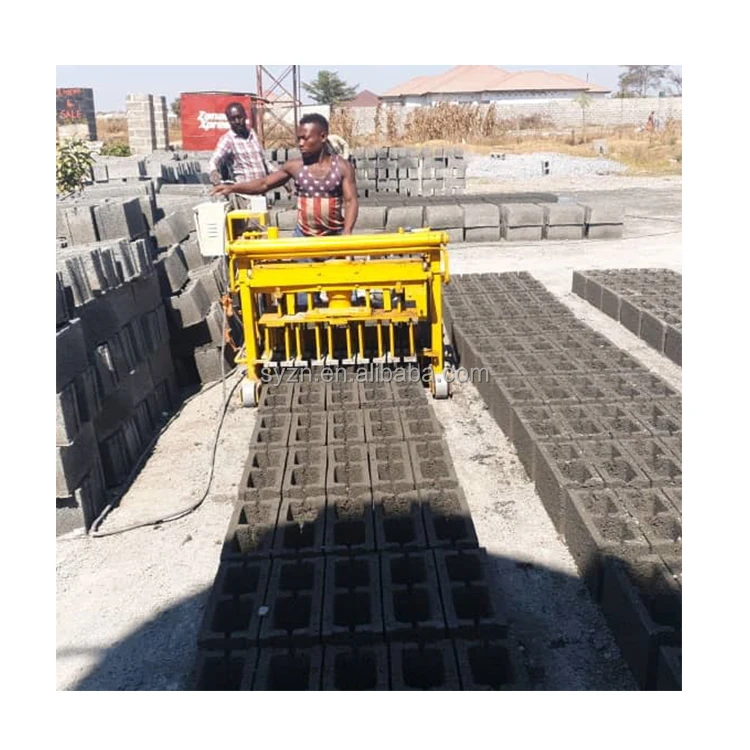
Coordinated Line Sizing — The QMY4-30 mobile block making setup is quoted with mixer output and material feed rates matched to its 25–30 s cycle, preventing the idle gaps that silently cut daily throughput on single-machine orders.
Technical Specifications
| Parameter | Value |
|---|---|
| Product Type | Mobile Hydraulic Block Making Machine |
| Model | QMY4-30 |
| Hydraulic Method | Mould vibration |
| Demold Method | Hydraulic |
| Molding Cycle | 25–30 seconds |
| Total Power | 5.95 kW |
| Pallet Requirement | Palletless (mobile egg-laying type) |
| Output Capacity | 480 pcs/h (based on 400×200×200mm hollow block, 4 pcs/mould) |
| Output Capacity | 600 pcs/h (based on 400×150×200mm hollow block, 5 pcs/mould) |
| Output Capacity | 840 pcs/h (based on 400×100×200mm hollow block, 7 pcs/mould) |
| Daily Output (8hr) | 3840 pcs (based on 400×200×200mm hollow block) |
| Daily Output (8hr) | 4800 pcs (based on 400×150×200mm hollow block) |
| Daily Output (8hr) | 6720 pcs (based on 400×100×200mm hollow block) |
| Automation Level | Manual / mobile operation |
| Standards | ISO9001:2000, CE |
Application Suitability
| Application | Material or Output |
|---|---|
| On-site housing project production | Hollow blocks from crushed stone, sand, and cement laid directly on the ground |
| Remote or difficult-terrain construction | Palletless egg-laying operation in mountainous, hilly, desert, or coastal zones |
| First-plant entrepreneurial startup | Low-investment hollow block production without curing rack infrastructure |
| Contractor self-supply on large developments | Continuous mobile laying of 400×200×200, 400×150×200, and 400×100×200 formats |
Why "480 Blocks per Hour" Rarely Survives the First Week on Site
A mobile block machine production line only holds its rated cycle when the mixer, feed rate, and curing floor are each sized to the same throughput.
I have watched contractors in Southeast Asia unbox a mobile press, run it for half a day, and wonder why the hopper keeps starving. The press wants fresh mix every 25–30 seconds, but the pan mixer beside it batches once every three minutes and the wheelbarrow runner cannot keep up. The QMY4-30 then sits idle between cycles, and the 480 pcs/h figure based on 400×200×200mm hollow blocks quietly drops. That is not a machine fault — it is a line-balance fault, and it happens because the quotation listed the press alone. [NEED_CITE: mobile egg-laying block machine line balance and mixer sizing]
Matching Every Station to the Press Cycle
A turnkey mobile block making setup starts with the press cycle and works backward. The QMY4-30 completes a mould every 25–30 seconds, which translates into a fixed demand for wet mix per minute. The mixer capacity, discharge gate size, and feed belt or manual transfer method must each deliver that volume without buffering or starving. When one station runs slower, the press waits; when one runs faster, mix sits and begins to set before it reaches the mould.
What the Curing Floor Actually Demands
Because this is a palletless egg-laying machine, every block is laid directly on the ground where it must cure in place for at least a day. That means the curing area must accommodate an entire shift’s output — 3840 pieces of 400×200×200mm hollow blocks or up to 6720 pieces of 400×100×200mm blocks — without the operator running out of flat, level floor. [NEED_CITE: curing floor area calculation for palletless mobile block production] Planning the line without measuring available ground space is how projects end up stacking blocks too early and cracking edges.
Reading the Power and Cycle Figures Together
The 5.95 kW total power rating covers both the hydraulic pump that drives demoulding and the vibration motor inside the mould. At this power level the machine can run from a standard site generator, which matters on remote hillside or island projects where grid supply is unreliable. The 25–30 second moulding cycle is the combined result of vibration compaction time and hydraulic lift time. Shortening the cycle by cutting vibration duration would reduce block density, so the figure in the table represents the practical minimum for structural hollow blocks rather than a speed to be beaten.
When the Rest of the Line Is an Afterthought
Ordering the QMY4-30 without specifying the supporting stations leads to predictable failures. A mixer that is too small forces the operator to skip cycles. A curing area that is too small forces early stacking, and green blocks crack under their own weight. Voltage and frequency confirmed too late mean the motor arrives wound for the wrong grid, and commissioning stalls until a replacement arrives. Each of these is a line problem dressed up as a machine problem. [NEED_CITE: common commissioning delays from unconfirmed voltage and frequency on export machinery]
Why Buyers Source the Full Setup Here
Block machinery is our single focus, so the QMY4-30 is never quoted in isolation. The mixer, feed arrangement, and curing plan are specified against the buyer’s actual aggregate and target format. Mould design covers the hollow block sizes the local market actually buys, including custom drawings when standard formats do not match. Configuration is set against the buyer’s mix design and local raw materials rather than a catalogue default. Automation level is selectable, so a buyer can begin with manual operation and add mechanical feed later. Installation support includes operator training on cycle timing and line pacing, not just button functions.
Documentation & Verification
- Line layout and capacity calculation stating the hollow block format assumed for each output figure
- Machine specification sheet with hydraulic and electrical schematic for the QMY4-30
- Mould drawing and format list covering 400×200×200, 400×150×200, and 400×100×200 hollow blocks
- Voltage and control language confirmation recorded before production begins
- Factory test record run on the buyer’s specified block format before dispatch
- Operation and maintenance manual with wear parts and mould replacement schedule
Installation, Commissioning & Support
- Ground must be level and compacted across the full curing area to support palletless egg-laying operation
- Power supply confirmed at the ordered voltage and frequency before the 5.95 kW motor is energized on site
- Mixer positioned within one batch cycle of the press to eliminate feed starvation during the 25–30 s moulding rhythm
- First commissioning run verifies demoulding pressure and vibration duration against the buyer’s local aggregate mix
- Operator trained on hopper refill timing to match the continuous mobile laying sequence without idle gaps
- Wear parts list and spare mould inventory reviewed to cover the first replacement cycle without production stoppage
What to Include in Your Inquiry
To size the mobile block machine production line correctly, send the hollow block format you sell most, your target daily output, and the aggregate materials available near your site. Confirm the local voltage, frequency, and the language you need on the control panel. If you already own a mixer or have a fixed curing area, state its capacity and dimensions so the supporting equipment is matched rather than duplicated.
Frequently Asked Questions
Q: How is the daily output of the QMY4-30 calculated, and which block format does each figure assume?
A: Each daily output figure is tied to a specific hollow block size and mould cavity count. The 3840 pcs per 8-hour shift assumes 400×200×200mm blocks with 4 cavities per mould. The 4800 pcs figure assumes 400×150×200mm blocks with 5 cavities, and 6720 pcs assumes 400×100×200mm blocks with 7 cavities. The calculation uses the 25–30 second cycle time without deduction for breaks or mixer delays.
Q: What mixer capacity and material feed rate are needed to keep the press running without idle gaps?
A: The mixer must discharge a full batch within one press cycle window so the hopper never runs empty. For the QMY4-30 at its 25–30 second cycle, this typically means a pan mixer sized to deliver enough wet mix for four to five moulds per batch, with a discharge gate fast enough to refill the hopper before the next cycle starts. We specify the exact mixer model after confirming your block format.
Q: How do I confirm voltage, frequency, and control language before the machine leaves the factory?
A: These three items are confirmed during the quotation stage and recorded on the specification sheet before production starts. If your site voltage or frequency differs from standard options, the motor winding and electrical panel are adjusted accordingly. The control panel labels and any digital display language are set to your preference so commissioning can begin immediately on arrival.
Q: What curing area and floor space does a palletless mobile line require for a full day’s output?
A: Every block laid by the QMY4-30 stays on the ground until it is strong enough to move, so the curing floor must hold an entire shift’s production. For 400×200×200mm hollow blocks at 3840 pcs per day, the required flat area is substantially larger than for smaller formats. We calculate the exact floor space after you confirm which format dominates your daily output.
Q: Which spare parts and moulds should be ordered upfront to avoid downtime during the first replacement cycle?
A: The documentation package includes a wear parts list specific to the QMY4-30 hydraulic and vibration assemblies. We recommend ordering the high-wear hydraulic seals, vibration motor bearings, and at least one spare mould for your highest-volume block format at the time of the initial purchase, so replacements arrive before the first change-out is due.


