
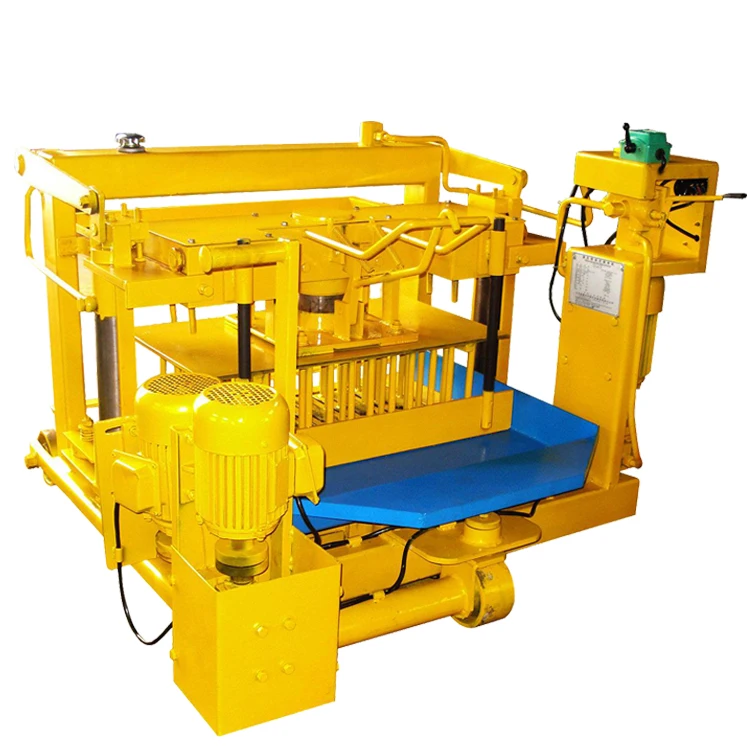
Matched system logic — The QMY4-30 mobile block making machine production line is specified as a complete on-site workflow where mixer, press, and curing area are aligned from day one, not assembled as separate purchases.
Technical Specifications
| Parameter | Value |
|---|---|
| Model | QMY4-30 |
| Product Type | Mobile Cement Block Making Machine |
| Dimension of Host Machine | 1300×1500×1000 mm |
| Molding Area | 400×800 mm |
| Rated Pressure | 6-8 MPa |
| Vibration Force | 28.6 kN |
| Vibration Frequency | 4500 r/min |
| Main Vibration Form | Moulding Vibration |
| Molding Cycle | 15-25 s (basis to be confirmed by block format and mix) |
| Demolding Method | Hydraulic |
| Pallet Size | No pallets required (egg-laying type) |
| Mixer Model | JQ350 |
| Overall Power | 5.95 kW |
| General Water Consumption | 4 T/day |
| Total Mass | 950-1000 kg |
| Factory Area | 500 m² |
| Applied Products | Concrete hollow/solid blocks, pavers, interlocking blocks |
| Automation Level | Automatic (mobile / egg-laying operation) |
| Standards | ISO 9001, CE, SGS |
Application Suitability
| Application | Material or Output |
|---|---|
| On-site building construction | Hollow and solid concrete blocks from crushed stone, sand, and cement |
| Road paving and squares | Interlocking pavers from gravel and cement mix |
| Landscaping and gardens | Porous and kerb blocks using fly ash and slag aggregates |
| Municipal and housing projects | Egg-laying production directly on the ground without pallet circulation |
What "15-25 Seconds per Cycle" Actually Means on Site
Cycle time only translates to daily output when the block format, mix design, and mixer feed rate are all confirmed.
When a mobile block making machine production line arrives without a capacity calculation tied to your specific hollow block or paver dimensions, the 15-25 second molding cycle becomes a theoretical number. I have watched contractors assume the fastest cycle applies to every format, only to find their 400 mm hollow blocks need the full 25 seconds plus manual repositioning time, cutting daily volume in half compared to the quote [NEED_CITE: capacity calculation methods for mobile egg-laying block machines]. The JQ350 mixer must also keep pace; if batch preparation lags behind the press, the machine sits idle between cycles.
Removing Pallet Logistics from the On-Site Workflow
The egg-laying design of the QMY4-30 deposits blocks directly onto the ground, eliminating the need for pallet purchase, circulation, and storage. For a mobile block making machine production line working within a 500 m² factory area, this means the curing zone is simply the flat concrete slab the machine traverses, rather than a dedicated rack system. The hydraulic demolding system releases each block in place, and the machine moves forward to the next position, leaving a continuous row of curing products behind it.
Aligning Mixer Output with Press Cycle on Uneven Ground
The JQ350 pan mixer is sized to match the material demand of the QMY4-30 press across its standard formats. On a typical housing project site, the mixer is positioned adjacent to the machine path, and raw material — whether crushed stone, sand, fly ash, or cement — is fed in batches that correspond to the molding cycle frequency. If the local aggregate has a higher clay content or different moisture profile than the test sample, the mix consistency changes, which directly affects how the 28.6 kN vibration force compacts the block [NEED_CITE: effect of aggregate clay content on block compaction strength]. This is why confirming local material properties before finalizing the line configuration matters more than comparing catalog cycle times.
Reading the Specs That Determine Actual Block Density
The 6-8 MPa rated pressure and 28.6 kN vibration force work together to compact the concrete mix within the 400×800 mm molding area. Hydraulic pressure provides the static clamping force that holds the mould walls firm, while the moulding vibration at 4500 r/min settles the aggregate into voids — insufficient vibration leaves honeycomb cavities, while excessive vibration segregates the cement paste from the stone. The 5.95 kW overall power must drive both the hydraulic pump and the vibration motor simultaneously; on sites where generator capacity is marginal, voltage drop under load can reduce vibration amplitude and produce softer blocks [NEED_CITE: voltage drop effects on hydraulic block machine vibration motors]. The 950-1000 kg total mass also contributes to stability during vibration, preventing the machine from shifting on unprepared ground.
When the Supporting Equipment List Stops at the Press
Quoting a mobile block machine without specifying how raw material reaches the mixer, how water is metered, and where curing blocks are protected from rain leaves the buyer to solve those gaps on site. The QMY4-30 egg-laying system removes pallet handling from the equation, but it still requires a level concrete surface for the machine to traverse, a water supply matching the 4 T/day consumption figure, and a curing protocol that accounts for local temperature and humidity. Contractors who skip these line-integration details typically spend the first week troubleshooting rather than producing [NEED_CITE: on-site block production setup requirements in developing infrastructure markets].
Why Buyers Plan the Full Line Here
The QMY4-30 is specified alongside its supporting equipment — the JQ350 mixer, water dosing arrangement, and site layout — as one matched system rather than a press-only quotation. Capacity calculations state which block format the cycle time assumes, so daily output projections hold up after commissioning. Voltage, frequency, and PLC display language are confirmed before dispatch to prevent wiring delays on arrival. Raw material feed configuration is adjusted to the buyer’s local aggregate report, not a default mix designed for Chinese river sand. Mould options cover the hollow block, solid block, paver, and interlocking formats the buyer’s market actually sells, and custom mould drawings are available for non-standard dimensions. Installation support includes operator training on the specific mix and format combination the buyer will run.
Documentation & Verification
- Machine specification sheet confirming hydraulic pressure, vibration force, and mixer model for your configuration
- Line layout drawing showing mixer placement, machine travel path, and curing area within the 500 m² site
- Capacity calculation stating the block format and mix design assumed for the quoted molding cycle
- Voltage and control language confirmation document signed off before production begins
- Factory test record on your specified block format before dispatch
Installation, Commissioning & Support
- Site must provide a level concrete surface across the 500 m² factory area for stable egg-laying traversal
- 5.95 kW power supply with dedicated circuit and confirmed voltage and frequency for the destination market
- Machine arrives as a single host unit (1300×1500×1000 mm) requiring on-site positioning and mixer connection
- First production run supervised to match JQ350 mixer batch timing with the 15-25 s molding cycle
- Operator training covers mould change procedure, hydraulic demolding sequence, and mix adjustment for local aggregate
- Wear parts list and mould maintenance schedule provided at handover
Before You Request a Quote
To configure the QMY4-30 mobile block making machine production line around your actual site conditions, we need the block formats you plan to produce with target dimensions, a lab report or description of your local sand and aggregate including clay content and moisture range, and the voltage and frequency standard at your project location. If you have an existing curing area or water source, share the dimensions and supply rate so the line layout can be drawn around them rather than the other way around.
Frequently Asked Questions
Q: How is daily output calculated for the QMY4-30 across different block formats?
A: Daily output depends on the specific block format, because the 15-25 second molding cycle varies by size and wall thickness. A capacity calculation is prepared stating which format the quoted cycle assumes, along with the JQ350 mixer batch frequency and realistic operating hours, so the projection matches your actual product rather than a generic catalog figure.
Q: What supporting equipment is needed to complete the on-site production line?
A: Beyond the QMY4-30 host machine and JQ350 mixer, the line requires a water supply matching approximately 4 T/day consumption, a level concrete surface within the 500 m² area for egg-laying traversal, and raw material storage positioned for efficient feeding into the mixer. A curing protection plan for local weather conditions is also factored into the site layout.
Q: How does the egg-laying system affect curing area planning?
A: Because blocks are deposited directly on the ground without pallets, the curing area is the same concrete slab the machine travels across. This eliminates pallet purchase and rack infrastructure, but the surface must be level and sufficiently cured itself to support block weight during the early strength gain period without surface damage.
Q: What voltage and control options are available for the destination market?
A: Voltage, frequency, and control display language are confirmed during the quotation stage to match the destination site’s electrical standard. This confirmation happens before production, preventing commissioning delays caused by mismatched motor wiring or unreadable PLC text after the machine arrives on site.
Q: How does the QMY4-30 integrate with material feeding in a mobile setup?
A: The JQ350 mixer is positioned adjacent to the machine travel path so that batched material can be fed into the press hopper at a rate matching the molding cycle. Raw material stockpiles are arranged to minimize manual transport distance, keeping the overall mobile block making machine production line workflow continuous throughout the shift.


