
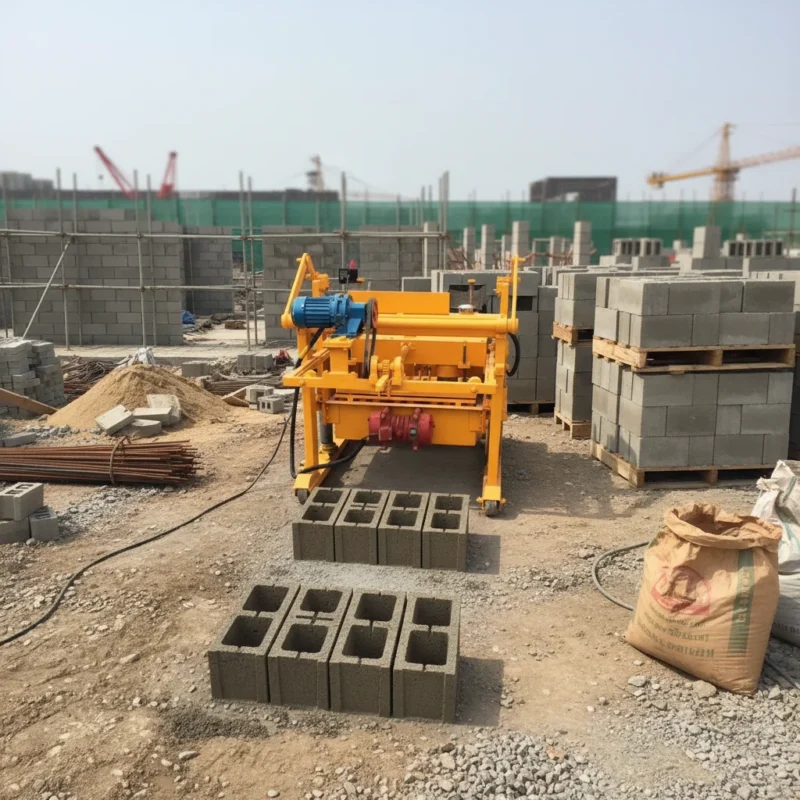
Matched System Planning — Every component of this mobile block line, from raw material feeding to curing layout, is specified around the QMY4-30’s on-site footprint rather than treated as an isolated press sale.
Technical Specifications
| Parameter | Value |
|---|---|
| Model | QMY4-30 |
| Product Type | Manual Mobile Block Making Machine |
| Overall Dimensions (L×W×H) | 1300 × 1500 × 1000 mm |
| Net Weight | 950 kg – 1000 kg |
| Vibration Force | 28.6 kN |
| Excitation Frequency | 4500 r/min |
| Hydraulic Method | Mold Vibration |
| Total Power | 5.95 kW |
| Voltage & Frequency | 380V ± 10% |
| Control System | Manual operation (source value — verify against manufacturer catalog) |
| Output Capacity | 3000 pcs/day (basis not stated in source — confirm block format / material / thickness) |
| Raw Material Compatibility | Concrete, fly ash, cinder, coal gangue, river sand, gravel, cement, and other industrial waste residues |
| Automation Level | Manual |
| Mobility | Mobile / egg-laying type |
Application Suitability
| Application | Material or Output |
|---|---|
| On-site housing project construction | Hollow and solid blocks from crushed stone, river sand, and cement |
| Remote infrastructure development | Paving blocks using locally sourced gravel and fly ash blends |
| Small-scale block production startups | Standard masonry blocks from coal gangue and cinder waste aggregates |
| Temporary contractor yards | Interlocking and kerb blocks for immediate site deployment |
Why "3000 Pieces per Day" Means Nothing Without Your Block Format
The output figure only becomes real once you anchor it to the exact hollow, solid, or paving block dimensions your market actually buys.
Mobile block machine production line capacity is almost always quoted as a single daily number. That number assumes a specific block format, a specific mix moisture content, and a specific number of working hours. Swap from a 400×200×200 mm hollow block to a thinner paving slab and the mold fill time, vibration duration, and demolding cycle all change [NEED_CITE: block format cycle time variables in mobile egg-laying machines]. I once spent two full days on a South Asian site chasing inconsistent block height because the ground had not been compacted before the machine arrived — the vibration was literally sinking the frame with every cycle. Before you commit to a Mobile Block Making Machine production line / turnkey plan, confirm what block format the quoted capacity assumes, how many hours per day the estimate uses, and whether your site ground bearing capacity is adequate for continuous vibration.
How the Line Flows Around a Machine That Moves
A fixed plant arranges stations in sequence around a stationary press. The QMY4-30 inverts that logic entirely. The machine travels forward after each molding cycle, laying blocks directly onto the ground surface, which means your raw material feeding and mixing station must be mobile or repositioned as the production front advances. Planning the material supply route, mixer placement, and water access points around a moving center of production is the core layout challenge here, not the press itself. A well-planned Mobile Block Making Machine production line / turnkey layout treats the curing zone and material staging as a system that grows with the machine’s daily travel path.
What Egg-Laying Operation Removes From Your Line
In a conventional stationary block plant, pallets must be purchased, fed into the press, retrieved after pressing, and circulated through a curing rack system. The egg-laying design of the QMY4-30 eliminates the entire pallet loop. Blocks are deposited directly onto a prepared concrete floor, which removes a significant line of capital expense and ongoing pallet replacement cost [NEED_CITE: pallet cost share in conventional block plant CAPEX]. The trade-off is that your curing area must be carefully planned in advance. The floor surface needs to be level, hard, and large enough to hold a full day’s output without blocks being moved while they gain initial strength.
Reading the Numbers That Actually Matter On-Site
The 28.6 kN vibration force at 4500 r/min is applied directly through the mold rather than through a separate vibrating table. This mold-vibration approach is what makes mobile operation possible — the compaction energy travels through the mold walls into the concrete mix without needing a heavy fixed frame to absorb reaction forces. For the operator, this means block density depends heavily on keeping the machine perfectly level and ensuring the mix moisture is consistent batch after batch.
The 5.95 kW total power draw is low enough for a standard construction site diesel generator to handle, which matters when your project is far from a reliable grid connection. However, the 380V ± 10% requirement must be matched precisely — under-voltage conditions on a long cable run from a generator will reduce vibration motor torque and produce softer blocks [NEED_CITE: voltage drop effects on vibration motor performance].
The 1300 × 1500 × 1000 mm footprint is compact enough to be pushed manually or towed between production areas, but the 950–1000 kg weight still demands a firm, prepared surface to prevent frame distortion during operation.
The Ground Preparation Mistake That Kills Block Consistency
The most common failure on a mobile machine site is not mechanical — it is civil work. When the production floor is bare soil or poorly compacted fill, the QMY4-30’s own vibration force settles the machine unevenly into the ground. The result is blocks that vary in height across a single production run, with one side consistently taller than the other. Operators compensate by adjusting the feed, which then creates density variation instead. Preparing a concrete production pad of adequate thickness before the machine arrives is non-negotiable [NEED_CITE: ground bearing requirements for egg-laying block machines]. Skipping this step wastes far more material and labor than the pad would have cost.
What You Are Actually Buying Beyond the Press
Every QMY4-30 configuration starts with the buyer’s target block format and local aggregate, not a catalog default. The mold is designed and supplied for the specific hollow, solid, or paving dimensions the buyer’s market demands, with custom mold drawings available when standard formats do not match. The raw material feed station — mixer type, water metering, and aggregate batching — is specified to work with the materials you can actually source at your project location. Installation support includes on-site commissioning with the operator trained on mix adjustment and mold change procedures, so the first production run is not a guessing game. The machine, mold, and surrounding line stations are quoted and documented as one matched system.
Documentation & Verification
- Line layout showing material staging and curing zone sized for your daily output
- Machine specification sheet confirming vibration force and power against your site supply
- Mold drawing and block format list with cycle time per format
- Voltage and control language confirmation signed before production begins
- Factory test record on your specified mix before dispatch
- Operation and maintenance manual covering mold change and vibration motor servicing
Installation, Commissioning & Support
- Prepare a level concrete pad exceeding 1000 kg machine weight to prevent frame settling during vibration cycles.
- Confirm 380V ± 10% supply from grid or generator with dedicated circuit rated above 5.95 kW draw.
- Machine ships as a single compact unit at 1300 × 1500 × 1000 mm, minimizing on-site assembly work.
- First-run commissioning includes mix moisture adjustment and block dimension verification on your local aggregate.
- Operator training covers manual mold change procedure and daily vibration motor inspection routines.
- Wear parts and replacement mold list supplied at handover with reorder lead times stated upfront.
What to Prepare Before You Send an Inquiry
A productive conversation about a Mobile Block Making Machine production line / turnkey setup starts with a few specific details. Share the exact block format or formats your local market requires, along with the daily output you need to hit your project schedule. Describe the raw materials available at your site — particularly the aggregate type, maximum particle size, and whether fly ash or other supplementary materials are accessible. Confirm your on-site power supply voltage and whether you will be running from grid connection or a generator set.
Frequently Asked Questions
Q: What does the 3000 pcs/day output figure actually mean for my block format?
A: That capacity number is tied to a specific block size, mix, and working hours per day that the source did not state. Before ordering, request a capacity calculation that names the exact hollow, solid, or paving block format you intend to produce, along with the assumed cycle time and shift length for that format.
Q: Can I run the QMY4-30 on a construction site generator?
A: The 5.95 kW total power requirement is within the range of standard construction site diesel generators. The critical check is whether your generator can maintain 380V ± 10% under load at the cable distance to the machine. Voltage drop over long temporary cables reduces vibration motor performance and affects block quality.
Q: Do I still need pallets for curing with a mobile egg-laying machine?
A: No. The egg-laying design deposits blocks directly onto a prepared concrete floor, eliminating the pallet purchase and circulation system entirely. Your curing area plan replaces the pallet investment — the floor must be level, hard, and large enough to hold a full production day without disturbance.
Q: What block formats can the QMY4-30 produce and how long does a mold change take?
A: The machine supports hollow, solid, and paving block molds. Exact format options and mold change duration depend on the mold set you specify at order. Request the format list and cycle time per format in your quotation so you can plan production scheduling around realistic changeover windows.


