
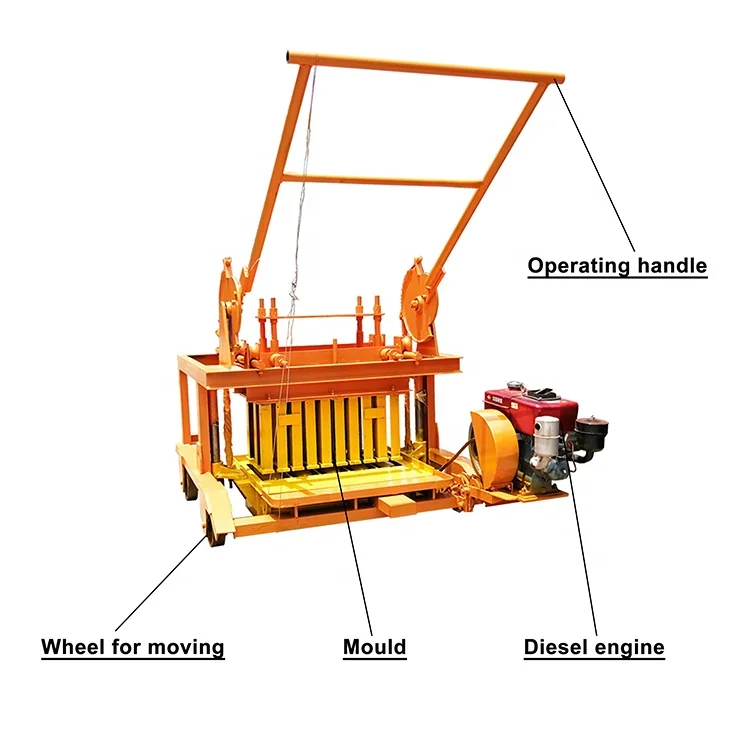
Matched system integration — A mobile diesel block machine specified together with its mixer, feeder, and curing layout so the on-site line runs without bottlenecks.
Technical Specifications
| Parameter | Value |
|---|---|
| Model | QMR4-45 |
| Product Type | Mobile Diesel Concrete Block Making Machine |
| Machine Type | Egg laying / mobile block making machine |
| Power Source | Diesel engine (hydraulic pressure supply) with optional electric motor |
| Diesel Engine | 6kW or 6-8HP |
| Rated Power (Electric Option) | 6kW |
| Voltage | 220V or 380V or according to client local voltage |
| Moulding Cycle | 40-45s |
| Pallet Size | No pallet required (egg-laying type) |
| Overall Dimensions (L×W×H) | 2420×1320×1650mm |
| Net Weight | 810kg |
| Output Capacity | 3000pcs/day (8 hours) based on 400×200×200mm hollow block, 4pcs/mould |
| Output Capacity | 3500pcs/day (8 hours) based on 400×150×200mm hollow block, 5pcs/mould |
| Output Capacity | 4500pcs/day (8 hours) based on 400×120×200mm hollow block, 6pcs/mould |
| Mould Change | Manual |
| Automation Level | Manual / low-investment semi-manual operation |
| Assembly State | Fully assembled, mobile on-site use |
| Key Features | No pallet required, diesel or electric drive options, manual mould swap for different formats |
Application Suitability
| Application | Material or Output |
|---|---|
| On-site building construction | Hollow blocks and solid bricks from local crushed stone, sand, and cement |
| Temporary housing project production | Multicellular bricks laid directly on cleared ground |
| Remote site block making | Paving bricks and standard bricks in locations without reliable grid electricity |
| Small-scale first production setup | Various hollow block formats via manual mould swap |
Why the Mixer Feeding Rate Dictates Your Real Output
The mobile block machine production line only produces as fast as the upstream mixer can deliver fresh concrete to it.
When a contractor buys a mobile diesel block machine and hooks it up to an undersized pan mixer, the press spends half its shift sitting idle waiting for the next batch. The 40-45 second moulding cycle means the QMR4-45 needs a steady flow of mixed material roughly every minute to maintain its stated capacity. I have seen operators standing around for twenty minutes at a time because the mixer was still grinding through a batch that should have been ready in five. This mismatch turns a turnkey mobile block making setup into a single machine surrounded by wasted labour and a disappointed site manager [NEED_CITE: on-site batching equipment sizing for mobile block production].
Matching the Press to the Supporting Equipment
The mobile block machine production line begins well before the press itself. Raw material feeding, mixing, and delivery to the hopper must all be calculated against the 40-45 second cycle time so the QMR4-45 never waits. For a site producing 400×200×200mm hollow blocks at four per cycle, the mixer needs to deliver a consistent batch volume every cycle without overloading the operator who is feeding material by hand or wheelbarrow. Getting the supporting equipment right is what separates a functioning on-site line from an expensive paperweight.
Ground Conditions and the Egg-Laying Layout
The egg-laying design means blocks are laid directly on the ground, which removes pallet costs entirely but introduces a different constraint. The ground must be level, firm, and cleared of debris for the machine to travel smoothly and for blocks to cure without cracking from uneven settlement. A mobile block machine production line without proper ground preparation produces blocks with dimensional inconsistencies, and the machine frame itself takes unnecessary stress as it moves across uneven terrain. Site preparation is part of the line layout, not an afterthought [NEED_CITE: ground preparation standards for mobile egg-laying block machines].
Reading the Specs That Matter on Site
The diesel engine rated at 6-8HP drives the hydraulic pressure supply, which is the force that compacts the concrete into the mould. Hydraulic pressure and vibration together determine block density and strength, and on a mobile unit the engine must sustain that pressure consistently through each 40-45 second cycle. The 810kg net weight provides the downward force needed during vibration — a lighter machine would struggle to produce blocks with adequate compressive strength. Voltage flexibility at 220V or 380V applies only when the electric motor option is selected; the diesel engine makes the machine independent of grid availability, which is the primary reason contractors choose this configuration for remote projects.
What Happens When the Line Is Not Planned Together
Buying the press alone and sourcing the mixer and feeder separately is how most on-site block production projects stall. The mixer delivers too slowly, the raw material pile is too far from the press, and the curing area is not marked out before the first block is laid. Output drops to a fraction of what the machine can produce, workers spend more time moving material than making blocks, and the contractor blames the machine rather than the missing line layout. Every mobile block machine production line needs someone to calculate the feeding rate, the travel path, and the curing footprint before the equipment arrives [NEED_CITE: common causes of output shortfall in mobile block production].
Why Sourcing the Full Line Here Works
Block machinery is the single focus of the operation, so the QMR4-45 is not sold as a standalone press but configured with the mixer, feeder, and handling equipment as one matched system. The machine and mould are specified against the buyer’s actual block format and local aggregate, not pulled from a generic catalogue. Custom mould design is available for formats the buyer’s market demands, with drawings provided before production. The automation level can start at manual operation and expand later as the operation grows. Installation and commissioning support includes operator training on the complete line, not just the press in isolation [NEED_CITE: block machine line integration standards and practices].
Documentation & Verification
- Line layout and capacity calculation stating the block format assumed for each output figure
- Machine specification sheet with diesel engine and electric motor option details
- Mould drawing and format list covering every block size the machine can produce
- Voltage and control language confirmation recorded before dispatch
- Factory test record demonstrating cycle time and block output on the configured mould
- Operation and maintenance manual with wear parts and mould replacement list
Installation, Commissioning & Support
- Ground must be level and firm across the full travel path and curing area for the 2420×1320×1650mm machine footprint
- Diesel engine option requires no electrical connection; electric option needs confirmed 220V or 380V supply
- Machine arrives fully assembled and mobile — no on-site mechanical assembly required
- First-run commissioning includes mould swap demonstration and cycle time verification on the buyer’s mix
- Operator training covers manual feeding rhythm matched to the 40-45 second moulding cycle
- Wear parts list and mould replacement schedule provided for the first year of operation
Before You Request a Quote
To configure the mobile block machine production line properly, share the block formats your market requires along with the daily output target for each. Let us know the local aggregate type and whether the site has reliable electricity or needs the diesel engine. Site dimensions, ground condition, and any existing mixer or feeding equipment you plan to reuse help us calculate the supporting layout before quotation.
Frequently Asked Questions
Q: What supporting equipment does the QMR4-45 need for a complete mobile block machine production line?
A: At minimum, a pan mixer sized to deliver a fresh batch every 40-45 seconds, a raw material feeding setup to keep the mixer supplied, and a marked-out curing area on level ground. Belt conveyors or wheelbarrow routes must be planned so the operator can feed the press without interruption. The full line layout is calculated based on your target block format and daily output.
Q: How is the 3,000 pieces per day output calculated?
A: That figure is based on producing 400×200×200mm hollow blocks at four pieces per mould over an eight-hour shift. Different block sizes change the count — for example, 400×120×200mm blocks yield 4,500 pieces per day at six per mould. Capacity calculations in the quotation always state the exact block format assumed.
Q: Can both the diesel engine and electric motor options be supplied?
A: Yes, both drive options are available. The diesel engine at 6-8HP suits sites without reliable grid power, while the 6kW electric motor option requires confirmed voltage and frequency. Some buyers take both for flexibility across different project sites.
Q: What ground preparation does this egg-laying machine need?
A: The ground must be level, compacted, and free of debris along the machine’s travel path and across the entire curing area. Uneven ground causes block dimensional issues and puts stress on the 810kg machine frame. Ground preparation is part of the line layout we provide before the machine ships.


