
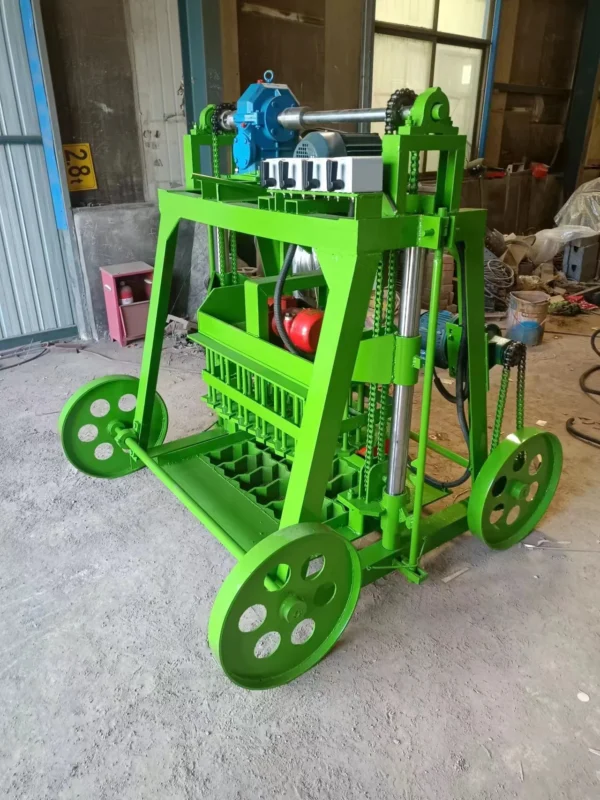
System-Matched Configuration — Every QMR4-45 deployment ships with raw material mixing, ground preparation, and curing layout specified together so the press never sits idle waiting for mix or space.
Technical Specifications
| Parameter | Value |
|---|---|
| Product Type | Diesel Egg Laying Block Making Machine |
| Overall Dimensions (L×W×H) | 2420×1320×1650mm |
| Net Weight | 810kg |
| Rated Power | 6kW |
| Diesel Engine | 6kW / 6-8HP |
| Voltage & Frequency | 220V / 380V or client local standard (frequency to confirm) |
| Control System | Manual / mechanical operation |
| Pallet Requirement | None (egg laying design) |
| Moulding Cycle | 40-45s |
| Output (400×200×200mm, 4pcs/mould, 8h) | 3000 pcs/day |
| Output (400×150×200mm, 5pcs/mould, 8h) | 3500 pcs/day |
| Output (400×120×200mm, 6pcs/mould, 8h) | 4500 pcs/day |
| Mould Formats | Hollow block: 400×200×200mm, 400×150×200mm, 400×120×200mm |
| Power Source | Diesel engine or electric motor (selectable) |
| Assembly State | Fully assembled (verify at order) |
| Warranty | 1 year |
| Certification | CE (certificate number to verify) |
Application Suitability
| Application | Material or Output |
|---|---|
| On-site hollow block production at construction zones | Crushed stone, sand, cement mixes laid directly on prepared ground |
| Remote job sites with no reliable grid electricity | Diesel-powered forming of 400×200×200mm hollow blocks at 3000 pcs per 8h shift |
| Housing project contractors producing locally | Hollow blocks in three format tiers (120mm, 150mm, 200mm wall thickness) |
| First-plant entrepreneurs with minimal capital | Egg laying output without pallet inventory or fixed curing racks |
What "Daily Output" Actually Means on a Mobile Block Making Machine Production Line
A capacity number is only honest when it names the block format, mould cavity count, and shift length it assumes.
Suppliers routinely quote a mobile block making machine production line at a single daily figure, but that number usually rests on the smallest block in the catalogue. Once the buyer switches to the format their market actually purchases, the mould has fewer cavities, the cycle stretches, and real throughput drops noticeably. On the QMR4-45, the difference between running 400×120×200mm blocks at six per mould and 400×200×200mm blocks at four per mould is significant over an eight-hour shift. Any capacity discussion that skips this breakdown leaves the buyer guessing at their real revenue. [NEED_CITE: block machine output calculation standards by format]
Line Balance Around an Egg Laying Press
The QMR4-45 drops blocks directly onto the ground, which removes the pallet loop entirely. That simplification shifts the bottleneck upstream: the mixer must deliver consistent batches at a pace the 40-45 second moulding cycle can absorb, and the curing area must be laid out so freshly formed blocks are never in the path of the next pass. When we scope a mobile block making machine production line, we map the mixer output rate against the press cycle and the walking speed of the operator to confirm no station starves another.
Ground Preparation and Curing Layout for Egg Laying Output
Egg laying means the ground itself becomes the pallet. The surface must be level within a narrow tolerance, compacted, and swept clean before each pass — otherwise block bottoms crack or dimensions drift. Curing happens in place, so the production path must loop through a zone where water can be applied and blocks left undisturbed for the required period. [NEED_CITE: ground preparation standards for egg laying block machines] If the curing loop is too tight, the operator runs over yesterday’s output; too wide, and the daily walking distance eats into productive hours.
Reading the Specs That Matter Most
The 6kW diesel engine is the defining feature for off-grid sites. It provides enough torque to drive the vibration mechanism through dense mixes without stalling, but it also means fuel consumption and engine maintenance become part of the daily routine rather than electrical costs. The 40-45 second moulding cycle sets the pace for everything upstream — a pan mixer that takes longer than this to produce a usable batch will leave the operator standing between cycles. The three hollow block formats share the same machine footprint but differ in cavity count, which directly governs whether the shift ends at 3000 or 4500 pieces. The 810kg net weight keeps the machine movable by a small crane or forklift between sites, which matters for contractors shifting between housing phases.
The Cost of Skipping Line-Level Planning
When a mobile block making machine production line arrives without a mixer matched to the press cycle, the operator hand-feeds small batches and the daily output collapses to a fraction of the quoted figure. Without a curing area plan, blocks get stacked on uneven ground or moved too early, and breakage rates climb. [NEED_CITE: common causes of block breakage during on-site curing] Voltage mismatches on electric motor versions delay commissioning by weeks while a transformer is sourced locally. These are not machine defects — they are line design gaps that turn a straightforward installation into a costly lesson.
Why Buyers Spec the Line Here
We configure the QMR4-45 as part of a matched system: mixer capacity, ground preparation guidance, and curing area dimensions are scoped against the buyer’s target block format before the quotation is issued. Mould selection is based on the formats the buyer’s market actually sells, not the formats easiest to quote. Automation level is honest — this is a manual, mechanical machine, and we state that clearly so buyers know the labour requirement upfront. Factory testing runs the buyer’s own aggregate sample when available, catching vibration parameter mismatches before the machine ships rather than after it arrives on site.
Documentation & Verification
- Line layout drawing showing mixer, press path, and curing zone scaled to buyer’s site
- Capacity calculation sheet with output stated per block format and mould cavity count
- Mould drawings for each hollow block size included in the order
- Machine specification sheet confirming diesel engine rating and cycle time
- Voltage and frequency confirmation form signed before production begins
- Factory test record on buyer’s aggregate sample where supplied
Installation, Commissioning & Support
- Ground must be level and compacted across the full production loop before the 2420×1320×1650mm machine arrives
- Diesel engine requires fuel priming and vibration mechanism belt tension check on first start
- Electric motor version needs confirmed voltage and frequency at site before wiring begins
- Mould change procedure trained on-site so operators can switch between the three hollow block formats
- Wear parts list with mould liner and vibration spring replacements identified for first reorder
- Daily maintenance covers engine oil, vibration mounts, and ground surface inspection
Before You Request a Quote
We need to know the block formats your market actually buys, the daily volume you are targeting, and whether your site has reliable electricity or requires the diesel engine option. Share your local aggregate type and any samples you can send — we will run them before the machine leaves the factory. Confirming site voltage and frequency up front prevents commissioning delays once the QMR4-45 arrives.
Frequently Asked Questions
Q: How is daily output calculated and which block format does the figure assume?
A: Each output figure on the QMR4-45 is tied to a specific hollow block size and mould cavity count. The 3000 pieces per day assumes 400×200×200mm blocks at four per mould over an eight-hour shift with a 40-45 second cycle. Switching to the 120mm format at six cavities raises output to 4500 pieces under the same conditions.
Q: Can the diesel engine be swapped for an electric motor, and what changes in the line?
A: The QMR4-45 is available with either a 6kW diesel engine or an electric motor configured to your site voltage. Switching to electric removes fuel handling from daily operations but requires confirmed supply capacity at the site. Line layout remains the same, but power cable routing must be planned around the production loop.
Q: What supporting equipment does the on-site production line need beyond the press itself?
A: Beyond the QMR4-45, the line needs a mixer sized to deliver batches within the 40-45 second moulding cycle, a water supply for both mixing and curing, and a compacted ground surface prepared across the full production and curing loop. We scope these stations together so the press is never left waiting.
Q: How does the egg laying design affect curing area planning?
A: Because the QMR4-45 lays blocks directly on the ground without pallets, the production path must loop through a curing zone where blocks remain undisturbed. The curing area length determines how many blocks can rest before the operator circles back, and water access must reach every section of that loop for consistent curing.


