
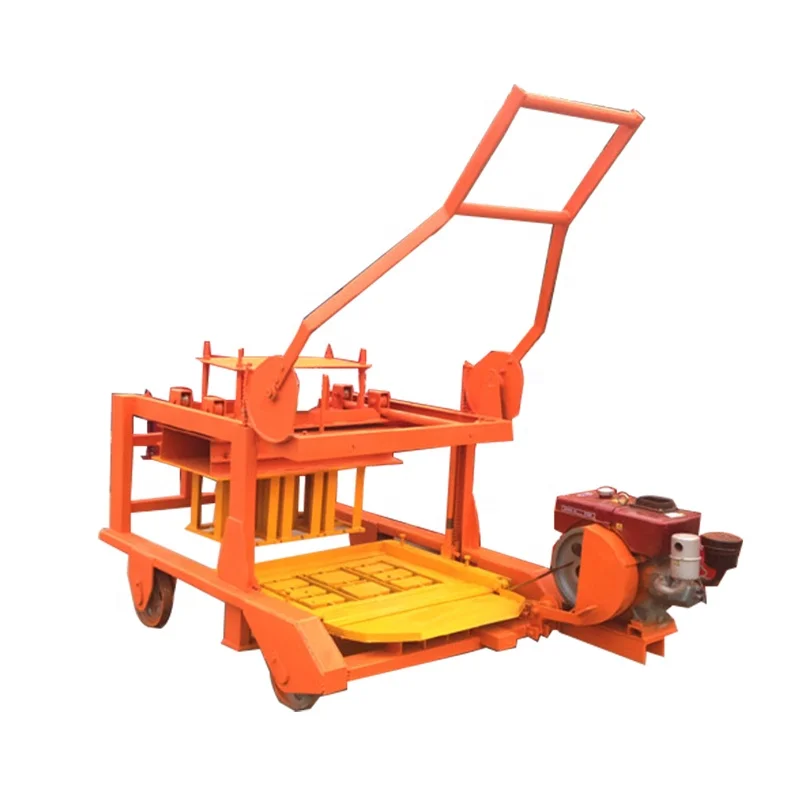
Matched Line Output — The QMR4-45 diesel mobile block machine, mixer, and trolley are quoted as one coordinated production line so material flow and cycle times align from batching through laying, not assembled from separate supplier quotes.
Technical Specifications
| Parameter | Value |
|---|---|
| Product Type | Mobile Concrete Block Making Machine |
| Model | QMR4-45 |
| Molding Cycle | 45s (basis not stated in source — confirm block format / material / thickness) |
| Power Source | Diesel |
| Rated Power | 8hp (rated or peak not specified in source) |
| Molding Form | Vibration and Pressure |
| Vibration Force | 60KN |
| Total Weight | 800kg |
| Overall Dimensions (L×W×H) | 2420×1320×1650mm |
| Pallet Size | Not required (pallet-free egg-laying type) |
| Automation Level | Manual / Mobile |
| Basic Equipment Included | JZC350 Diesel Concrete Mixer or JQ350 Diesel Concrete Mixer (Electric Generating Unit); Trolley |
| Mould Format | Paver brick, hollow block, concrete block, solid brick, fly ash brick (basis not stated in source — confirm block format / material / thickness) |
| Standards | CE (source value — verify against manufacturer catalog) |
Application Suitability
| Application | Material or Output |
|---|---|
| On-site housing project block production | Hollow and solid concrete blocks from crushed stone, river sand, and cement |
| Remote or off-grid block laying | Diesel-powered operation where grid electricity is unavailable |
| Small-scale entrepreneur block operation | Paver bricks and interlocking blocks from locally sourced aggregate |
| Fly ash brick production near thermal plants | Fly ash mixed with sand and cement in egg-laying format |
| Contractor-produced kerb and paving blocks | On-site mobile production following the project as it moves |
What a "45-Second Cycle" Quotation Rarely Tells You
The cycle time only holds if the mixer, material feed, and operator pace keep up with the press — a matched line is the real unit of capacity.
When a mobile block machine arrives on a project site without a specified mixer or handling plan, operators spend half the shift waiting for material or moving finished blocks by hand. The 45-second molding cycle quoted on the spec sheet assumes a steady supply of correctly mixed concrete and clear space to lay each block [NEED_CITE: on-site concrete block production workflow standards]. Without that supporting equipment, actual daily output can fall far short of what the cycle time suggests. This mobile block machine production line addresses that gap by including the diesel mixer and trolley as part of the quotation.
How the Line Stations Connect on a Project Site
The QMR4-45 mobile block machine production line begins with the JZC350 or JQ350 diesel mixer batching concrete while the press completes its previous cycle. The trolley carries mixed material to the machine hopper, and the operator positions the press for the next egg-laying position. Each station must finish its task within the 45-second window or the press sits idle — which is why the mixer capacity and trolley distance matter as much as the press itself.
Why Diesel Power Changes the Line Layout
On remote sites in regions where I have supervised installations, diesel is the only dependable energy source. The QMR4-45 runs the vibration motor, hydraulic pressure system, and travel mechanism from an 8hp diesel engine, while the included mixer has its own diesel drive [NEED_CITE: diesel engine performance under high ambient temperature conditions]. This means the entire mobile block machine production line operates independently of the local grid, but it also means fuel quality, filter maintenance, and ambient temperature all affect whether the 60KN vibration force is consistently delivered.
Vibration Force, Pressure, and Block Density on Site
The 60KN vibration force works together with mechanical pressure to compact concrete into the mould cavity. Higher vibration alone does not guarantee stronger blocks — the mix moisture content, aggregate grading, and cement ratio must match what the vibration frequency and amplitude can consolidate. On a site in West Africa, I watched a contractor substitute volcanic scoria for standard river sand without adjusting vibration parameters, and the blocks crumbled at the edges during curing. The QMR4-45’s vibration and pressure settings need to be tuned to the buyer’s actual local aggregate and mix design, not left at a factory default.
When the Supporting Equipment Is Missing from the Quote
I have seen quotations for mobile block presses that list only the machine, leaving the buyer to source a mixer, arrange material transport, and figure out curing on their own. The press sits idle while workers shovel concrete by wheelbarrow, and the pallet-free egg-laying advantage is lost because nobody planned where the blocks should be laid or how the curing area should be organized [NEED_CITE: mobile block production site planning guidelines]. The result is a line that technically works but produces at a fraction of its intended pace, and the buyer blames the machine rather than the incomplete line specification.
Why This Line Configuration Works for On-Site Production
The QMR4-45 is specified here as a complete mobile block machine production line because the mixer, press, and trolley are selected to match each other’s throughput. The 800kg machine weight provides enough structural rigidity for consistent vibration transfer without requiring a concrete foundation. The pallet-free egg-laying design removes the need for pallet circulation, curing racks, and stacker equipment — keeping the line simple enough for a first-time operator. Every station in this layout has been checked against the others so the press is never waiting and the mixer never overproducing.
Documentation & Verification
- Line layout drawing showing mixer, press, and trolley positions with cycle time per station
- Capacity calculation stating the block format and mix assumed for the 45-second cycle
- Machine specification sheet confirming 60KN vibration force and 8hp diesel engine rating
- Mould drawing and format list for all included block types
- Factory test record with press and mixer running together as one line
- Operation manual covering daily maintenance for diesel engine and vibration system
Installation, Commissioning & Support
- Level compacted ground required; the 2420×1320mm footprint needs no concrete foundation
- Diesel fuel quality and filter schedule confirmed for local ambient conditions before first start
- Machine arrives partially assembled; vibration box and hopper bolted on site
- Mixer and press tested together under load to verify material flow matches cycle time
- Operator training covers mould change procedure and vibration adjustment for different block formats
- Wear parts list provided with recommended stock quantities for first year of operation
Before You Request a Quote
To size this mobile block machine production line correctly, share the block formats your market actually sells, the local aggregate type and grading available, and your target daily output. Include the site dimensions and whether curing will happen on a prepared ground area or existing slab. Confirm the ambient temperature range and diesel fuel grade at your project location so the engine and mixer can be matched accordingly.
Frequently Asked Questions
Q: How is the 45-second molding cycle measured, and which block format does it assume?
A: The 45-second cycle is measured from mould close to block release, but the source documentation does not state which block format, material mix, or block thickness that figure assumes. Buyers should request a capacity calculation that names the specific block size and mix design used for the test, because a hollow block and a solid paver will have different cycle times on the same machine.
Q: Does the quoted line include the mixer, trolley, and all material handling?
A: The basic equipment package includes either a JZC350 or JQ350 diesel concrete mixer and a trolley alongside the QMR4-45 press. This covers mixing, material transport to the hopper, and the egg-laying press itself. Curing area planning and block stacking after laying are not automated — buyers should confirm site layout guidance is included in the documentation.
Q: Can the diesel engine and mixer be matched to local fuel quality and temperature?
A: Diesel engine performance varies with fuel sulfur content, filter specification, and ambient heat. The 8hp engine and mixer drive should be confirmed against your local diesel grade and the temperature range at your site. In high-heat environments, cooling intervals and oil specifications may need adjustment to maintain consistent vibration force output.
Q: What is the realistic daily output when all line stations run together?
A: Realistic daily output depends on the block format produced, operator experience, material supply continuity, and curing space availability. The 45-second cycle is only achievable if the mixer batches and the trolley delivers within that same window. Buyers should request a daily output estimate based on their specific block format and shift length rather than relying on cycle time alone.
Q: How should block curing and stacking be planned on-site without pallets?
A: The pallet-free egg-laying design means blocks are laid directly on prepared ground and cured in place. The site needs a level, cleared area large enough for one shift’s output plus the required curing duration. Buyers should plan the laying pattern and watering schedule before production starts, since blocks cannot be moved until initial set is achieved.


