
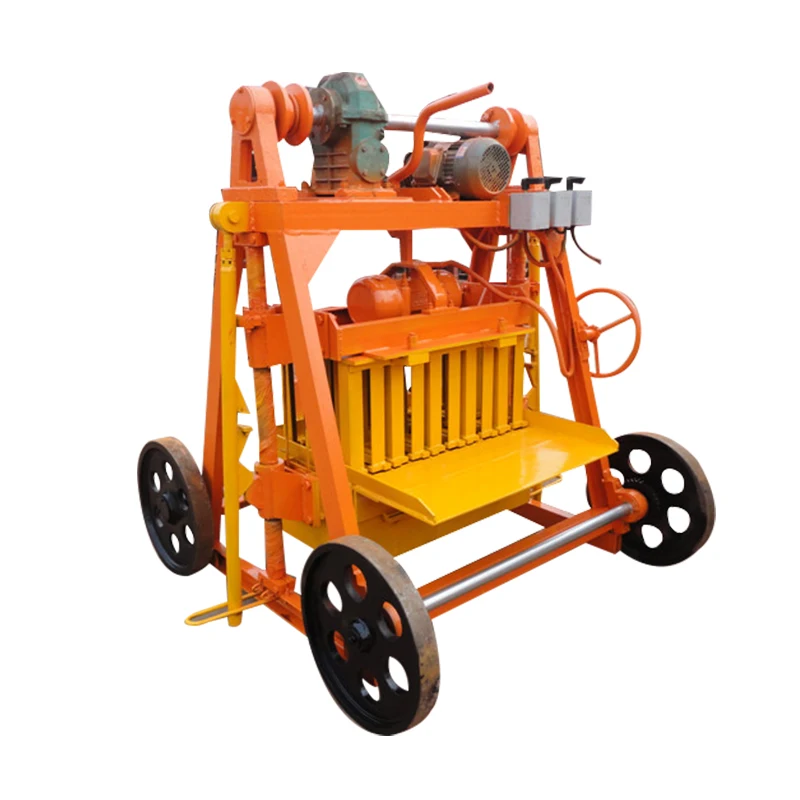
Matched System Design — the QMJ4-45 egg layer, mixer, and curing layout are specified as one connected line, not a standalone press dropped into an unverified site.
Technical Specifications
| Parameter | Value |
|---|---|
| Model | QMJ4-45 |
| Product Type | Movable Manual Egg Layer Block Making Machine |
| Molding Cycle | 30–45 s |
| Output Capacity | 2,600 pcs / 8 hr based on 400×200×200 mm hollow block, 4 pcs / mould |
| Output Capacity | 3,200 pcs / 8 hr based on 400×150×200 mm hollow block, 5 pcs / mould |
| Output Capacity | 4,480 pcs / 8 hr based on 400×100×200 mm hollow block, 7 pcs / mould |
| Vibration System | Twice vibrations of molding core |
| Automation Level | Manual / Movable (egg-laying type) |
| Assembly State | Mobile, no fixed plant required |
| Pallet Size | Not applicable — blocks laid directly on ground |
| Mould Format | Hollow block (400×200×200 / 400×150×200 / 400×100×100 mm) |
| Stacking Method | Manual |
| Standards | ISO 9001:2000, CE |
Application Suitability
| Application | Material or Output |
|---|---|
| On-site hollow block production for building contractors | Crushed stone, sand, cement, water — laid directly on compacted ground |
| Housing project block supply in remote locations | Local aggregate mixed on-site, eliminating transport of finished blocks |
| First-plant entrepreneur producing standard hollow blocks | Low-investment entry with manual mixing and ground-cured output |
| Small-scale block yard expanding format range | Supplementary egg layer alongside an existing stationary line |
What "Pieces per Shift" Really Means on an Egg Layer Site
Capacity only matters when tied to the exact block size your market buys.
Sellers often quote a single output figure without naming the block format behind it. On an egg-laying line, the gap between the largest and smallest mould can mean nearly two thousand blocks difference across one shift. A mobile egg layer block making machine production line built around a 400×200×200 mm hollow block will deliver 2,600 pieces in eight hours, while the same QMJ4-45 running a 400×100×200 mm mould reaches 4,480 pieces in the same window. If your local demand is the larger format and you planned around the higher number, the shortfall surfaces on day one. [NEED_CITE: typical block format demand by regional construction market]
Line Rhythm Between Mixer and Egg Layer
The QMJ4-45 completes a moulding cycle every 30 to 45 seconds, which means a fresh batch of mixed concrete must arrive at the hopper roughly every minute to avoid idle time. On a turnkey mobile egg layer block making machine production line, the pan mixer capacity and batch cycle have to match that rhythm. A mixer that is too small forces the operator to wait; one that is too large lets the mix sit and stiffen before it reaches the mould. We size the upstream mixer to the actual cycle time and the buyer’s aggregate gradation, not to a catalogue default.
Ground Curing Area and Block Movement
Because the egg-laying method places blocks directly on the ground, the curing footprint is the first constraint buyers overlook. Each shift lays out rows that stretch across a flat, compacted surface, and those rows cannot be disturbed until initial set is reached. The required area grows with daily output and shrinks only when ambient temperature accelerates curing. Planning the ground area before the machine arrives prevents the situation where freshly produced blocks run out of space and the operator starts stacking green units, cracking the bottom course. [NEED_CITE: ground curing area calculation methods for egg-laying block production]
How Vibration and Cycle Time Shape Block Density
The QMJ4-45 uses twice vibrations of the molding core instead of the single-vibration setup found on earlier egg layers. The first vibration settles the concrete into the mould cavity; the second compacts it further before the machine lifts away. This two-stage action produces a denser block wall with more consistent strength across the batch. Combined with the 30 to 45-second cycle, the system gives the operator enough time to level the feed and clear the mould face without rushing, which reduces surface tearing on the freshly laid block. Moulding cycle stays within that window across all three listed hollow block formats, so the rhythm of production does not change when you swap moulds.
When the Upstream Mixer Becomes the Bottleneck
I once visited a site where the egg layer was running fine, but the mixer was a single-shaft unit sized for half the output the operator needed. Every few minutes the QMJ4-45 sat idle while the next batch finished mixing, and the crew started adding extra water to speed things up — weakening the blocks and inviting cracks during ground curing. The fix was not a bigger press; it was a correctly sized pan mixer and a raw material feed sequence that kept the hopper charged. On a mobile egg layer block making machine production line, every station upstream must be verified against the cycle time, or the bottleneck simply moves rather than disappears. [NEED_CITE: impact of mix consistency on egg-laid block strength]
Why Sourcing the Whole Line from One Point Matters
Block machinery is our single focus, so the QMJ4-45, its moulds, and the supporting mixer and feeding equipment are specified as one matched set. Configuration starts with your actual mix design, local aggregate, and target block format rather than a default catalogue entry. Mould design covers the hollow block sizes your market sells, and custom drawings are available when standard formats do not fit. Automation level is selectable — a buyer can begin with manual pallet handling on other line types and upgrade later, while the egg layer itself remains a low-infrastructure entry point. Installation support includes operator training on cycle rhythm, mix proportioning, and ground curing practice.
Documentation & Verification
- Line layout and capacity calculation stating the block format assumed for each output figure
- Machine specification sheet confirming vibration system and moulding cycle per format
- Mould drawing and format list matching the hollow block sizes you order
- Voltage and frequency confirmation recorded before production begins
- Factory test record on your chosen mould before dispatch
- Operation and maintenance manual covering daily inspection points
Installation, Commissioning & Support
- Ground surface must be compacted and level to support egg-laid block rows without settling
- Power supply circuit sized to the rated motor load with dedicated breaker protection
- Machine arrives assembled; wheels and guide rails checked before first production run
- Initial moulding trials verify cycle time and block dimensions against the ordered mould format
- Operator training covers mix proportioning, vibration timing, and mould change procedure
- Wear parts list identifies mould liners and vibration components for first reorder
Before You Request a Quote
Tell us the hollow block format your market buys most, the daily output you plan to reach, and the type of aggregate available locally. Share the voltage and frequency at your site so the motor and control panel match before the machine leaves the factory. If you already own a mixer or material feed system, send its capacity and cycle data so we can confirm it keeps pace with the QMJ4-45.
Frequently Asked Questions
Q: How is daily output calculated, and which block format does each figure assume?
A: Each output figure is tied to a specific hollow block size and mould cavity count. The QMJ4-45 produces 2,600 pieces per eight-hour shift with the 400×200×200 mm four-cavity mould, 3,200 pieces with the 400×150×200 mm five-cavity mould, and 4,480 pieces with the 400×100×200 mm seven-cavity mould. All assume a 30 to 45-second cycle with continuous mix supply.
Q: What supporting equipment is needed to keep the egg layer running without idle time?
A: A pan mixer sized to deliver a fresh batch every 30 to 45 seconds, a raw material feed arrangement that keeps the mixer charged, and a compacted ground area large enough for one full shift of laid blocks. If any station falls behind, the QMJ4-45 waits and daily output drops accordingly.
Q: Can this machine work with my local aggregate and mix design?
A: Yes, provided the aggregate gradation and cement proportion are verified before production starts. The twice-vibration molding core handles a range of crushed stone and sand mixes, but the exact ratio must be adjusted to your material. We confirm the mix design during the configuration stage, not after the machine arrives.
Q: What is the curing area requirement when blocks are laid directly on the ground?
A: The area depends on daily output and block size. Each shift lays rows that must remain undisturbed until initial set, which can take several hours depending on temperature. We include a curing area calculation in the line layout so you can prepare the ground before the QMJ4-45 arrives on site.
Q: How does the QMJ4-45 connect to upstream mixing and downstream curing in a complete block line?
A: Upstream, the mixer feeds mixed concrete into the machine hopper on a rhythm matching the 30 to 45-second cycle. Downstream, ground curing replaces pallet-based rack systems, so block movement begins only after set. The mobile egg layer block making machine production line layout we provide shows every station and its timing so no gap is left between mixing, moulding, and curing.


