
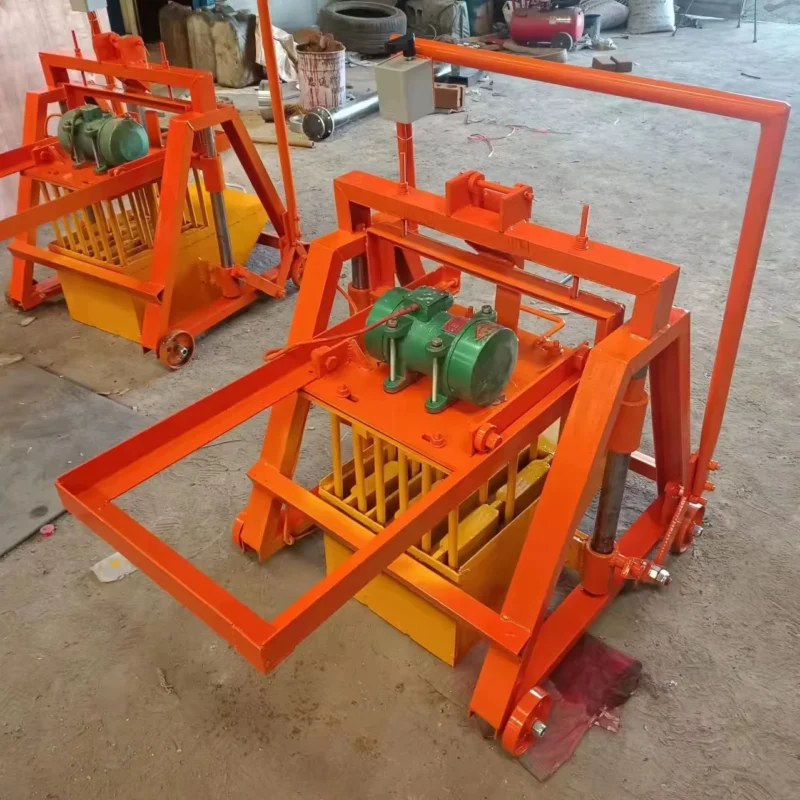
Integrated Line Matching — Every station around the QMJ2-45 is sized so the mixer and curing area keep pace with the press, not quoted as isolated cycle times.
Technical Specifications
| Parameter | Value |
|---|---|
| Model | QMJ2-45 |
| Product Type | Mobile Concrete Block Making Machine |
| Machine Type | Motorized hand-pushed mobile (egg-laying) |
| Pallet Requirement | No pallets required |
| Power Source | Electric motor |
| Mobility | Hand-pushed, free movement on-site |
| Labor Requirement | 1 to 3 workers |
| Mould Change | Interchangeable moulds for different hollow brick formats |
| Output Capacity — 400×200×200 mm hollow block | 160 pcs/h, 1280 pcs/8hr (basis: 2 pcs/mould, 25-30s cycle) |
| Output Capacity — 400×150×200 mm hollow block | 240 pcs/h (basis: 3 pcs/mould, 25-30s cycle; 8hr total basis to be confirmed) |
| Output Capacity — 400×100×200 mm hollow block | 320 pcs/h, 2560 pcs/8hr (basis: 4 pcs/mould, 25-30s cycle) |
| Molding Cycle | 25-30s |
| Automation Level | Manual / motorized hand-pushed |
| Stacking Method | Manual (egg-laying on ground) |
| Standards | ISO 9001:2000, CE |
Application Suitability
| Application | Material or Output |
|---|---|
| On-site hollow block production for construction contractors | Crushed stone, sand, cement and water mix without a fixed plant |
| Small-scale block production in limited space | Hollow and interlocking bricks in constrained yard or site conditions |
| Interlocking brick and hollow brick manufacturing | Cement-aggregate mixes for housing and development projects |
| Entrepreneur first block plant | Low-volume hollow block runs with minimal infrastructure investment |
Why the Voltage Question Must Precede the Order
Confirming site voltage and frequency before production prevents motor burnout and weeks of idle waiting on site.
I have arrived at project sites across Africa and South Asia to find a brand new mobile block making machine production line sitting under a tarp because the local grid delivers a voltage or phase configuration the motor was never wound for. The QMJ2-45 relies on an electric motor as its sole power source, so there is no mechanical workaround once the winding specification is wrong. A rewound motor or a replacement typically takes several weeks to source locally, during which the contractor’s masonry crew stands idle. [NEED_CITE:]
Line Layout Around a Pallet-Free Press
The QMJ2-45 lays blocks directly on the ground, which removes pallet feeding, pallet return and pallet storage from the mobile block making machine production line entirely. The layout focus shifts to positioning the mixer and raw material stockpile within the machine’s push path so the operator never walks more than a few metres between cycles.
Keeping the Mixer Ahead of the Moulding Cycle
A 25-30 second molding cycle means the press consumes a fresh batch of mixed material roughly every half minute. If the mixer is undersized or positioned across uneven ground, the operator spends more time wheeling concrete than pressing blocks. Sizing the mixer drum to deliver slightly ahead of the press demand keeps the mobile block making machine production line running without micro-stops. [NEED_CITE:]
What 25-30 Seconds Per Cycle Means in Practice
The cycle time assumes the operator can push the machine to the next position, lower the mould, fill, vibrate and lift within the stated window. In real site conditions, ground flatness and aggregate size influence how quickly each step completes. A 25-30 second cycle with 2 pieces per mould yields 160 hollow blocks of 400×200×200 mm per hour; with 4 pieces per mould the same cycle delivers 320 blocks of 400×100×200 mm per hour. These figures hold only when the mix consistency and ground preparation allow uninterrupted operation.
Ground Preparation and Curing Area Layout
Egg-laying operation demands a flat, compacted surface; otherwise blocks settle unevenly before the cement sets. The curing area grows outward from wherever the machine travels, so the site plan must reserve a clear zone for at least several hundred blocks before the machine loops back. Without this zone, fresh blocks are disturbed by foot traffic or the machine’s own return path.
The Cost of Skipping Line Integration
When a quotation covers only the press, the buyer arrives on site to discover that mixing, material handling and curing were never planned. Workers end up carrying mixed concrete in buckets, and freshly pressed blocks are stacked by hand in whatever space is available. The resulting bottleneck erases the cycle time advantage the press was supposed to deliver. [NEED_CITE:]
What Makes This Supply Different
Block machinery is the single product focus here, so the QMJ2-45 is specified alongside its mixer, curing layout and mould set as one matched system. Configuration starts from the buyer’s actual aggregate and target block format rather than a catalogue default. Mould design covers the hollow and interlocking formats the buyer’s local market sells, including custom drawings when standard sizes do not apply. Automation level remains selectable, allowing a buyer to begin with manual operation and add mechanised feeding later. Installation support includes operator training at the site, and mould plus wear part availability is confirmed before the first replacement falls due.
Documentation & Verification
- Line layout drawing showing mixer, material stockpile and curing area around the QMJ2-45 working path
- Capacity calculation per block format with mould configuration and 25-30s cycle clearly stated
- Voltage, frequency and motor winding confirmation matched to buyer site power before dispatch
- Factory test record on buyer’s requested hollow block format before container loading
- Operation and maintenance manual with mould interchangeability procedure included
Installation, Commissioning & Support
- Ground must be compacted and level across the full QMJ2-45 travel path for consistent block geometry
- Site power supply confirmed for voltage and frequency before the electric motor is energised
- Mould change procedure practised on site so operators can swap hollow brick formats within a shift
- Mixer positioned within hand-push distance to keep the 25-30s cycle uninterrupted
- Spare mould wear parts list provided for first reorder planning based on local aggregate abrasiveness
Before You Send an Inquiry
Share the hollow block formats your market demands, the daily output you need per format, and the aggregate available locally. Include your site voltage, phase and frequency so the motor specification is locked before production starts. If the machine will operate on a construction site rather than a fixed yard, note the ground conditions and available curing space.
Frequently Asked Questions
Q: How is daily output calculated for each block format?
A: The 1280 blocks per 8-hour shift figure for 400×200×200 mm hollow blocks assumes 2 pieces per mould and a 25-30 second cycle. For 400×100×200 mm blocks, 4 pieces per mould yields 2560 in the same period. These figures hold only when material supply and ground conditions allow continuous operation.
Q: What mixing setup keeps the QMJ2-45 running without stops?
A: The press consumes material every 25-30 seconds, so the mixer must deliver a fresh batch slightly faster than that rate. Positioning the mixer within the machine’s push path avoids long wheelbarrow runs that interrupt the cycle.
Q: What ground preparation does egg-laying operation require?
A: A compacted, level surface is essential so blocks do not tilt or crack before curing begins. The curing area must extend outward from the machine’s travel route with enough space for several hundred blocks before the path loops back.
Q: What electrical details must be confirmed before dispatch?
A: Site voltage, phase configuration and frequency must be specified so the electric motor is wound correctly. Arriving with a motor mismatched to the local grid causes burnout and multi-week delays while a replacement is sourced.
Q: How does the QMJ2-45 handle downstream stacking?
A: Blocks are laid directly on the ground, so stacking and cubing are manual processes. The site plan must allocate clear curing lanes so finished blocks are not disturbed before the cement gains adequate strength for handling.


