
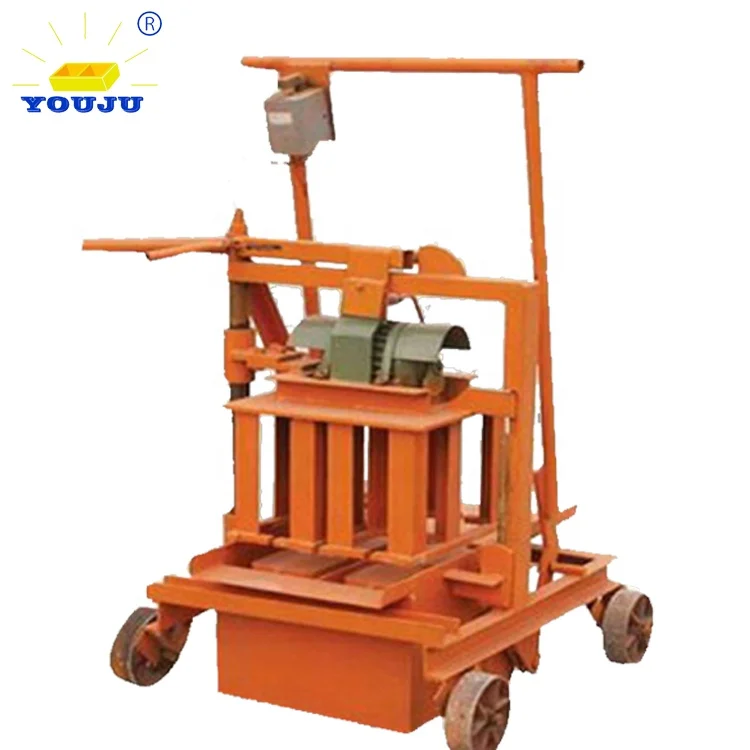
Integrated line pacing — matching mixer output, curing turnover and manual feed rhythm to the QMJ2-45 cycle so the press is never left waiting or the crew left idle.
Technical Specifications
| Parameter | Value |
|---|---|
| Model | QMJ2-45 |
| Product Type | Mobile Block Making Machine |
| Machine Operation | Manual mobile egg-laying |
| Mould Compatibility | Hollow brick in multiple formats via mould change |
| Cycle Time | 25–30 s per cycle |
| Output (400×200×200 mm block) | 2 pcs/cycle, rated 160 pcs/h or 1280 pcs/8 hr |
| Output (400×150×200 mm block) | 3 pcs/cycle, 240 pcs/h (basis not stated in source) |
| Output (400×100×200 mm block) | 4 pcs/cycle, rated 320 pcs/h or 2560 pcs/8 hr |
| Pallet Requirement | None required |
| Power Source | Diesel engine (kW rating to be confirmed) |
| Crew Requirement | 1 to 3 workers |
| Mobility | Free-moving across prepared ground |
| Control System | Manual operation, no PLC |
| Standards | ISO 9001:2000, CE |
Application Suitability
| Application | Material or Output |
|---|---|
| On-site contractor production | Hollow blocks from crushed stone, sand and cement directly at project locations |
| First plant setup | Low-investment hollow block production without fixed infrastructure |
| Remote housing projects | Engine-driven block making where grid power and pallet logistics are unavailable |
| Space-constrained yards | Egg-laying production eliminating pallet storage and curing rack footprint |
Why "Blocks per Hour" Means Nothing Without the Rest of the Line
A mobile block making machine production line / turnkey only reaches stated output when mixer capacity, ground curing space and manual feed rhythm all match the press cycle.
I once watched a QMJ2-45 sit idle for half a cycle because the single-shaft mixer could not discharge fast enough, and the crew was still hand-carrying raw mix in wheelbarrows from a stockpile thirty metres away. The machine itself never missed a beat; the bottleneck was everywhere else. Buyers often focus on the 25–30 second cycle figure and forget that each cycle needs a measured batch of mix delivered on time, flat ground to lay on, and enough cured blocks cleared to keep walking forward [NEED_CITE: typical manual batching errors in small block yards].
How Egg-Laying Changes the Downstream Layout
A pallet-based press demands a pallet return loop, stacking station and rack curing area before a single block leaves the line. The QMJ2-45 removes all of that. Blocks are laid directly on the ground and cured in place, which means the mobile block making machine production line / turnkey design starts from a completely different baseline — you plan ground preparation, water access for curing and block clearance paths instead of pallet inventory and forklift routes.
Matching Mixer Discharge to Press Cycle
Each 25–30 second cycle of the QMJ2-45 consumes a fixed volume of concrete mix. If the mixer takes two minutes to batch and discharge, the press waits idle for three or four cycles out of every four minutes. Sizing the mixer drum capacity and discharge speed to the press cycle is where a mobile block making machine production line / turnkey either runs smoothly or stalls repeatedly [NEED_CITE: mixer sizing guidelines for small block plants].
Reading the Specs That Matter
The diesel engine power source removes electrical grid dependency, which is significant for remote project sites where three-phase power is unavailable or generator capacity is already allocated to other equipment. The manual operation with 1–3 workers places this machine at the entry tier of a block line, meaning the labour allocation for mixing, feeding and curing must be planned separately. The mould change capability across 400×200×200, 400×150×200 and 400×100×200 mm hollow block formats gives format flexibility, but each format change requires stopping production, swapping the mould box and verifying block dimensions before resuming. The no-pallet requirement means capital that would go into pallet inventory stays available for ground preparation and curing infrastructure.
What Happens When Line Pacing Is Ignored
When the raw material feeding station is undersized relative to the press cycle, workers resort to ad-hoc batching with shovels and wheelbarrows, introducing inconsistency in water-to-cement ratio from batch to batch. Block strength then varies across the curing yard even though the press settings never changed. When the curing area is too small, fresh blocks get stacked before initial set, causing deformation that shows up as rejected stock at delivery [NEED_CITE: common causes of hollow block strength variation in manual yards].
Why Source the Supporting Equipment Together
Sourcing the press alone leaves the buyer to assemble mixer, feed hopper and ground layout from separate suppliers with no single party responsible for line rhythm. We specify the QMJ2-45 together with its raw material feeding, mixing and curing area plan so that discharge intervals match cycle times and the crew is not left running to keep up. Configuration is set against your actual local aggregate and target block format, not a catalogue default. Mould drawings are confirmed against the hollow block dimensions your market sells before production starts. The automation level is selectable, so a buyer starting with manual operation has a defined upgrade path to semi-automatic or automatic pallet-based systems when output targets grow.
Documentation & Verification
- Line layout drawing with capacity calculation stated per hollow block format
- Mould drawing and format list matching your local market dimensions
- Engine specification sheet with confirmed kW rating and fuel consumption
- Factory test record on your selected block format before dispatch
- Operation manual covering mould change procedure and daily maintenance
- Packing photographs and customs documentation for export shipment
Installation, Commissioning & Support
- Ground preparation spec for flat, load-bearing surface suited to egg-laying operation
- Diesel engine first-start procedure, fuel line bleeding and break-in run schedule
- Mould alignment check and block dimension verification on your selected format
- Manual feed rhythm training so crew paces mix delivery to the 25–30 s cycle
- Wear parts list covering mould liners and vibration components with replacement intervals
- Daily greasing points and engine service schedule for continuous site operation
What to Include in Your Inquiry
To size the supporting equipment around the QMJ2-45, we need your target hollow block format and daily output requirement, the local aggregate type and gradation you plan to use, and the site area available for ground curing. Share your existing mixer or feed equipment if any, and whether electrical supply is available for ancillary items like water pumps even though the press itself is engine-driven.
Frequently Asked Questions
Q: Output figures vary by block format — which format drives the daily target?
A: The QMJ2-45 produces 2 pcs/cycle for 400×200×200 mm blocks but 4 pcs/cycle for 400×100×200 mm blocks, so the same machine delivers very different daily totals depending on format. Confirm which hollow block size represents the majority of your sales volume before basing your line plan on a single output figure.
Q: How does the QMJ2-45 cycle time align with mixer capacity?
A: Each 25–30 second cycle needs a measured batch of mix ready to feed. If your mixer takes longer to batch and discharge than the press cycle, the machine waits idle and actual throughput drops below the rated figure. We calculate mixer drum size and discharge rate against your chosen block format during line layout.
Q: Is my local aggregate suitable for egg-laying without pallet support?
A: Egg-laying production requires a mix that holds shape immediately after the mould lifts, since there is no pallet to support the block during initial set. Aggregate gradation, cement content and water ratio all affect this. We review your local material sample before confirming the configuration.
Q: What ground area does a mobile egg-laying line need compared to a pallet plant?
A: A pallet-based plant concentrates curing on vertical racks in a smaller footprint, while the QMJ2-45 lays blocks directly on the ground, requiring a larger flat area that grows with daily output. We include curing area calculation in the line layout so you know the total site requirement before ordering.
Q: When does it make sense to stay manual versus upgrading?
A: Manual operation suits sites with low daily targets, limited capital or no grid power. When daily volume grows to the point where crew fatigue limits output or block consistency becomes critical for a commercial block yard, upgrading to a semi-automatic line with pallet handling and mechanical batching becomes the practical next step.


