
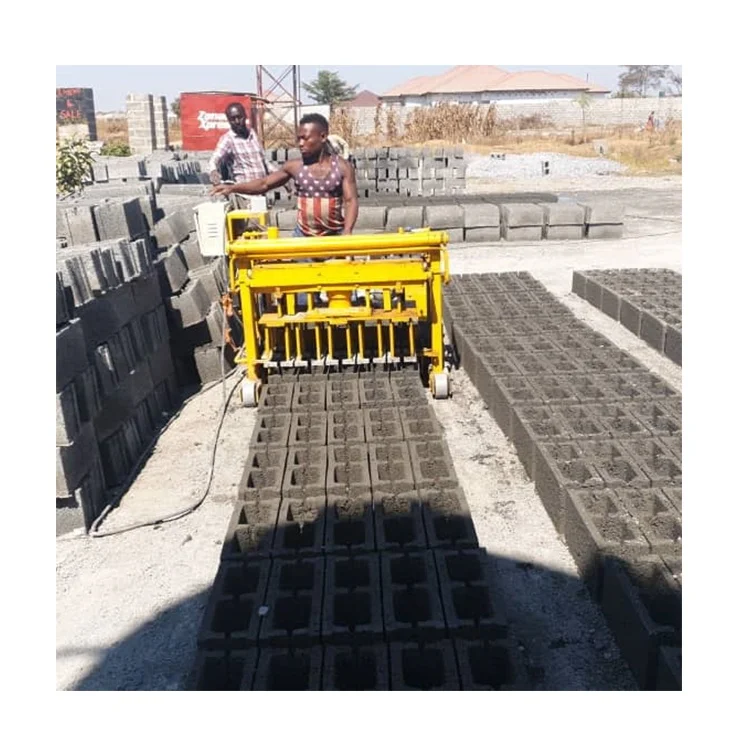
Single-Focus Line Matching — every QMY4-30 mobile block machine dispatch leaves our Linyi factory with the mixer, feeder and curing layout specified against the same cycle time so the press never waits on upstream or downstream stations.
Technical Specifications
| Parameter | Value |
|---|---|
| Product Type | Mobile Hollow Block Making Machine |
| Model | QMY4-30 |
| Rated Power | 5 kW |
| Overall Dimensions (L×W×H) | 1200×1200×1100 mm |
| Net Weight | 950 kg |
| Cycle Time | 30 seconds |
| Mould Format | Hollow block and solid brick (moulds changeable) |
| Automation Level | Manual / mobile egg-laying type |
| Raw Materials | Cement, sand, crushed stones, slag |
| Output Capacity | 480 pcs/h (based on 400×200×200mm hollow block, 4 pcs/mould) |
| Output Capacity | 600 pcs/h (based on 400×150×200mm hollow block, 5 pcs/mould) |
| Output Capacity | 840 pcs/h (based on 400×100×200mm hollow block, 7 pcs/mould) |
| Output per 8-hour Shift | 3840 pcs (based on 400×200×200mm hollow block) |
| Output per 8-hour Shift | 4800 pcs (based on 400×150×200mm hollow block) |
| Output per 8-hour Shift | 6720 pcs (based on 400×100×200mm hollow block) |
| Pallet Size | Not stated in source — confirm pallet requirement |
| Hydraulic Pressure | Not stated in source — confirm |
| Vibration Force | Not stated in source — confirm |
| Voltage & Frequency | Not stated in source — confirm before shipment |
| Assembly State | Fully assembled, mobile unit |
Application Suitability
| Application | Material or Output |
|---|---|
| On-site block production for contractors | Hollow blocks from local sand, cement and crushed aggregate without a fixed plant footprint |
| First-line small-scale block business | Solid bricks and hollow blocks from slag or stone dust blends for local sale |
| Housing project supply | Daily block volumes matched to build schedules using site-sourced raw material |
What the Quoted Hourly Output Actually Assumes
A capacity number without a block format attached is not a capacity number — it is a marketing placeholder.
Sellers often quote the highest cycle figure the press can reach and leave out which block size that figure assumes. A buyer expecting 840 pieces per hour from a QMY4-30 mobile block making machine production line might be running 200mm hollow blocks where the realistic rate is 480 pieces. The gap between the quoted sheet and the first week of real output is where most site disputes start [NEED_CITE: common discrepancies between quoted and actual block plant output]. Stating the assumed format next to every throughput figure is the only way a buyer can match the line to the market they actually sell into.
Matching the Supporting Line to a 30-Second Cycle
The press itself cycles every 30 seconds, but throughput only holds if the mixer, feeder and curing handling keep pace. A mobile block making machine production line built around the QMY4-30 needs a pan mixer that discharges a full batch inside that same window, otherwise the operator stands idle waiting for material. On the output side, freshly laid blocks need a curing layout that removes them from the machine path before the next mould drops, or the press stops to avoid crushing green product.
Where the Ground Becomes the Pallet
Egg-laying mobile presses bypass pallets entirely and lay directly onto prepared ground, which shifts the planning burden onto site preparation. The curing area must be level, hard enough to bear repeated machine travel, and large enough to hold a full shift of output before blocks can be moved. If the ground is soft or uneven, block bases deform and a noticeable portion of the shift output is rejected [NEED_CITE: ground preparation standards for mobile egg-laying block machines]. This is why the line layout we provide includes the curing area footprint, not just the press position.
Reading the Spec Sheet Against Real Production
The 5 kW rated power makes the QMY4-30 usable on sites where supply is limited, but voltage and frequency must be confirmed against the local grid before production begins — a 50 Hz motor rewound for a 60 Hz market loses torque at the vibration stage. The 30-second cycle time governs every other station in the mobile block making machine production line; any feeder or mixer sized slower becomes the actual bottleneck. The 1200×1200×1100 mm footprint means the unit passes through standard site gates, and the 950 kg weight lets a small loader reposition it as the curing area fills. Mould changeability between hollow and solid formats gives one press two revenue streams, provided the change procedure is practised before the first customer order arrives.
The Cost of Skipping the Supporting Equipment Scope
When a quotation covers the press alone and leaves mixing, feeding and curing handling to local improvisation, the result is a machine that runs below its designed rhythm. Operators hand-shovel material into the hopper at inconsistent rates, block density varies from one mould to the next, and the curing area becomes a bottleneck because no handling plan was laid out before installation [NEED_CITE: block line throughput losses from unbalanced station design]. These are not press faults — they are line planning gaps that show up as missed daily targets.
Why This Line Is Scoped Before It Is Shipped
Every station around the QMY4-30 is specified against the same 30-second cycle, so the mixer discharge rate, feeder volume and curing handling distance are calculated together rather than sourced separately. The line layout states the block format assumed for each output figure, removing the ambiguity that causes site disputes. Configuration is set against the buyer’s actual aggregate sample and local mix design, not a generic catalogue default. Voltage, frequency and control language are confirmed in writing before the line enters production. Moulds are supplied for the formats the buyer’s market actually sells, with custom drawings available for non-standard sizes.
Documentation & Verification
- Line layout showing the block format assumed for every output figure on the QMY4-30
- Factory test record run on the buyer’s confirmed aggregate sample before dispatch
- Voltage, frequency and control language confirmation sheet signed before production
- Mould drawing set covering every hollow and solid format included in the scope
- Pallet and curing area specification matched to the mobile press output rate
- Packing photographs of the QMY4-30 and supporting stations before container loading
Installation, Commissioning & Support
- Level hard-standing curing area sized to the QMY4-30 shift output before arrival
- Dedicated 5 kW circuit at the confirmed voltage and frequency for the press motor
- Fully assembled mobile unit requiring no structural reassembly on site
- First-run vibration parameters adjusted against the buyer’s actual raw material sample
- Operator training covering the 30-second cycle rhythm and mould change procedure
- Wear parts list matched to the specific mould formats supplied with the line
What We Need to Scope Your Line
To match the QMY4-30 to your site, share the block formats your market demands, the local aggregate type available, and your target daily output. We also need the site voltage and frequency so the electrical specification is locked before the line enters production.
Frequently Asked Questions
Q: How is daily output calculated for the QMY4-30 and which format does each figure assume?
A: Each output figure is tied to a specific block size and mould cavity count. The 480 pieces per hour assumes a 400×200×200mm hollow block at four cavities, while 840 pieces per hour assumes a 400×100×200mm block at seven cavities. Daily shift figures multiply the hourly rate by an eight-hour working window, so matching your market format to the correct row is essential before comparing machines.
Q: What supporting equipment keeps the QMY4-30 running at cycle pace?
A: A pan mixer matched to discharge within the 30-second cycle, a raw material feeder sized to the hopper volume, and a curing area plan that removes laid blocks before the next pass are all required. Without these stations balanced to the press rhythm, the actual daily throughput falls below the quoted figures regardless of how well the press itself performs.
Q: How are voltage and frequency confirmed before the line ships?
A: We request the site supply specification in writing during the proposal stage and lock the motor winding and control configuration before production begins. This prevents the common situation where a machine arrives rated for the wrong frequency and loses vibration force, requiring a costly rewind before commissioning can proceed.
Q: Can the line start manual and move to automatic handling later?
A: Yes. The QMY4-30 ships as a manual mobile egg-laying press, and automatic stacking or curing rack handling can be added as separate stations once volume justifies the investment. The line layout we provide at the quotation stage shows where those future stations connect, so the initial installation does not need to be reworked later.
Q: What ground conditions does the mobile egg-laying press require on site?
A: The curing area must be a level, compacted surface capable of bearing repeated machine travel without settling. A soft or uneven ground causes block base deformation and rejection. We include the required curing area dimensions in the line layout so the site can be prepared before the QMY4-30 arrives.


