
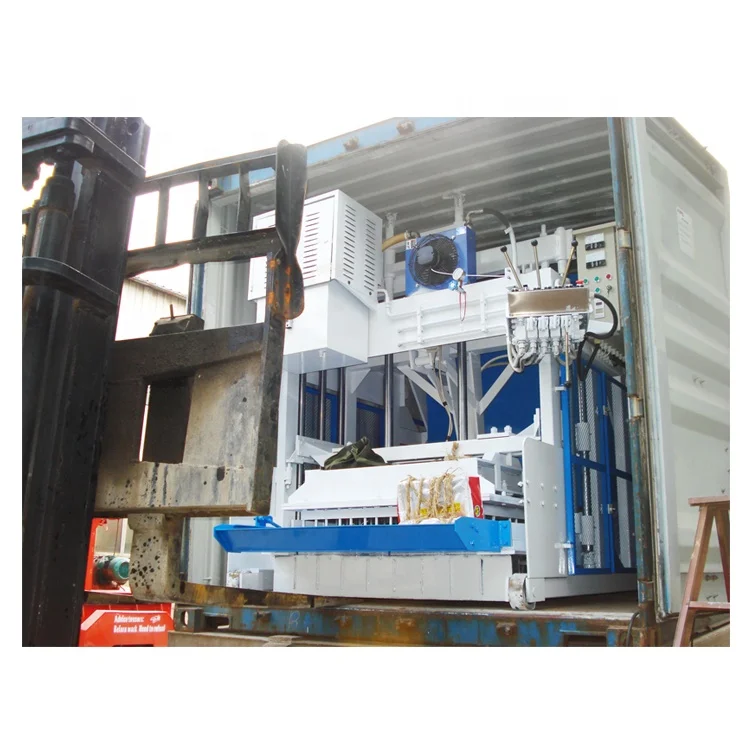
Matched line configuration — the QMY10-15 host machine, JS7500 mixer, and material feeders are specified as one system so cycle times align and the press is never starved on a remote job site.
Technical Specifications
| Parameter | Value |
|---|---|
| Model | QMY10-15 |
| Product Type | Mobile Concrete Block Making Machine |
| Molding Capacity | 10 pcs/mold |
| Molding Cycle | 10s–15s |
| Total Power | 16 kW |
| Output Capacity | 11,000 pcs/day (8 hours) (basis to be confirmed with target block format and material) |
| Vibration System | Dual vibration motors |
| Hydraulic System | Controls upper and lower demoulding, equipped with heat dissipator |
| Movement | Electric walking, hydraulic steering |
| Pallet Requirement | No pallets needed (egg-laying type) |
| Basic Configuration | QMY10-15 Host Machine, JS7500 Concrete Mixer, Dump Truck |
| Optional Equipment | PL1200 Batching Machine, Cement Silo, Screw Conveyor, Loader |
Application Suitability
| Application | Material or Output |
|---|---|
| On-site hollow block production | Crushed stone, cement, sand, and local aggregate |
| Project-site solid block manufacturing | Fly ash, gravel, and cement blends |
| Mobile paving block production | High-density aggregate mixes for interlocking or kerb formats |
| Remote construction site output | Variable local materials without fixed plant infrastructure |
Why the Voltage Question Must Be Answered Before the mobile block making machine production line Ships
Unconfirmed site voltage turns a finished installation into a three-week standstill.
I spent years on assembly floors before moving to line planning, and the most expensive delays I witnessed were not mechanical. One African project site had a mobile block making machine production line arrive fully assembled, only for the crew to discover the local grid ran at a frequency the control panel could not accept. The entire commissioning schedule waited on a replacement transformer. When you order equipment for a remote location, the electrical specification is the most critical dimension on the drawing [NEED_CITE: voltage and frequency standards by export market].
Matching Mixer Throughput to Press Cycle
The press is the pacing station in any block line, and a mobile block making machine production line is no exception. If the JS7500 mixer cannot deliver a fresh batch within the 10s–15s molding cycle, the QMY10-15 sits idle while operators wait for material. We size the mixer drum volume and discharge gate to clear a full batch in under twelve seconds, ensuring the press never loses a cycle to material starvation.
Ground Preparation and Travel Path Planning
An egg-laying machine moves continuously across the curing yard. The travel path must be compacted, level, and free of standing water so the electric walking drive maintains consistent block spacing. Hydraulic steering allows the QMY10-15 to navigate tight turnaround radii at the end of each run, but the ground must support the full loaded weight without rutting. We provide a site grading outline with every layout drawing [NEED_CITE: ground bearing capacity requirements for mobile block production].
Dual Vibration and Hydraulic Demoulding Balance
Block density depends on how evenly vibration energy reaches every corner of the mould cavity. Dual vibration motors on the QMY10-15 distribute force across the full mould area, producing uniform wall thickness in hollow blocks and consistent surface finish on pavers. The hydraulic system controls both upper and lower demoulding strokes, and the heat dissipator keeps oil temperature stable during continuous shifts so cycle times do not drift as production hours accumulate.
No-Pallet Design and Curing Yard Footprint
Eliminating pallets removes a major consumable cost and the need for pallet-return conveyors. The egg-laying method deposits blocks directly on the ground, which means the curing area must be large enough to hold a full day’s output without blocking the machine’s next travel path. We calculate the required yard dimensions based on your target block format and daily run hours before finalizing the line layout.
The Hidden Cost of Undersized Supporting Equipment
Buyers often compare host machine prices while ignoring the feeder, mixer, and conveyor that keep it running. A batching station that cannot meter cement accurately forces operators to adjust mix ratios by eye, leading to strength variation across batches. A screw conveyor with insufficient throughput creates a bottleneck that caps real daily output well below the quoted figure. These mismatches surface only after the line is running and the shortfall becomes obvious [NEED_CITE: common line bottleneck causes in mobile block production].
Why This Configuration Approach Works
Block machinery is our single focus, so the QMY10-15, its moulds, and every supporting station are specified as one matched system rather than assembled from separate suppliers. We set the configuration against your actual mix design and local aggregate, not a catalogue default. Mould design covers the formats your market sells, including custom drawings to your dimensions. Automation level is selectable, so you can start with manual material handling and add batching or conveying later. Every machine ships after a factory test run on your specified block format.
Documentation & Verification
- Line layout drawing showing station positions and material flow for the QMY10-15 footprint
- Capacity calculation sheet stating output per block format with the 10s–15s cycle assumption
- Mould drawing and format list with recommended mix design for your local aggregate
- Voltage, frequency, and control language confirmation record before dispatch
- Factory test record on your target block format before shipment
Installation, Commissioning & Support
- Site grading outline matched to the QMY10-15 electric walking drive and loaded weight
- Power connection schedule listing the 16 kW total draw and dedicated circuit requirements
- On-site assembly supervision covering host machine, JS7500 mixer, and optional PL1200 batching station
- First-run parameter setting for vibration duration and hydraulic demoulding stroke on your mix
- Operator training covering mould change procedure and daily heat dissipator inspection
- Wear parts and mould list with reorder codes for the formats you run
What to Include in Your Inquiry
Tell us the block formats your market sells, the daily output you need, and the raw materials available locally. We also need your site voltage and frequency, plus the dimensions of the area you can allocate for the curing yard. With that information we can return a line layout and a capacity calculation stated per format.
Frequently Asked Questions
Q: What block format does the 11,000 pcs/day figure assume, and what is output for my target format?
A: The published figure is a reference point and does not state which block format it assumes. Real output depends on mould cavity count, cycle time for your specific block height, and how many hours you run. We provide a capacity calculation sheet that states daily output for each format you plan to produce so you can compare against your actual sales mix.
Q: How do I match the JS7500 mixer output to the QMY10-15 press cycle so the machine is not starved?
A: The mixer must discharge a full batch within the press molding window. We size the JS7500 drum volume and discharge gate timing to clear a batch in under twelve seconds. If you add the PL1200 batching machine, we also set the aggregate and cement feed rates so the mixer is never waiting for dry material between batches.
Q: What voltage, frequency, and PLC display language will be configured for my site?
A: We confirm your local supply voltage, frequency, and the operator language for the control display before production begins. This record is part of the dispatch documentation. Matching the electrical spec to your site grid avoids transformer replacements or control panel rewiring after the machine arrives.
Q: Which moulds are included, and how long does a format change take on site?
A: The standard package includes one mould set for your primary block format. Additional moulds for pavers, kerbstones, or other shapes are available as line items. Mould change time depends on the format and operator familiarity; we train your crew on the procedure and provide a format list with the changeover steps for each mould you order.


