
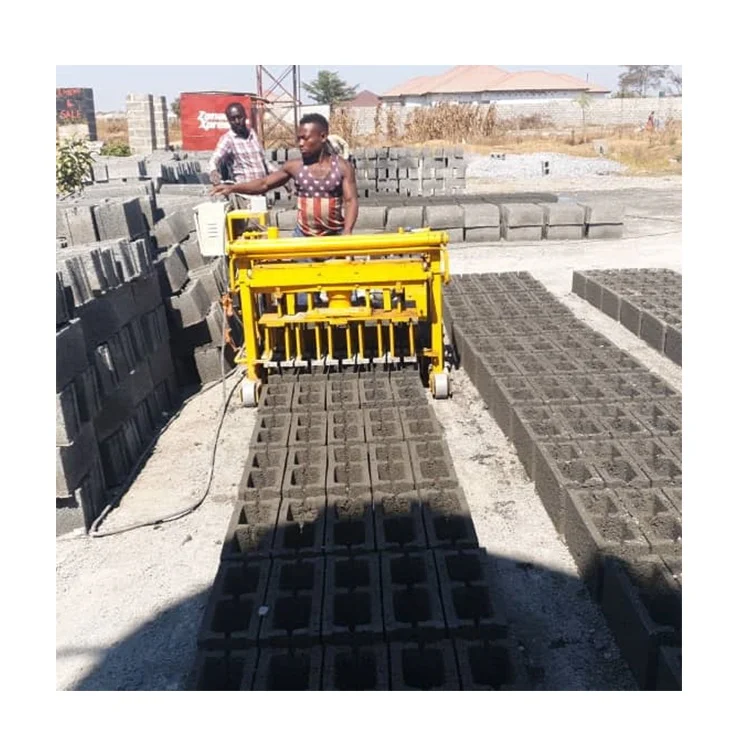
Matched System Design — the QMY4-30 mobile egg-laying block machine is specified alongside its mixing feed rate, mould format and curing footprint so the press never waits idle between batches on your site.
Technical Specifications
| Parameter | Value |
|---|---|
| Model | QMY4-30 |
| Product Type | Mobile Egg-laying Block Machine |
| Rated Power | 5 kW |
| Molding Cycle Time | 30 seconds |
| Overall Dimensions (L×W×H) | 1200 × 1200 × 1100 mm |
| Net Weight | 950 kg |
| Output Capacity (400×200×200 mm hollow block) | 480 pcs/h, 4 pcs/mould |
| Output Capacity (400×150×200 mm hollow block) | 600 pcs/h, 5 pcs/mould |
| Output Capacity (400×100×200 mm hollow block) | 840 pcs/h, 7 pcs/mould |
| Daily Output — 8 h (400×200×200 mm) | 3,840 pcs |
| Daily Output — 8 h (400×150×200 mm) | 4,800 pcs |
| Daily Output — 8 h (400×100×200 mm) | 6,720 pcs |
| Raw Materials | Cement, sand, crushed stones, slag |
| Mould Format | Hollow block and solid brick, interchangeable |
| Automation Level | Manual / mobile egg-laying (no pallet system) |
| Voltage & Frequency | To be confirmed before dispatch |
| Control System | To be confirmed |
| Hydraulic Pressure | To be confirmed |
| Vibration Force | To be confirmed |
| Warranty | One year |
Application Suitability
| Application | Material or Output |
|---|---|
| On-site hollow block production for housing projects | Cement, local river sand, crushed stone |
| Remote construction sites without fixed batching infrastructure | Slag-blended aggregate mixes |
| First-time block producers with limited capital | Standard hollow blocks and solid bricks |
| Contractor-led production adjacent to building footprints | Interchangeable mould formats per floor section |
Why the Upstream Feed Must Match the 30-Second Cycle
A mobile block machine production line stands still the moment the mixer runs dry.
Buyers often focus on the press cycle and overlook what feeds it. The QMY4-30 completes a moulding cycle every 30 seconds, which means raw material must arrive at the hopper continuously throughout an eight-hour shift. When the mixer or feed conveyor is undersized, the operator spends more time waiting than pressing, and daily output drops well below the capacity figures on paper. On one West African site I visited, the contractor paired a high-cycle mobile egg-laying block machine with a batch mixer rated for half the volume the press consumed per hour [NEED_CITE: typical mixer-to-press throughput matching in small block lines]. The result was a press idling nearly half the shift. Sizing the mixer, conveyor and water feed to sustain continuous operation is the difference between quoted capacity and actual daily tonnage leaving the curing yard.
Keeping the Mix Flowing Without a Fixed Plant
This mobile egg-laying block machine eliminates the pallet handling system entirely by laying blocks directly on the ground as it advances. That design removes an entire station from the line — no pallet feeder, no return conveyor, no pallet cleaning — but it also means the upstream feed must be just as mobile or positioned within reach of a short conveyor run. A pan mixer or small twin-shaft mixer placed beside the machine, fed by manual or belt-loaded aggregate batching, keeps the 30-second rhythm intact. The entire mobile block machine production line fits within a footprint that a standard building site can accommodate without permanent foundations.
Matching the Curing Yard to Daily Output
An egg-laying machine deposits blocks in rows across the floor, and those blocks remain in place for the initial curing period. Planning the curing area means calculating how many days of output — based on the block format you run most often — will occupy the floor before blocks are moved to storage. A site producing 6,720 pieces per 8-hour shift of 100 mm hollow blocks needs considerably more floor space than one running the larger 200 mm format [NEED_CITE: curing area planning for egg-laying block machines]. The surface condition matters equally; a rough or uneven floor transfers directly into block dimensional tolerance and edge quality.
Reading the Spec Sheet Against Your Block Format
The rated power of 5 kW reflects the compact vibration and hydraulic system driving a single mould station — adequate for the format range this machine covers, but it also signals that the vibration force and hydraulic pressure are tuned for small-to-medium block cross-sections. The 30-second cycle time holds across hollow block formats, but piece count per mould changes: four pieces for the 200 mm width, five for 150 mm, seven for 100 mm. That variation is why daily output must always be stated against a specific block size. The 1200 × 1200 mm machine footprint keeps the unit manoeuvrable on site, and the 950 kg net weight means it can be relocated with standard site lifting equipment when production shifts to a new section of the project.
When the Mixer, Voltage and Floor Get Overlooked
I have seen a mobile egg-laying block machine arrive at a site where the local supply was three-phase at a frequency the motor was not wound for. The machine sat under a tarp for weeks while a replacement motor was shipped. The same project had a curing yard of bare earth, and the first week of blocks cracked unevenly because moisture wicked into the soil at different rates across the yard [NEED_CITE: common commissioning failures for exported block machines]. None of these problems were the press’s fault. They were line-integration problems that a pre-shipment checklist covering voltage confirmation, floor preparation and mixer sizing would have caught before the container left the factory.
What This Supply Channel Covers Beyond the Press
Block machinery is our single focus, which means the QMY4-30 is not treated as a standalone item pulled from a catalogue. The machine, mould set, and upstream mixing recommendation are specified together against your target block format and local aggregate. Mould design covers the hollow block and solid brick formats your market actually sells, with custom drawings available when standard formats do not match. Configuration is set against the mix design you can source locally — not a default recipe that forces you to import materials. Installation support includes operator training on mould change procedure and cycle rhythm, so your crew is producing from the first week rather than learning through trial and breakage.
Documentation & Verification
- Capacity calculation sheet stating the block format behind each output figure
- Mould drawing and format list matched to your market’s block dimensions
- Voltage, frequency and control language confirmation record before dispatch
- Factory test record run on your specified raw material mix
- Hydraulic and electrical schematic for on-site maintenance reference
- Operation and maintenance manual with wear parts schedule
Installation, Commissioning & Support
- Level concrete floor required; the 1200 × 1200 mm footprint needs clearance for operator movement on all sides
- 5 kW power supply on a dedicated circuit with confirmed voltage and frequency before wiring
- Machine ships assembled; on-site setup limited to mould mounting and electrical connection
- First-run parameter adjustment covers vibration timing and feed volume for your aggregate mix
- Mould change training included so operators switch between hollow and solid formats without extended downtime
- Wear parts list provided with recommended replacement intervals based on abrasive content of your raw materials
Before You Send an Inquiry
Tell us the block formats your market demands — hollow block dimensions, solid brick size, and any special shapes — along with your target daily output. Share the aggregate source you plan to use, the available power supply at your site, and the floor space you can allocate for curing. If you already have a mixer or batching setup, include its capacity so we can confirm whether it sustains the 30-second feed cycle.
Frequently Asked Questions
Q: How is output capacity calculated for each block format on this mobile egg-laying block machine?
A: The 30-second moulding cycle is constant, but piece count per mould varies by block width. At four pieces per mould for 400×200×200 mm hollow blocks, the QMY4-30 produces 480 pieces per hour or 3,840 in an eight-hour shift. Switching to 100 mm blocks yields seven pieces per mould, raising the hourly figure to 840. Always match your production target to the specific format you will run most often.
Q: What upstream mixing setup is needed so the machine runs without idle gaps?
A: The 30-second cycle demands a continuous material supply. A pan mixer or small twin-shaft mixer with output matching the press consumption rate, paired with a short belt conveyor or manual feed arrangement, keeps the hopper filled. Undersized mixers are the most common reason daily output falls below the per-format calculation on a mobile block machine production line.
Q: What floor surface and curing area does the egg-laying design require?
A: A smooth, level concrete floor is essential because the machine travels on it and blocks cure in place. The curing yard must accommodate multiple days of output for your chosen format before blocks are moved. Uneven or absorbent ground surfaces affect block dimensional accuracy and cause inconsistent curing across the yard.
Q: How are voltage and frequency confirmed before the machine ships?
A: We require written confirmation of your site supply — voltage, phase and frequency — before electrical assembly begins. Control language is agreed at the same stage. This step is built into the pre-dispatch checklist so the machine is wired correctly for the destination and ready to run upon arrival, avoiding weeks of downtime from motor or panel incompatibility.
Q: What is involved in switching between hollow block and solid brick moulds?
A: Moulds are interchangeable on the QMY4-30, and the changeover involves releasing the current mould, positioning the replacement, and securing it before adjusting feed volume for the new format. Operator training covers this procedure so the switch can be completed within a standard shift without interrupting the day’s production schedule.


