
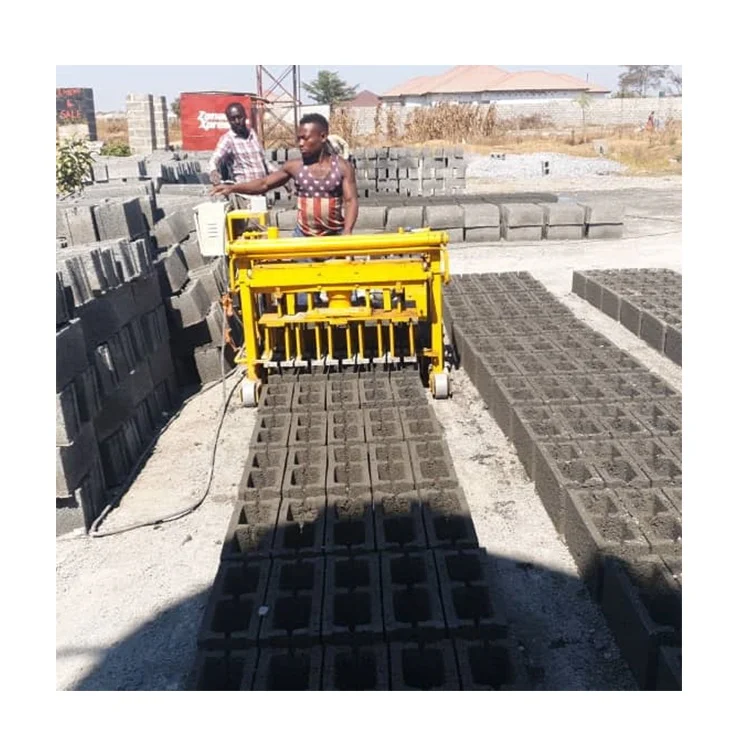
Integrated Line Loop — the QMY4-30 mobile block machine production line is specified against your actual site conditions and curing layout, not a catalogue default.
Technical Specifications
| Parameter | Value |
|---|---|
| Model | QMY4-30 |
| Product Type | Mobile Concrete Block Making Machine |
| Rated Power | 5 kW |
| Molding Cycle Time | 30 seconds |
| Overall Dimensions (L×W×H) | 1200 × 1200 × 1100 mm |
| Net Weight | 950 kg |
| Automation Level | Manual / mobile egg-laying type |
| Mould Format | Interchangeable for hollow block and solid brick |
| Output Capacity | 480 pcs/h (basis: 400×200×200 mm hollow block, 4 pcs/mould) |
| Output Capacity | 600 pcs/h (basis: 400×150×200 mm hollow block, 5 pcs/mould) |
| Output Capacity | 840 pcs/h (basis: 400×100×200 mm hollow block, 7 pcs/mould) |
| 8-Hour Shift Output | 3,840 / 4,800 / 6,720 pcs depending on block format |
| Raw Materials | Cement, sand, crushed stones, slag |
| Pallet Size | Not applicable (mobile egg-laying machine, lays blocks on ground) |
| Voltage & Frequency | Configurable to site supply (to be confirmed before dispatch) |
| Warranty | One year |
Application Suitability
| Application | Material or Output |
|---|---|
| On-site housing project block production | Hollow blocks from cement, sand and crushed stone |
| Small-scale start-up brick plant | Solid bricks from local aggregate and slag |
| Contractor self-production at infrastructure sites | Hollow and solid formats in 30-second cycles |
| Distributor adding mobile-produced blocks to range | Format switching between 400×200×200 mm and 400×100×200 mm blocks |
Why the Mixer Matters More Than the Press on a Mobile Block Machine Production Line
The press starves when the upstream feed falls behind the 30-second cycle, and the real daily output collapses.
I have walked onto housing sites where a mobile egg-laying machine sat idle for minutes each cycle, waiting for the next batch of mixed concrete from an undersized pan mixer. The operator blamed the press. The fault was always upstream. A mobile block machine production line is only as fast as its weakest station, and with the QMY4-30, the mixer, the material feed, and the curing yard all have to keep tempo with the press or the whole loop breaks down [NEED_CITE: line balance principles in mobile block production].
The Loop from Raw Feed to Cured Block
The QMY4-30 lays blocks directly on the ground, which eliminates pallet handling entirely. But that simplicity is deceptive. The material feed must deliver a consistent mix to the hopper every 30 seconds, and if the mixer is too small or the aggregate feed is bottlenecked, the press idles. The mobile block machine production line only delivers its rated output when every station — from aggregate batching through mixing, feeding, pressing, and curing — is matched to the same cycle tempo.
Curing Yard Capacity and the Real Daily Number
The QMY4-30 can lay thousands of blocks per shift depending on the format, but those blocks need flat, level ground to cure on. If the curing yard is too small or the ground is uneven, blocks crack or tilt before they gain initial strength. The mobile block machine production line must account for curing area, forklift access, and stacking labour downstream of the press, because a machine that runs ahead of its curing capacity simply produces damaged stock.
Power Draw and Off-Grid Site Planning
At 5 kW total rated power, the QMY4-30 can run from a site generator in locations without grid connection. But the generator must also carry the mixer, any conveyor feeding the hopper, and lighting for the curing yard. Sizing the generator for the press alone leaves the mobile block machine production line stalled the moment the mixer starts under load [NEED_CITE: generator sizing for construction site equipment].
How Pressure and Vibration Define the Block
The QMY4-30 relies on vibration force to compact the concrete into the mould cavity. The density and strength of the finished block depend on how well the vibration frequency matches the mix design. A dry, low-slump mix with coarse aggregate needs different vibration characteristics than a wetter mix with fine sand. Getting this wrong produces blocks that look correct off the mould but crumble under load testing. The machine specification must state the vibration force and confirm it suits the buyer’s actual raw materials.
What Happens When the Line Is Imbalanced
A contractor I worked with in a desert housing project paired a mobile egg-laying machine with a mixer that could not keep up. The press completed its 30-second cycle, then waited. Over an eight-hour shift, the idle gaps added up to hours of lost production. The buyer assumed the machine was faulty. It was the line balance. When the supporting equipment is not included in the quotation, the buyer fills the gaps with mismatched equipment, and the mobile block machine production line never reaches the cycle-based capacity figure [NEED_CITE: mobile block plant line balance failures].
Why the Whole Line Is Specified Together
The QMY4-30 is the centre of the loop, but the mixer, feed system, and curing layout are specified as one matched set. The machine is configured against the buyer’s local aggregate and mix design, not a catalogue default. Moulds are selected for the block formats the buyer’s market actually sells, including custom drawings when standard formats do not match. Automation level is selectable, so a buyer can start with manual pallet and stacking operations and add equipment later. Installation support covers the full line layout, not just the press.
Documentation & Verification
- Line layout drawing showing mixer, feed, press and curing yard positions
- Capacity calculation stating the block format assumed for each output figure
- Mould drawing and format list with interchangeable options
- Factory test record run on the buyer’s specified block format before dispatch
- Voltage and frequency confirmation document matching the buyer’s site supply
- Operation and maintenance manual with wear parts and mould replacement list
Installation, Commissioning & Support
- 1200 × 1200 mm footprint requires level ground with clearance for material feed access on all working sides
- 5 kW power draw needs a dedicated circuit or generator sized for press, mixer and ancillary loads combined
- Machine shipped in plywood case at approximately 3 m³, dismantled for dispatch and reassembled on site
- First-run commissioning includes cycle timing verification on the buyer’s chosen block format
- Operator training covers mould change procedure and mix adjustment for local aggregate
- Wear parts list provided at handover with recommended replacement intervals
What We Need from You to Configure the Line
To match the QMY4-30 and its supporting equipment to your project, we need the block formats your market sells, the daily output target, the raw materials available locally, and the dimensions of your curing yard. Provide your site voltage and frequency so the machine can be configured before dispatch. If you already have a mixer or forklift on site, tell us the model and capacity so the line loop is balanced around what you have.
Frequently Asked Questions
Q: How do I verify the real daily output against the 30-second cycle claim?
A: The 30-second cycle produces different hourly volumes depending on the block format — 480 pieces per hour for 400×200×200 mm hollow blocks, for example. Real daily output also depends on whether the mixer and material feed keep tempo with the press. Ask for a capacity calculation that states which format and shift pattern the figure assumes.
Q: What supporting equipment does a mobile egg-laying machine actually need?
A: The QMY4-30 eliminates pallets but still needs a mixer matched to its cycle time, a consistent material feed to the hopper, level curing ground, and a stacking plan. Without these, the press idles between cycles and daily output falls well below the rated figure.
Q: How do I match the curing yard to the QMY4-30 output?
A: At 3,840 pieces per eight-hour shift on the 400×200×200 mm format, you need enough flat, level ground for that volume plus the curing time before blocks can be moved. Forklift access and stacking labour must also be factored into the layout.
Q: What voltage and frequency details must I confirm before ordering?
A: The QMY4-30 is configured to the buyer’s site supply before dispatch. Confirm your site voltage, frequency, and whether you are running from grid power or a generator. Generator sizing must cover the press, mixer, and all ancillary equipment combined.


