
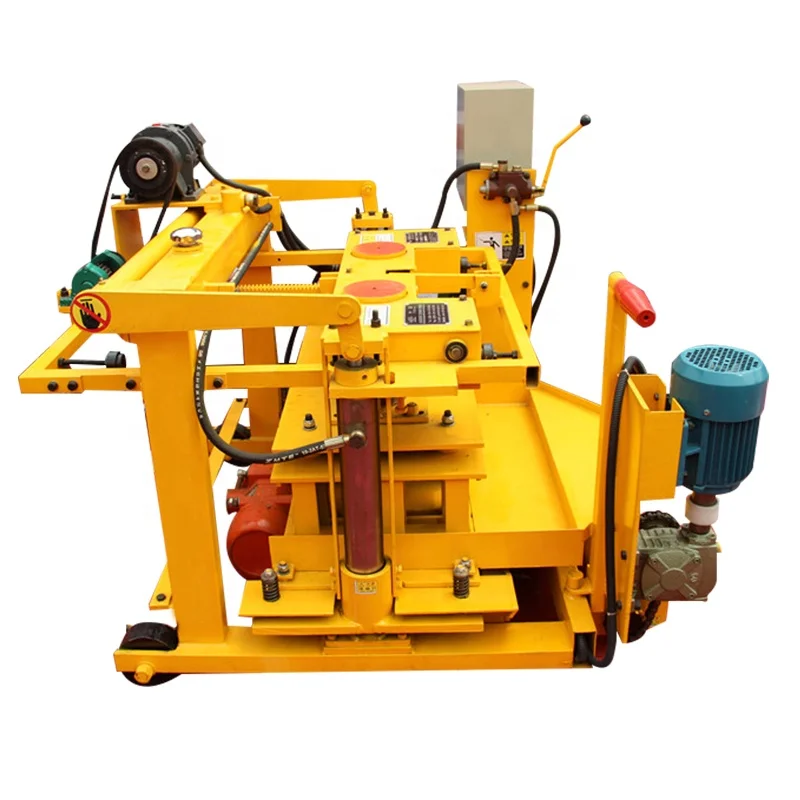
Matched System Design — We map the mixer, feed and curing workflow around the QMY4-30 so your on-site line runs continuously without the press waiting for material.
Technical Specifications
| Parameter | Value |
|---|---|
| Model | QMY4-30 |
| Product Type | Mobile Hydraulic Block Making Machine |
| Overall Dimensions (L×W×H) | 1300 x 1500 x 1000 mm |
| Net Weight | 950 – 1000 kg |
| Total Power | 5.95 kW |
| Vibration Force | 28.6 kN |
| Excitation Frequency | 4500 r/min |
| Hydraulic Method | Mold Vibration |
| Cycle Time | 30 s |
| Output Capacity | 3000 pcs/day (8 hours) (basis to be confirmed) |
| Raw Material Compatibility | Concrete, sand, cement, fly ash, stone dust, slag, river sand, construction waste |
| Assembly State | Mobile / Egg-laying |
| Control System | Manual with hydraulic assist |
| Pallet System | Not applicable (egg-laying type) |
Application Suitability
| Application Scenario | Material & Output Context |
|---|---|
| Remote building sites without fixed plant infrastructure | Hollow block production from locally sourced crushed stone and cement |
| Housing development projects requiring continuous block supply | On-site concrete block output synchronized with daily masonry progress |
| Rural or coastal block entrepreneurship | Small-scale production using river sand, fly ash or stone dust mixes |
| Mine industrial area construction | Block making from slag, mine tailings or coal gangue aggregate |
| Hillside and mountainous terrain projects | Mobile egg-laying operation across uneven ground without pallet logistics |
What the 3,000-Piece Figure Doesn’t Tell Your Site Crew
The daily output number only matters when it names the exact block format and wall thickness it assumes.
I have stood on project sites in West Africa where a mobile block machine production line was ordered based on a headline capacity figure. The machine arrived, the crew started running hollow blocks, and the daily count fell noticeably short of expectation. The issue was not the press itself — it was that the capacity calculation assumed a specific block dimension and mix design that did not match what the site was actually producing. When you evaluate any mobile egg-laying machine, the cycle time and vibration force must be checked against your target block format before the output claim means anything [NEED_CITE: block format assumptions in capacity quotations]. A 30-second cycle produces a different daily total for a 400×200×200 mm hollow block than it does for a thinner partition block, and the difference compounds across an eight-hour shift.
How the Material Feed Loop Keeps the Press Running
The QMY4-30 completes a molding cycle every 30 seconds, which means the mixer and material feed arrangement must deliver a fresh batch to the hopper within that same window. On sites where a single worker shovels mixed concrete from a ground-level pan mixer, the feed rate often cannot keep pace once the crew settles into a rhythm. A mobile block machine production line built around this press works best when a small belt conveyor or a raised hopper with gravity feed bridges the gap between the mixer discharge and the machine hopper. The 5.95 kW total power draw means most small-site generators can handle the press, but you need to account for the mixer motor on the same circuit to avoid voltage drop during simultaneous startup.
Curing Layout for an Egg-Laying Line Without Pallets
Because the QMY4-30 lays blocks directly on the ground, the curing area is the floor itself — and that changes how you plan the site. Every block produced stays where it was placed until it reaches sufficient strength to be moved, so the available flat ground must accommodate a full day’s output spread across the molding path. The machine moves forward after each cycle, leaving a row of fresh blocks behind. On a typical eight-hour shift, that row length extends considerably, and the curing zone must be cordoned off from foot traffic and site vehicles [NEED_CITE: on-site block curing area requirements for egg-laying machines]. Planning the mobile block machine production line layout means marking the daily travel path before production starts, not after.
Reading the Specs That Actually Shape Your Output
The 28.6 kN vibration force delivered through the mold vibration hydraulic method is what compacts the concrete mix into the mold cavity. This force level, combined with the 4500 r/min excitation frequency, determines how densely the aggregate particles pack together during each 30-second cycle. Denser compaction means higher block strength, but only if the mix design supplies the right ratio of fine aggregate to cement. I have seen crews in laterite-rich areas run the same vibration settings they used with clean river sand, and the resulting blocks crumbled at the edges because the clay content absorbed vibration energy differently. Matching the vibration parameters to your actual local aggregate is a step that must happen before the machine ships, not after it arrives on site.
The 1300 x 1500 x 1000 mm footprint and sub-1000 kg weight make the QMY4-30 genuinely portable — a site pickup or small flatbed can relocate it between work zones without a crane. This matters on large development sites where block production needs to follow the build front rather than stay fixed at one corner of the project.
When the Supporting Line Is Missing From the Quote
A mobile block machine production line that arrives as a standalone press without mixer specification, feed arrangement, or curing workflow plan leaves the buyer to figure out production logistics on day one. The result is often a crew standing idle while the mixer catches up, or blocks being damaged by site traffic because the curing path was never mapped. The vibration force and cycle time are engineered values — the material flow around them is what determines whether the machine runs at its designed rhythm or spends half the shift waiting [NEED_CITE: production line idle time causes in small-scale block plants].
Why Sourcing the Line Together Matters
We treat the press, the mixer batch size, the feed rate and the curing layout as one calculation rather than separate purchases. The QMY4-30 configuration is set against your actual mix design and target block format, not pulled from a default catalogue entry. Mould supply covers the hollow block dimensions your local market buys, and custom mould design is available when your project calls for a non-standard format. The automation level starts at manual with hydraulic assist, and the supporting equipment can be expanded as your operation grows. Installation support includes on-site commissioning with operator training so your crew understands cycle timing, mould change procedure, and daily maintenance before the first production week ends.
Documentation & Verification
- Line layout showing mixer placement, feed path and curing zone sized to your site dimensions
- Capacity calculation stating the exact block format and wall thickness behind the output figure
- Machine specification sheet with voltage and frequency confirmed for your local grid or generator
- Hydraulic and electrical schematic for your maintenance team to reference on site
- Factory test record produced using your specified mix design before dispatch
- Operation and maintenance manual covering daily checks and mould change procedure
Installation, Commissioning & Support
- Flat compacted ground required across the full curing path before the QMY4-30 begins production
- Power supply must deliver 5.95 kW at your confirmed voltage and frequency, with dedicated circuit for the mixer
- Machine arrives assembled; position on leveled ground and connect hydraulic lines before first run
- Commissioning includes test cycles with your local aggregate to verify vibration force and block density
- Operator training covers mold change, hydraulic assist operation, and daily wear part inspection
- Wear parts list and mould maintenance schedule provided with first spare part recommendations
What to Share With Your Inquiry
Tell us the hollow block dimensions your market requires and the daily volume your project schedule demands. Share your local aggregate type — whether river sand, crushed stone, fly ash or construction waste — along with the cement grade you source. Confirm whether your site runs on grid power or a generator, and provide the voltage and frequency so the motor and hydraulic system arrive configured correctly.
Frequently Asked Questions
Q: What block format and dimensions does the 3,000 pcs/day capacity assume?
A: The output figure depends entirely on the hollow block size being produced. A larger format such as 400×200×200 mm yields fewer pieces per cycle than a smaller partition block. We provide a capacity calculation that names the exact format, wall thickness and cycle time assumed, so you can verify the daily total against your project requirement before confirming the order.
Q: What mixer batch size keeps the QMY4-30 running without idle time?
A: With a 30-second molding cycle, the mixer must deliver enough material for at least two to three cycles per batch to avoid constant stopping. The exact batch volume depends on the block format being produced — a larger hollow block consumes more concrete per cycle. We size the mixer and feed arrangement to match your chosen format and shift length.
Q: How large a curing area do I need for this mobile egg-laying line?
A: Since the QMY4-30 lays blocks directly on the ground and moves forward with each cycle, the curing area is the production path itself. For a full eight-hour shift, you need a flat, cordoned-off zone long enough to hold an entire day’s output without blocks being moved before initial set. We map the travel path as part of the line layout before dispatch.
Q: What voltage and frequency options work for generator-powered sites?
A: The total power draw of 5.95 kW is within the range of most small industrial generators used on remote construction sites. Voltage and frequency must be confirmed before production so the motor and hydraulic pump are matched to your power source. We build to your specification whether the site runs on 220V single-phase, 380V three-phase or another local standard.


