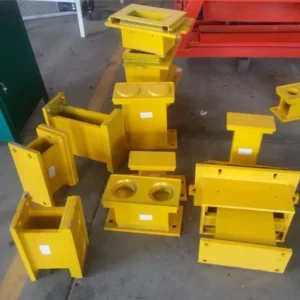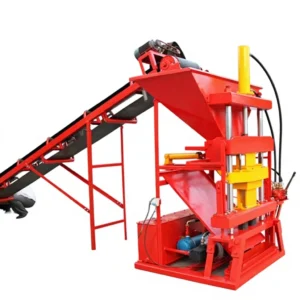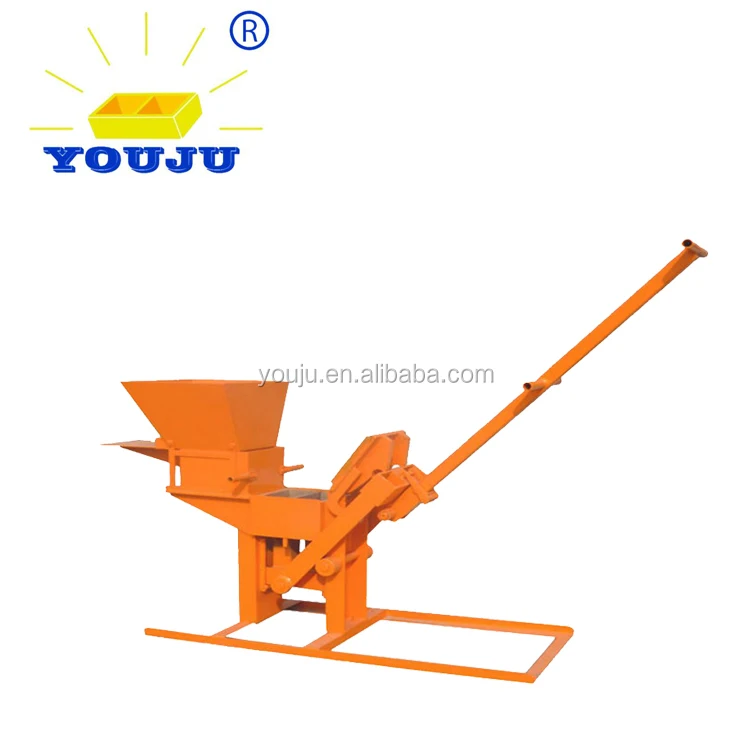
System-Matched Line — The LY2-40 press, mixer and pallet flow are calculated as one cycle rather than quoted as isolated stations, so the manual clay interlocking brick making machine production line never leaves the operator waiting for material or space.
Technical Specifications
| Parameter | Value |
|---|---|
| Model | LY2-40 |
| Product Type | Manual Clay Interlocking Brick Making Machine |
| Total Power | No Power, Completely Manual |
| Overall Dimensions (L×W×H) | 1600 x 700 x 1200 mm |
| Net Weight | 200-240 kgs |
| Molding Cycle | 30-40s |
| Output Capacity | 400pcs-1000 pcs/day (basis not stated in source — confirm block format / material / thickness) |
| Lifting System | Manually |
| Mobility | Steel wheels |
| Mould Options | Changeable for various blocks |
| Basic Equipment | JFA-1 Mixer or JQ350 Mixer |
| Automation Level | Completely Manual |
| Warranty | 1 Year |
Application Suitability
| Application | Material or Output |
|---|---|
| Small-scale rural housing projects | Local clay soil mixed with a stabilizer (cement or lime) |
| Remote construction sites with no grid power | Interlocking brick forming directly on-site |
| Community block-making cooperatives | Manual production of interlocking bricks for local sale |
| Eco-building contractors | Earth-based interlocking bricks for sustainable structures |
Why "Output Per Day" Means Nothing Without the Rest of the Line
A manual press can only move as fast as the mixer feeds it and the curing area absorbs it.
Many first-time buyers focus on the 30-40s molding cycle of a manual clay interlocking brick making machine production line and assume the daily total will stack up on its own. The reality I’ve seen on site is that a mismatched mixer creates idle minutes between every press, and a poorly planned curing zone forces workers to shuffle pallets by hand while the press sits empty. [NEED_CITE: manual block plant line balancing principles] The daily figure only holds when every station upstream and downstream keeps pace with the operator’s rhythm.
How the Mixing Station Sets the Press Pace
The LY2-40 relies entirely on human force for compaction, so the operator’s stamina becomes part of the cycle. If the chosen mixer — whether the JFA-1 or JQ350 — cannot deliver a fresh batch every few minutes, the operator spends those gaps leaning on the handle instead of pressing. A manual clay interlocking brick making machine production line must treat mixer batch size and press cycle as two halves of one calculation.
Pallet Flow and Curing Space Around a Zero-Power Press
Without conveyors or automated stackers, every pallet travels by hand from the press to the curing area and back. If the curing zone is too far or too small, pallets pile up near the machine, blocking the operator’s movement and slowing the cycle. Planning the pallet loop and curing rack distance before the press arrives prevents the kind of bottleneck that turns a 40-second cycle into a 90-second reality on site. [NEED_CITE: pallet circulation planning for manual block plants]
Reading the Specs That Actually Shape Your Day
The zero-power design means no motor, no wiring, and no generator fuel — but it also means every stroke depends on the operator. The 1600 x 700 mm footprint keeps the machine compact enough for a small yard, yet the steel wheels let one or two workers roll it closer to the material stockpile when the wind or sun shifts. Mould changes are manual too, so the formats you plan to produce should be grouped by size to minimize downtime between runs. The 200-240 kg net weight gives the frame enough mass to resist rocking during compaction without needing a bolted foundation.
The Hidden Cost of Treating the Press as a Standalone Purchase
Buying the press alone and sourcing a random mixer locally often leads to a batch volume that is either too large — leaving clay to dry out before it is pressed — or too small, starving the operator between cycles. Workers end up improvising pallet racks from scrap timber, and curing covers are added as an afterthought, leading to uneven moisture loss and weak bricks. [NEED_CITE: field failures from unmatched block line components] These are not machine faults; they are line-integration gaps that show up only after the first week of production.
Why Procuring the Whole Line Here Matters
- Single-focus block machinery supplier — the press, mixer, pallets and moulds are specified together so cycle times align from day one.
- Mixer matched to press cycle — the JFA-1 or JQ350 is selected based on your target block format, not a generic catalogue default.
- Mould format planning — changeable moulds are supplied for the interlocking profiles your local market actually sells, with drawings provided upfront.
- Site-condition configuration — pallet size and curing rack layout are calculated against your available yard space, not a standard template.
- Upgrade path retained — the manual line layout leaves room to add a motorized mixer or pallet feeder later without repositioning the press.
Documentation & Verification
- Line layout drawing showing mixer-to-press distance and pallet circulation loop for the LY2-40
- Mould drawing and interlocking brick format list matched to your local market demand
- Factory test record confirming 30-40s cycle on your specified clay mix
- Operation and maintenance manual with manual-press-specific lubrication and adjustment procedures
- Wear parts and mould list identifying items to stock for the first year of production
Installation, Commissioning & Support
- Ground leveling guidance for the 1600 x 700 mm footprint to prevent frame twist during compaction
- No electrical hookup required — commissioning focuses on mechanical alignment and handle tension
- Steel wheel mobility allows repositioning on site without dismantling the LY2-40 frame
- First-run trial with your local clay to confirm mix consistency against the chosen mixer
- Operator training covering mould change sequence and daily press inspection points
- Wear parts kit sized for manual-press usage patterns and first-year mould replacement
Preparing Your Inquiry
To size the manual clay interlocking brick making machine production line accurately, share the interlocking brick profile and dimensions you intend to produce, the type of clay or soil available on your site, and the approximate daily volume you need. Include a sketch or dimensions of your available production yard so pallet flow and curing area can be planned before the quotation is issued.
Frequently Asked Questions
Q: How is the daily output of 400–1000 pcs calculated, and which block format does it assume?
A: The stated range is based on continuous manual operation, but the exact brick dimensions, wall thickness and material density all shift the figure. Before we quote a line, we recalculate capacity using your specific interlocking block drawing and confirm the output in writing so both sides agree on the baseline format.
Q: What mixer capacity is needed to keep the LY2-40 press fed without idle time?
A: The JFA-1 or JQ350 is selected based on your block volume per batch and the 30-40s press cycle. A mixer that discharges faster than the operator can press causes material to dry out, while one that is too slow creates idle gaps. We match batch size to your chosen format during the line layout stage.
Q: How should the curing area and pallet flow be laid out around a manual press line?
A: Pallets must travel from press to curing zone and back without crossing paths or stacking on the floor. We draft a yard plan showing pallet rack positions, curing cover areas and walking lanes based on the dimensions you provide, so the operator never waits for a cleared pallet.
Q: What block formats can the changeable mould produce, and how long does a mould change take?
A: The LY2-40 accepts interchangeable moulds for various interlocking profiles within the clay brick range. Change time depends on the operator’s familiarity, but grouping production by format reduces the number of swaps per shift and keeps the daily cycle consistent.