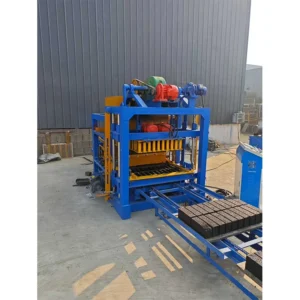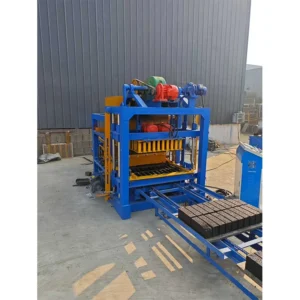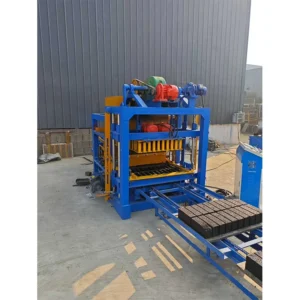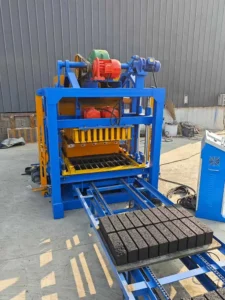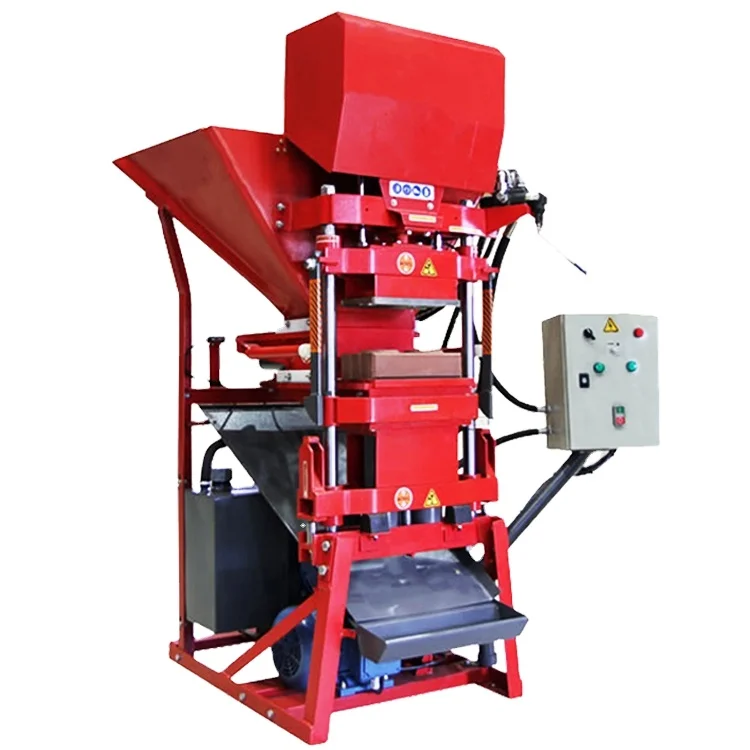
Complete Line Configuration — The ECO 2700 interlocking clay brick machine is specified as the centre of a coordinated production line where raw material feeding, clay-cement mixing, and curing handling match the press cycle to prevent upstream or downstream bottlenecks.
Technical Specifications
| Parameter | Value |
|---|---|
| Model | ECO 2700 |
| Product Type | Interlocking Clay Brick Machine |
| Automation Level | Semi-automatic or Automatic (configurable per request) |
| Power Source | Electric motor or Diesel engine |
| Rated Power | 7.5 kW or 12 HP |
| Hydraulic Pressure | 16 MPa |
| Voltage & Frequency | 380V, 3-phase, 50Hz (customizable to local voltage) |
| Overall Dimensions (L×W×H) | 1000 × 1000 × 1800 mm |
| Net Weight | 1000 kg |
| Pallet Requirement | No pallets required |
| Cycle Time | 10–15 s |
| Output Capacity | 2500–3000 pcs/day (8h) (basis to be confirmed) |
| Mould Format | Interlocking brick, sizes listed 300×150×100 mm and 250×125×60 mm |
| Motor Brand Option | Chinese Siemens Brand |
| Raw Material Compatibility | Clay + Cement (80–90% clay, 6–8% cement, 3% water) or Full Clay (97% clay, 3% water) |
| Warranty | 1 year (excluding wearing parts) |
Application Suitability
| Application | Material or Output |
|---|---|
| Interlocking brick production for housing and construction projects | Clay-based raw materials with cement binder |
| On-site or small-plant block production | Local clay mixed with 6–8% cement or full clay |
| Interlocking paver manufacturing | 300×150×100 mm and 250×125×60 mm interlock formats |
Why the Mixer Matters More Than the Press
A press that sits idle waiting for mixed clay never reaches its quoted cycle time.
I have seen plant owners invest heavily in a block press only to find that a slow mixer or an undersized material feeder cuts the actual daily output in half. The interlocking clay brick machine production line is only as fast as its slowest station. If the upstream mixing cannot deliver a fresh batch every 10–15 seconds, the ECO 2700 sits idle, and the rated capacity becomes a theoretical figure on paper [NEED_CITE: production line bottleneck analysis in block manufacturing]. This is why a line layout must calculate capacity at every station, not just at the press.
Matching Upstream Feeding to the Press Cycle
The ECO 2700 completes one mould cycle in 10–15 seconds. For continuous operation, the raw material feeding and mixing station must deliver a homogeneous clay-cement batch within that same window. A mixer with insufficient capacity forces the operator to pause the press, erasing the advantage of a fast cycle. The interlocking clay brick machine production line must therefore pair the press with a mixer rated for the specific clay moisture content and cement proportion used locally.
Downstream Curing Without Pallets
The pallet-free design of the ECO 2700 changes the downstream handling layout entirely. Freshly pressed interlocking bricks are placed directly onto the curing surface or rack without the need to manage pallet return loops. This simplifies the curing area but demands that the handling crew or conveyor system moves finished bricks away fast enough to keep the press running. A congested curing area slows the entire interlocking clay brick machine production line [NEED_CITE: curing area logistics in pallet-free brick production].
Hydraulic Pressure and Brick Density
The 16 MPa hydraulic pressure directly influences the density and compressive strength of each interlocking brick. Higher pressure compacts the clay-cement mix more tightly, producing a heavier and stronger brick. However, the pressure must be matched to the raw material: a mix with too much water will squeeze out under high pressure, while a dry mix may not bind properly. The 7.5 kW motor provides the force needed to sustain this pressure across thousands of cycles per shift. The 1000 × 1000 × 1800 mm footprint keeps the press compact enough for on-site deployment while maintaining structural rigidity under full hydraulic load.
What Happens When Stations Are Mismatched
A buyer who orders the press alone and sources a mixer separately often discovers that the two machines were never designed to communicate. The mixer may deliver batches at intervals that do not align with the press cycle, or the material consistency may vary from batch to batch because the mixer was sized for a different application. The result is inconsistent brick strength, wasted raw material, and operator frustration [NEED_CITE: equipment mismatch consequences in block production lines]. The hidden cost is not the equipment itself but the lost production hours spent troubleshooting a line that was never configured as one system.
Why Configure the Line as One System
Sourcing the press, mixer, feeder, and curing handling from a single supplier means every station is specified against the same production target and raw material profile. The ECO 2700 is configured against the buyer’s actual clay type and cement proportion, not a catalogue default. Mould design covers the interlocking formats the buyer’s market demands. Automation level is selectable so a plant can start semi-automatic and add automatic stacking later. Installation support covers the full line, not just the press. Documentation includes a line layout with capacity calculations stated per block format at every station.
Documentation & Verification
- Line layout with capacity calculation per block format at each station
- Machine specification sheet confirming hydraulic pressure and cycle time
- Mould drawing and format list for interlocking brick dimensions
- Voltage and control language confirmation before shipment
- Factory test record on buyer’s clay-cement mix proportion
- Operation and maintenance manual covering press and supporting stations
Installation, Commissioning & Support
- Foundation requirements based on 1000 × 1000 mm footprint and 1000 kg net weight
- Power supply confirmation for 380V 3-phase 50Hz or local voltage adaptation
- On-site assembly and alignment of press with upstream mixer and feeder
- First-run commissioning with parameter setting for local clay and cement mix
- Operator training covering press cycle, mould change, and daily maintenance
- Wear parts list and supply plan for hydraulic seals and mould surfaces
What to Include in Your Inquiry
Provide your target interlocking brick dimensions, the clay source and its moisture content, and the cement proportion you plan to use. Include your site voltage and frequency, the available floor space for the full line, and whether you need diesel engine power for areas with unreliable grid supply. If you have existing upstream or downstream equipment, share its specifications so the line can be configured around it.
Frequently Asked Questions
Q: How is daily output verified and what does it depend on?
A: The quoted output of 2500–3000 pieces per day assumes a specific block format and continuous operation over an 8-hour shift. Actual output depends on the mixer delivering batches within the 10–15 second press cycle and the curing area clearing finished bricks without delay. A capacity calculation per format should accompany every quotation.
Q: How must the mixer match the press cycle time?
A: The mixer must produce a homogeneous clay-cement batch every 10–15 seconds to keep the ECO 2700 running without pauses. If the mixer is slower, the press sits idle and daily output drops. The mixer capacity must be calculated against the specific clay moisture and cement ratio used.
Q: What voltage and power source options are available?
A: The standard configuration is 380V, 3-phase, 50Hz with an electric motor rated at 7.5 kW. Voltage can be customized to match local supply standards. A diesel engine option rated at 12 HP is available for sites with unstable or unavailable grid power.
Q: What does curing look like without pallets?
A: The pallet-free design means freshly pressed bricks are placed directly onto the curing surface or rack. This eliminates pallet return loops but requires that the curing area is sized and organized so finished bricks are moved away quickly enough to keep the press running continuously.
Q: What does on-site installation and training cover?
A: On-site support covers approximately one week and includes assembly, alignment with upstream and downstream stations, first-run commissioning with the buyer’s raw material, and operator training on press operation, mould change, and daily maintenance. The buyer covers engineer travel, accommodation, and costs.