
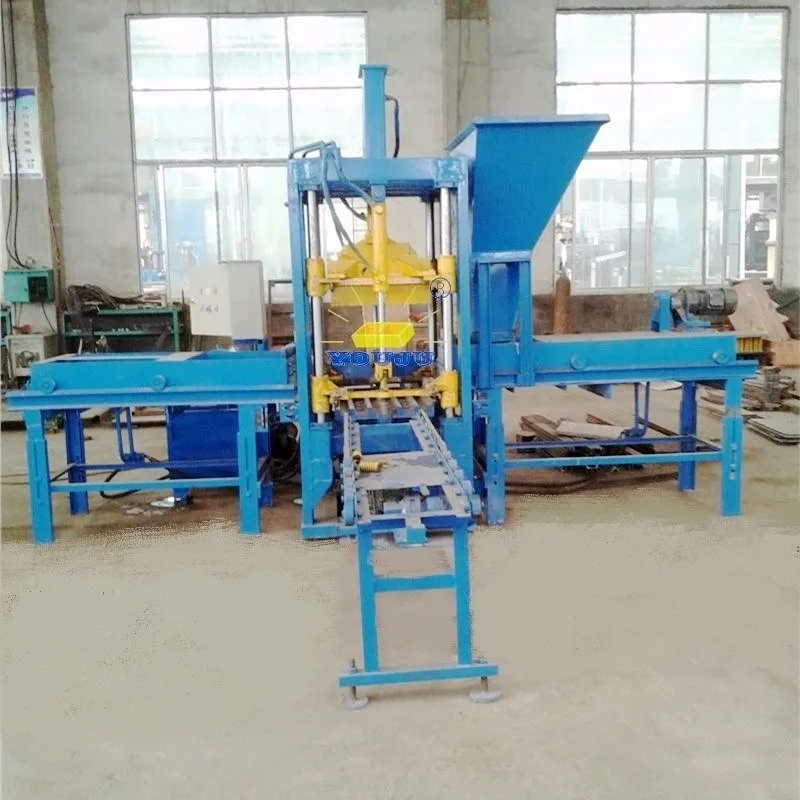
Matched system design — the QTF3-20 stationary block making machine production line is specified as one integrated chain from batch mixer through press to pallet return, so cycle times align and the press is never starved or blocked.
Technical Specifications
| Parameter | Value |
|---|---|
| Product Type | Stationary Hydraulic Concrete Block Making Machine |
| Model | QTF3-20 |
| Main Vibration Form | Platform vibration and hydraulic pressure |
| Cycle Time | 20 seconds (basis not stated in source — confirm block format, material and thickness) |
| Vibrating Frequency | 4600 rolls/minute |
| Total Motor Power | 14.25 kW |
| Pallet Size | 680 × 530 mm |
| Raw Materials | Crushed stone, sand, cement, fly ash, cinder, slag, gangue, gravel, perlite, industrial wastes |
| Applied Products | Solid and hollow blocks, paving stones, kerbstones, interlocking blocks, grass blocks, slope blocks |
| Standards | CE, ISO 9001 |
Application Suitability
| Application | Material or Output |
|---|---|
| Urban wall block production | Crushed stone, sand, cement and fly ash mixes |
| Roadway and pavement blocks | Aggregate with face mix layer for wear resistance |
| Landscaping and garden products | Lightweight mixes using perlite or slag |
| Rural masonry block supply | High fly-ash or cinder content mixes |
| Kerbstone and edger production | Dense concrete with hydraulic compression |
What "20 Seconds per Cycle" Actually Means for Your Output
A cycle time only matters when every station around the press can keep up.
Many quotations list a single cycle figure without naming the block format it assumes. The QTF3-20’s 20-second cycle is a press-level baseline. If the mixer takes 45 seconds to deliver a fresh batch, or the pallet return conveyor is five seconds slower than the press index, the real daily output of this stationary block making machine production line drops well below the headline number [NEED_CITE: typical line bottleneck patterns in block manufacturing]. Plant owners who discover this mismatch after installation are left re-scheduling shifts to hit contracted delivery volumes.
How Upstream Feeding Meets the Press Cadence
The mixer must discharge a full batch into the feed hopper before the QTF3-20 completes its current cycle. For a 20-second press cycle, the batching and mixing station needs to deliver consistent volume at roughly three cycles per minute. A stationary block making machine production line that starves the press for even two cycles an hour loses hundreds of blocks across a standard shift. Matching the mixer drum capacity, conveyor belt speed and hopper gate timing to the press rhythm is the first calculation we run before confirming a line layout.
Downstream Pallet Return and Where Lines Stall
Fresh blocks leave the press on 680 × 530 mm pallets that must travel to the curing area and return empty. If the pallet return loop is longer than the curing rack fill time, the press waits [NEED_CITE: pallet circulation requirements in stationary block plants]. We map the pallet travel distance, elevator speed and rack spacing against the press output so the return conveyor delivers a clean pallet to the feed station within the 20-second window. This is where most incomplete quotations leave a gap — the buyer pays for the press and discovers pallet handling was never included.
Reading the QTF3-20 Specifications Against Real Production
The 4600 rolls/minute vibrating frequency works with platform vibration and hydraulic pressure to compact the mix across the full pallet area. Higher frequency alone does not guarantee block density; it must be paired with adequate hydraulic force matched to the buyer’s aggregate and cement ratio. The 14.25 kW total motor power covers the vibration motor, hydraulic pump and feed system together — this figure lets plant electricians size the incoming supply and verify it matches the mixer and conveyor motors already on site. The 680 × 530 mm pallet dimension dictates curing rack width, forklift tine spacing and the footprint of the entire wet-side handling area.
The Cost of Ignoring Line-Level Integration
A press specified in isolation often arrives to find the existing mixer is too small, the pallets do not fit the curing racks, and the voltage on site differs from the motor nameplate. These problems surface one by one during commissioning, each one adding days of downtime [NEED_CITE: common commissioning delays in exported block machinery]. The result is a stationary block making machine production line that runs below capacity not because the press is faulty, but because the stations around it were never matched.
Why Sourcing the Complete Line Here Reduces Integration Risk
Block machinery is our single focus, so the QTF3-20 press, its moulds, pallets and handling equipment are specified as one system. We set the configuration against the buyer’s actual mix design and local aggregate rather than a catalogue default. Mould design covers the formats the buyer’s market actually sells, with custom drawings available. Automation level is selectable — a buyer can start with semi-automatic pallet handling and add stacking later. Line layout drawings state the capacity assumption per block format, so there is no gap between the quoted number and real daily output.
Documentation & Verification
- Line layout showing QTF3-20 station positions, conveyor lengths and pallet return path
- Capacity calculation stating the block format assumed for the 20-second cycle figure
- Pallet specification matched to buyer’s curing rack dimensions and forklift fleet
- Voltage and frequency confirmation recorded before the QTF3-20 enters production
- Factory test record on the buyer’s chosen mould format before dispatch
Installation, Commissioning & Support
- Foundation plan showing load points for the QTF3-20’s vibration platform and hydraulic unit
- Dedicated electrical circuit sized for the 14.25 kW total motor load plus starting surge
- Pallet conveyor alignment checked against the 680 × 530 mm pallet return loop
- First-run parameter setting on the buyer’s local aggregate and cement ratio
- Operator training covering mould change procedure and daily vibration system inspection
- Wear parts list with hydraulic seal and mould liner reorder intervals
Before You Request a Quote
To size a stationary block making machine production line around the QTF3-20, share the block formats you plan to produce and the daily volume each format requires. Confirm your local raw material source — sand type, aggregate grading, and whether fly ash or slag is available. Provide your workshop dimensions, existing curing area layout and current forklift capacity so we can verify pallet and rack compatibility before the line is finalized.
Frequently Asked Questions
Q: How does block format affect the 20-second cycle and realistic daily output?
A: The 20-second figure is a press-level baseline. Larger hollow blocks with deep cores need longer vibration and compression time, which extends the cycle. Daily output must be calculated per format, accounting for mould fill time and mix flow characteristics. We provide a format-by-format capacity table so you see the real number for each block you intend to sell.
Q: What upstream and downstream equipment must match the QTF3-20?
A: The mixer must discharge a full batch within the press cycle window. The pallet return conveyor must deliver a clean pallet before the next press stroke. Pallet elevator speed, curing rack spacing and conveyor belt rate all connect to the 680 × 530 mm pallet size. We confirm each station’s timing during the line layout stage.
Q: Will the 680 × 530 mm pallets work with my current curing racks and forklift?
A: Pallet size determines rack width, spacing between tiers, and forklift tine entry. If your existing racks were built for a different pallet dimension, you may need to adapt the racks or select a compatible pallet size. We cross-check your curing area drawings before finalizing the pallet specification.
Q: How do I confirm voltage and control language before production starts?
A: Voltage, frequency and PLC display language are confirmed during the order stage and recorded in the production documents. This prevents commissioning delays when the machine arrives on site. We request your electrical supply details and preferred operator language before the QTF3-20 enters assembly.
Q: What does the line include versus what I must source locally?
A: The quotation covers the QTF3-20 press, moulds, pallets, mixer, conveyors and pallet handling equipment as specified. Items such as the workshop building, curing area cover, water supply and foundation works are typically buyer scope. The line layout drawing clearly marks included versus local-scope items so there are no gaps at delivery.


