
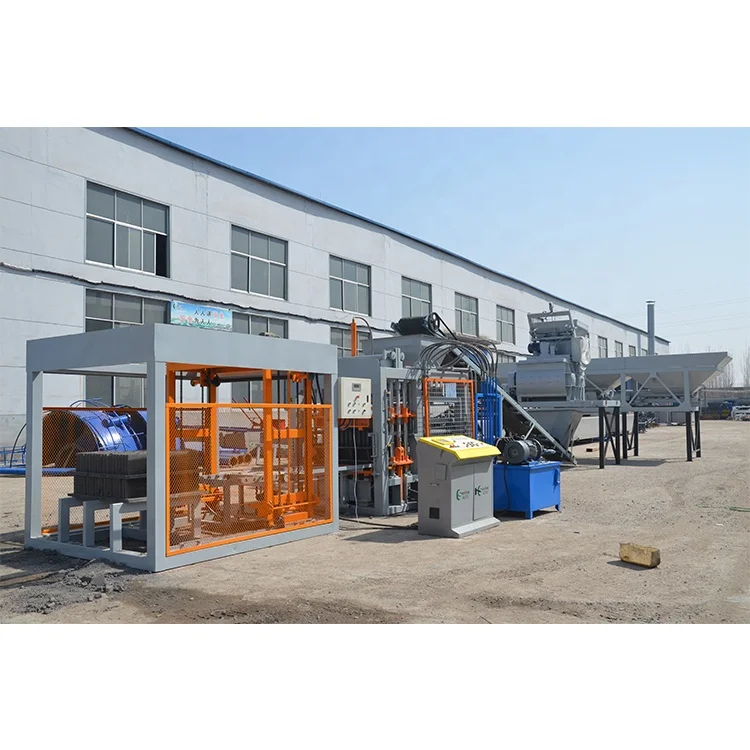
Fully Automatic QT5-15 Block Making Machine Production Line – Turnkey Solution
Cycle-Matched Line Engineering — The QT5-15 press, mixer, pallet feeder, stacker and curing handler are sized together so no station waits on another.
Technical Specifications
| Parameter | Value |
|---|---|
| Product Type | Fully Automatic Hydraulic Block Making Machine |
| Model | QT5-15 |
| Overall Dimensions | 7400 × 1950 × 2800 mm |
| Rated Hydraulic Pressure | 21 MPa |
| Main Vibration Form | Platform Vibration |
| Vibration Frequency | 2800–4500 r/min |
| Pallet Size | 1100 × 550 mm |
| Molding Cycle | 15–25 s |
| Overall Power | 26.5 kW |
| Demolding Method | Hydraulic |
| Output (Hollow brick 400×200×200mm) | 5 pcs/mold, 16–20 s cycle, 1800 pcs/h |
| Output (Hollow block 400×150×200mm) | 6 pcs/mold, 15–20 s cycle, 1300 pcs/h |
| Output (S paver 225×112.5×60mm) | 16 pcs/mold, 15–17 s cycle, 3700 pcs/h |
| Raw Materials | Crushed stone, sand, cement, fly ash, gravel, slag |
| Voltage & Frequency | Configurable (confirm with supplier) |
| Control System | PLC (brand / model to confirm) |
| Automation Level | Configurable from semi-automatic to fully automatic stacking |
| Applied Products | Hollow/solid blocks, pavers, interlocking blocks, curbstone, colored pavers |
Application Suitability
| Application | Material or Output |
|---|---|
| Hollow block production plants | Crushed stone, sand, cement, fly ash blends |
| Paving block and interlocking brick manufacturing | Gravel, sand, cement with pigment additives |
| Curbstone and solid block production | Coarse aggregate and cement mixes |
| On-site block production for housing projects | Locally sourced sand, slag and cement |
| Concrete product manufacturers expanding format range | Existing aggregate stock with new mould setups |
Why a Press Quoted in Isolation Never Hits Its Rated Output
A block press only runs as fast as its slowest upstream or downstream station. I spent years doing after-sales service across the Yangtze River Delta, and one pattern kept repeating: a plant would bring in a QT5-15 and then wonder why daily output never approached the numbers on the spec sheet. The mixer discharged too slowly, the pallet feeder jammed every forty minutes, and the stacker could not keep pace with the press discharge. The press sat idle for half of every shift, not because of any fault in the press itself, but because the line around it was never balanced [NEED_CITE: common causes of throughput loss in block production lines].
A Fully Automatic Block Making Machine production line must be engineered station by station. The feeding conveyor, the mixer discharge rate, the pallet return speed, the stacking cycle and the curing rack handler all have to be timed against the 15–25 second molding cycle of the QT5-15. When even one of these links runs slower, the press waits — and that wait time compounds across an eight-hour shift into thousands of missing blocks.
From Raw Material Feed to Cubed Output — One Matched System
A Fully Automatic Block Making Machine production line built around the QT5-15 starts with raw material feeding and batching, moves through mixing, then into the press itself, followed by pallet transfer, stacking and curing rack handling. Each station is selected so that its cycle time does not exceed the press cycle, which means the press is never starved for material or blocked by a full downstream buffer. The 1100 × 550 mm pallet size is confirmed against the curing rack dimensions and the forklift capacity already on site.
Where the Bottlenecks Actually Hide
In most block plants, the bottleneck is not the press. It is the pallet return conveyor running too slow, the mixer gate that opens only partially, or the stacker that requires a manual reset every few cycles. These are the problems that do not show up in a catalogue but become obvious on the first production day. Every station in this line is specified with its own cycle time, and those times are cross-checked against the QT5-15 molding cycle before the quotation is issued [NEED_CITE: block plant cycle time matching methodology].
Pressure, Vibration and Mix Design — How They Interact
The 21 MPa rated hydraulic pressure and 2800–4500 r/min platform vibration of the QT5-15 work together to compact the mix into a dense block. Higher vibration frequency liquefies the mix inside the mould, while hydraulic pressure forces the material into every corner. If the local aggregate is coarse or the cement content is low, the vibration and pressure settings must be adjusted downward or upward accordingly — otherwise block edges crack or strength drops. The pallet size of 1100 × 550 mm also determines how many blocks cure per rack level, so choosing a pallet that does not match the curing area means either wasted rack space or pallets that cannot fit. The 26.5 kW overall power rating informs the electrical panel sizing and transformer selection before the line arrives on site.
The Cost of Skipping Line-Level Planning
When the pallet size is chosen without checking the curing racks and forklift on site, the plant ends up either buying new racks or moving pallets by hand — both of which erase the output gains the press was supposed to deliver. When voltage and frequency are not confirmed before production, the control panel arrives with the wrong contactors and the PLC display shows the wrong language, delaying commissioning by days or weeks [NEED_CITE: voltage and frequency standards by export market]. And when mould changeover is not factored into the daily schedule, the format flexibility that justified the investment disappears because operators avoid switching formats to save time.
Why Source the Full Line from One Supplier
Every station — from the raw material feeder to the cubing stacker — is specified against the same production target, so cycle times are cross-verified before fabrication rather than reconciled on site. The mould selection is driven by the block formats the buyer’s market actually sells, including custom drawings when standard moulds do not cover a required size. Pallet size and material are confirmed against the curing area dimensions and forklift capacity the buyer already operates, not selected from a default list. The automation level is selectable, allowing a buyer to start with semi-automatic pallet handling and add full stacking later without replacing the press. Installation includes operator training on the actual mix and mould combinations the plant will run.
Documentation & Verification
- Line layout drawing showing station positions, conveyor lengths and cycle times per format
- Machine specification sheet with hydraulic pressure, vibration frequency and pallet size confirmed
- Mould drawing and format list matching the buyer’s target block dimensions
- Hydraulic and electrical schematic for line-level commissioning
- Factory test record on the buyer’s selected block format before dispatch
- Voltage, frequency and PLC display language confirmation document
Installation, Commissioning & Support
- Foundation plan based on 7400 × 1950 mm footprint and 26.5 kW load requirement
- Power supply wiring matched to confirmed voltage and frequency before panel assembly
- Machine dismantling for container loading with reassembly sequence documented
- First-run parameter setting on the buyer’s local aggregate and mix design
- Operator training covering mould change procedure and daily maintenance checkpoints
- Wear parts and mould replacement list with part numbers for reordering
What We Need to Size Your Line Correctly
Send the block formats you plan to produce, the daily output target for each format, and the local aggregate types you can source. Include your workshop dimensions, existing curing rack size and forklift capacity, along with the voltage and frequency standard in your region. If you already operate a mixer or batching system, share its discharge rate so we can verify it against the QT5-15 cycle time.
Frequently Asked Questions
Q: How are cycle times matched across feeding, mixing, pressing, pallet handling and stacking so no station idles?
A: Each station’s cycle is calculated against the QT5-15 molding cycle of 15–25 seconds. The mixer discharge rate, pallet feed speed and stacker cycle are all set so that the press is never waiting for material or blocked by downstream backup. This balance is verified in the line layout before fabrication begins.
Q: What does the line quotation include beyond the press itself?
A: The quotation covers raw material feeding, mixing, pallet feeding, the QT5-15 press, pallet return, automatic stacking, curing rack handling and cubing. Every station is listed with its own cycle time so the buyer can see how the line balances before committing.
Q: How is the pallet size and material chosen to fit the buyer’s existing curing area and forklift?
A: The 1100 × 550 mm pallet size is checked against the curing rack slot dimensions and the forklift tine spacing on site. Pallet material — timber, bamboo or composite — is selected based on the curing environment humidity and the expected pallet lifespan the buyer requires.
Q: What voltage, frequency and control language options are confirmed before the line is built?
A: Voltage, frequency and PLC display language are confirmed in writing before the electrical panel is assembled. This prevents situations where the line arrives with incompatible contactors or an unreadable HMI, which would delay commissioning.
Q: What line-level documentation ships with the equipment?
A: Documentation includes the line layout drawing with cycle times, hydraulic and electrical schematics, mould drawings, factory test records on the buyer’s chosen format, operation and maintenance manual, and a wear parts list with part numbers for reordering.


