
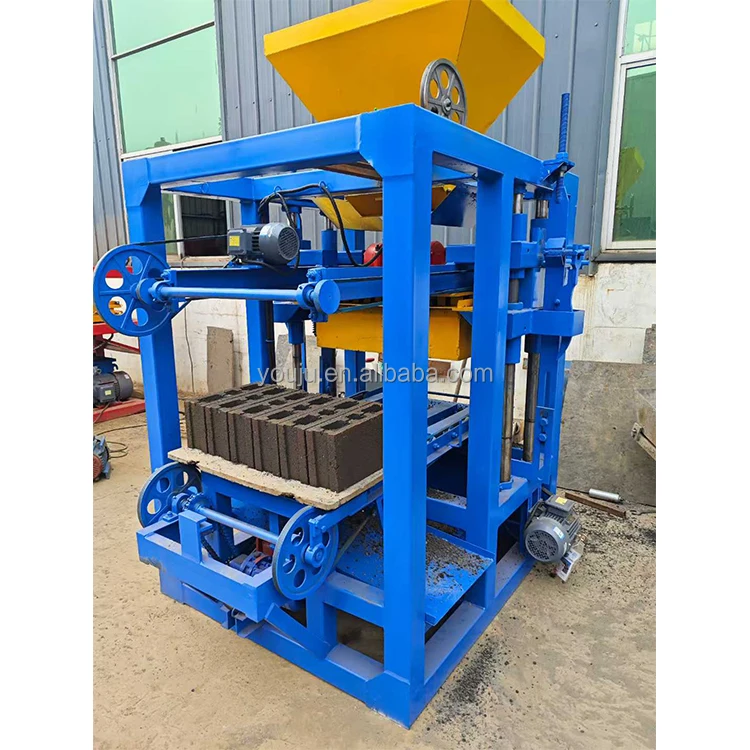
Matched System Throughput — the QTJ4-24 is specified as a complete line with mixer, conveyor and optional stacker, so each station is sized to the press cycle rather than sourced as independent units.
Technical Specifications
| Parameter | Value |
|---|---|
| Model | QTJ4-24 |
| Product Type | Semi-Automatic Concrete Block Making Machine |
| Molding Type | Platform Vibration |
| Overall Dimensions (L×W×H) | 3600mm × 1700mm × 2560mm (working state) |
| Total Mass | 1750 kg |
| Pallet Size | 850mm × 450mm |
| Overall Power | 14.25 kW |
| Vibration System | Lower platform vibration (2 × 3 kW motors) + upper attached vibrator (1.5 kW) |
| Elevating System | Cone-shape motor with JZQ250 speed reducer, V-belt drive |
| Delivery Device | Cycloidal pin wheel speed reducer, chain and V-belt drive |
| Machine Frame | Dragon gate style, super steel construction, four vertical wear-resisting shafts |
| Control System | Electronic controlling part (PLC or relay logic basis to be confirmed) |
| Automation Level | Semi-automatic (mechanical + electronic combined operation) |
| Assembly State | Stationary, platform type |
| Supporting Equipment (Basic) | JQ350 pan mixer, 6m belt conveyor |
| Supporting Equipment (Optional) | Auto stacker (3–6 layers depending on block height), curing yard trolley |
| Mould Format (Hollow Block) | 390mm × 190mm × 190mm, 4 pcs/mould |
| Mould Format (Solid Brick) | 240mm × 115mm × 53mm, 21 pcs/mould |
| Output Capacity | (basis not stated in source) |
| Cycle Time | (basis not stated in source) |
| Voltage & Frequency | (basis to be confirmed) |
| Hydraulic Pressure | Not applicable (mechanical vibration type) |
Application Suitability
| Application | Material or Output |
|---|---|
| Small-scale hollow block production plants | Crushed stone, sand, cement and water mix |
| Solid brick manufacturing for local construction | Fly ash, river sand, cement blend |
| On-site block production for contractors | Locally available aggregate with cement binder |
| First workshop setup for block entrepreneurs | Standard concrete mix with regional raw materials |
| Expansion line for existing block producers | Additional hollow block or solid brick formats |
What "Per Hour Capacity" Leaves Out When the Mixer Can’t Keep Up
The semi-automatic block machine production line is only as fast as its slowest station.
I once watched a West African block plant where the hydraulic press completed a cycle in twenty seconds, then sat idle for another forty because the upstream mixer had not delivered the next batch. The quoted capacity assumed continuous feed, but the line was effectively halved before the first pallet left the curing yard. When evaluating any semi-automatic block machine production line, the cycle time of the press must be checked against the batch time and discharge rate of the mixer feeding it. [NEED_CITE: concrete batching cycle time alignment with block press throughput]
The QTJ4-24 pairs with a JQ350 pan mixer and a 6m belt conveyor, closing the distance between mixing discharge and the press hopper. This is not an afterthought; the mixer batch volume and the conveyor belt speed are selected so that fresh concrete arrives at the hopper before the current cycle completes. If the mixer is undersized or the conveyor too slow, the vibration platform waits, and daily output drops regardless of what the press specification sheet claims.
How Station-to-Station Timing Affects the Press
Each station in this semi-automatic block machine production line is evaluated for its contribution to continuous flow. The JQ350 pan mixer discharges a batch into the belt conveyor, which carries it into the press hopper within the window the current cycle requires. The cycloidal pin wheel delivery device moves material from the hopper into the mould box, timed by the same control logic that governs the platform vibration and the elevating system.
When these timings drift — a worn V-belt on the conveyor, a mixer paddle set at the wrong angle, a hopper gate that sticks — the press either receives a short charge or waits for the next full batch. The result is inconsistent block weight and density across the shift. Keeping each station’s cycle visible and adjustable is what separates a functioning line from one that constantly bottlenecks at the weakest link.
Where the Optional Stacker Fits in the Exit Flow
At the line exit, wet blocks on pallets must be moved to the curing yard before the next cycle deposits another pallet behind them. Without a stacker, an operator pulls each pallet by hand, loads it onto a trolley, and walks it to the yard. That walk time directly limits how fast the press can release the next pallet.
The optional auto stacker collects three to six layers depending on block height, reducing the number of trips to the curing yard. This matters most when the yard is located more than a few metres from the press. If the stacker is omitted from the quotation, the buyer must account for the manual handling labour and the pallet traffic pattern in the plant layout. [NEED_CITE: manual pallet handling impact on block plant throughput]
Why Vibration Layout and Frame Rigidity Matter for Block Density
The QTJ4-24 uses dual 3 kW lower platform motors combined with a 1.5 kW upper attached vibrator. Lower vibration compacts the aggregate from the pallet upward, while the upper vibrator settles the top surface. This two-direction layout produces more uniform density through the block height than lower-only vibration, particularly for the 190mm-tall hollow block format.
The dragon gate frame with four vertical wear-resisting shafts keeps the mould box aligned across thousands of cycles. If the shafts wear unevenly or the frame deflects under vibration load, the mould shifts laterally, producing blocks with one thin wall and one thick wall. The super steel construction and four-shaft arrangement resist that deflection, maintaining dimensional accuracy through a full production shift.
Pallet size at 850mm × 450mm must be matched to the buyer’s curing yard racking and the forklift tine spacing already on site. A pallet that does not fit the existing racks forces the buyer to rebuild the curing area or handle pallets at ground level, which slows retrieval and increases breakage. Voltage and frequency must be confirmed before production so the motor wiring and control panel match the local grid on arrival, avoiding weeks of rewiring before the line can run.
The Hidden Cost of Specifying the Press Alone
Quotations that list only the press unit leave mixing, conveying, stacking and curing logistics to the buyer’s improvisation. A mismatched mixer starves the press. Manual pallet handling at the exit slows the line to walking speed. An unconfirmed pallet size forces a curing yard rebuild. These are not minor adjustments; each one directly reduces daily output and increases labour cost in ways that only appear after the machine is installed and running. [NEED_CITE: block production line integration failures from mismatched stations]
Why Buyers Source This Line Here
Block machinery as a single focus means the press, mixer, conveyor, pallet and stacker are specified as one matched system, not assembled from separate suppliers with uncoordinated cycle times. Configuration starts from the buyer’s actual mix design, local aggregate and target block format, so the JQ350 mixer batch size and the conveyor speed are set to the specific material being pressed.
Mould supply covers the formats the buyer’s market sells, including custom drawings when the local demand requires a non-standard hollow block or interlocking paver. The automation level is selectable, allowing a buyer to start with the basic line and add the auto stacker as production volume grows. Installation support includes operator training that covers every station, not just the press controls.
Documentation & Verification
- Line layout drawing showing mixer, conveyor, press and stacker station positions
- Capacity calculation stating which block format each throughput figure assumes
- Factory test record running all stations as one integrated line before dispatch
- Voltage, frequency and control language confirmation sheet signed before production
- Pallet specification matched to buyer’s curing yard dimensions and forklift capacity
Installation, Commissioning & Support
- Level concrete foundation sized for 3600mm × 1700mm working footprint and 1750 kg mass
- Dedicated 14.25 kW power circuit with voltage and frequency matching confirmed pre-shipment
- Machine shipped in working-state configuration with bolted assembly for site erection
- First-run commissioning covering mixer batch timing, conveyor feed rate and press cycle alignment
- Operator training on mould change procedure and platform vibration adjustment
- Wear parts list covering V-belts, shafts and vibration motor bearings for planned maintenance
What to Share Before Requesting a Quote
To size this semi-automatic block machine production line correctly, specify the block formats you sell and the daily volume your market requires. Confirm the raw materials available locally — aggregate type, cement grade, any fly ash or additives — so the mixer and mould can be matched to your actual mix. State your site voltage, frequency and the control panel language your operators will use, along with the curing yard layout and forklift specifications already on site.
Frequently Asked Questions
Q: How is daily output calculated for this line?
A: Daily output is calculated per block format, not as a single number. The 390×190×190mm hollow block mould produces four pieces per cycle, while the solid brick mould produces twenty-one. Each figure assumes a specific cycle time and continuous material feed from the JQ350 mixer through the conveyor. The capacity calculation document provided with the quotation states the format and cycle time assumed for every throughput figure.
Q: What happens if the mixer output does not match the press cycle?
A: If the JQ350 mixer takes longer to discharge a batch than the press takes to complete a cycle, the platform waits for material and daily output drops. This is why the mixer batch volume, the 6m conveyor belt speed and the press hopper capacity are evaluated together during line configuration, not specified as independent items.
Q: Is the auto stacker part of the standard line?
A: The auto stacker is an optional addition, not included in the base quotation. It collects three to six pallet layers depending on block height, reducing manual handling at the line exit. Buyers who omit the stacker should plan for manual pallet removal and trolley transport in their plant layout and labour allocation.
Q: How does pallet size affect my curing yard?
A: The 850mm × 450mm pallet must fit your existing curing racks and forklift tine spacing. A mismatch forces ground-level stacking or a rack rebuild, both of which slow block retrieval and increase handling breakage. Pallet size and material are confirmed during line configuration to match your yard dimensions before the line ships.
Q: What must be confirmed before the line enters production?
A: Voltage and frequency must match the local grid at your site, and the control panel display language must be set to what your operators read. These are confirmed in writing before the machine enters production, avoiding commissioning delays caused by rewiring or unfamiliar control labels after the line arrives.


