
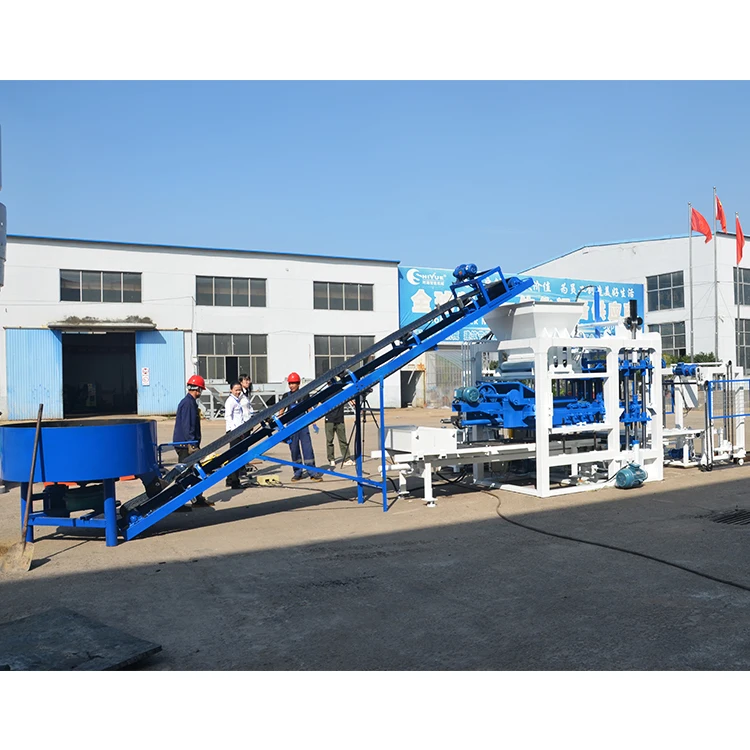
Matched Line Integration — Every station from raw material feeding through pallet stacking is sized to the QT4-18 press cycle, so the forming station never waits on upstream or downstream equipment.
Technical Specifications
| Parameter | Value |
|---|---|
| Model | QT4-18 |
| Product Type | Stationary Hydraulic Block Making Machine |
| Vibration Frequency | 0–60 Hz |
| Vibration Form | Platform Vibration |
| Pallet Size | 900 × 500 mm |
| Molding Cycle | 18–25 s |
| Vibration Force | 45 kN |
| Demolding Method | Hydraulic |
| Control System | PLC with person-machine conversation interface |
| Output Capacity (400×200×200 mm hollow block, 4 pcs/mould, 18 s cycle) | 799 pcs/h |
| Output Capacity (400×150×200 mm hollow block, 5 pcs/mould, 18 s cycle) | 999 pcs/h |
| Output Capacity (240×115×52 mm solid brick, 26 pcs/mould, 18 s cycle) | 5,199 pcs/h |
| Mould Format Compatibility | Hollow block, solid brick, color face brick, road curb rock, hydraulic block, sod brick |
| Automation Level | Semi-automatic with interlocking electric-hydraulic procedures |
| Assembly State | Complete machine line |
| Warranty | 1 year for whole machine (excluding spare parts) |
| Certification | CE (basis not stated in source — confirm applicable certification) |
Application Suitability
| Application | Material or Output |
|---|---|
| Hollow block production for building walls | Crushed stone, cement, sand, and water mix on 900×500 mm pallets |
| Solid brick manufacturing for load-bearing structures | Local aggregate and cement blends in 240×115×52 mm format |
| Paving and road curb production for infrastructure projects | High-density concrete mixes pressed under 45 kN vibration force |
| On-site block production for housing developments | Semi-automatic line with raw material feeding and pallet circulation |
| First block plant setup for new entrepreneurs | Complete line scope from mixer through curing rack handling |
What "Complete Line" Actually Covers in a QT4-18 Block Production Line
A quoted block line often stops at the press — pallets, mixers, stacking, and curing handling appear as extras or not at all.
I have watched contractors in the Middle East receive a stationary block making machine turnkey package, only to find the pallets did not fit the curing racks already on site and the mixer could not keep up with an 18-second cycle. The press sat idle for half of every shift because the raw material feed station was undersized. [NEED_CITE: block production line scope gaps reported by plant operators] A complete QT4-18 block production line definition should spell out every station, every connection point, and every cycle time match before the purchase order is signed.
How Raw Material Feeding and Mixing Stay Synchronized with the Press
The QT4-18 moulding cycle ranges from 18 to 25 seconds depending on block format and mix design. If the mixer delivers batch output slower than this cadence, the press operator is forced to wait, and daily throughput drops well below the calculated capacity figures. Raw material feeding equipment — belt conveyors, weigh hoppers, and aggregate bins — must be specified so that the mixer receives its charge in time for the next cycle. A stationary block making machine turnkey proposal should state mixer batch volume, conveyor belt speed, and bin count alongside the press specs so the buyer can verify the timing chain.
Pallet Circulation as the Hidden Bottleneck in Block Line Design
Pallets travel from the forming station to the curing area and back. On a 900×500 mm pallet size, the curing rack dimensions, forklift reach, and stacking method all influence how fast empty pallets return to the press. If the return loop is too slow, the press stops regardless of mixer readiness. [NEED_CITE: pallet circulation impact on block machine throughput in semi-automatic plants] The pallet feeding station, curing rack handling equipment, and any automatic stacking components must be designed around the same 900×500 mm dimension and the buyer’s existing site layout. This is where a line-level quotation prevents surprises that a press-only quotation hides.
Reading the Cycle Time Against Your Actual Block Format
The 18-second cycle produces different outputs depending on what sits on the pallet. A 400×200×200 mm hollow block yields 4 pieces per cycle, giving 799 pieces per hour. A 240×115×52 mm solid brick yields 26 pieces per cycle, giving 5,199 pieces per hour. These figures assume an 18-second cycle with no downtime for pallet exchange, mould adjustment, or material interruption. Real daily output depends on how many hours the line runs continuously, how often the mould changes, and whether the upstream and downstream stations maintain pace. Platform vibration at 45 kN across a 0–60 Hz frequency range allows the vibration profile to be adjusted to the buyer’s local aggregate characteristics — high-clay sand, for instance, requires a different vibration setting than clean crushed gravel.
What Happens When Stations Are Specified in Isolation
A mixer that matches the press capacity on paper may still underperform if the aggregate moisture content in the buyer’s region is higher than the default mix design assumes. I have seen lines where the hydraulic demolding system worked correctly, but the pallet return conveyor was specified for a lighter pallet material than what the curing area required, and the pallets warped within weeks. [NEED_CITE: pallet material degradation in block curing environments] When each station is sourced from a separate vendor without a unified line layout, the integration gaps appear only after the machines are bolted to the floor and the first production run begins.
Why Sourcing the Full Line from One Supplier Changes the Conversation
Block machinery as a single focus means the QT4-18 press, moulds, pallets, and handling equipment are specified as one matched system. Configuration is set against the buyer’s actual mix design, local aggregate, and target block format rather than a catalogue default. Mould design covers the formats the buyer’s market sells, including custom drawings for non-standard dimensions. Automation level is selectable — a buyer can start with the semi-automatic interlocking control system and plan a future upgrade path. Installation and commissioning support includes operator training so the crew understands the timing relationship between every station from day one.
Documentation & Verification
- Line layout drawing showing every station from aggregate bin to curing rack with cycle time annotations for the QT4-18
- Capacity calculation sheet stating block format, pieces per mould, and cycle time for each output figure
- Pallet specification sheet confirming 900×500 mm size, material grade, and curing rack compatibility
- Hydraulic and electrical schematic showing station interlocks and PLC communication points
- Voltage, frequency, and PLC display language confirmation signed before production begins
- Factory test record on buyer’s specified block format before dispatch
Installation, Commissioning & Support
- Foundation plan for the complete QT4-18 line including mixer pad, press base, and pallet return conveyor trench
- Power supply requirements for the PLC control system and hydraulic unit with dedicated circuit specifications
- Dismantled shipment packing list so each station component can be identified and positioned on arrival
- On-site commissioning covering the full line from raw material feed through stacking, not only the press
- Operator training on mould change procedures and interlocking control sequences for all formats
- Wear parts and hydraulic seal list matched to the QT4-18 with recommended replacement intervals
What We Need to Scope Your Line Accurately
Provide your target block formats and the daily volume you plan to produce in each. Share a sample of your local aggregate — sand type, maximum particle size, and typical moisture content — so the mixer and vibration settings can be matched before the quote is finalized. Confirm your site voltage, frequency, and preferred PLC display language so commissioning is not delayed by electrical mismatches. If you already have curing racks or forklifts on site, send their dimensions so the 900×500 mm pallet specification and handling equipment are designed to fit.
Frequently Asked Questions
Q: How is the daily output calculated, and which block format does each figure assume?
A: Each output figure states the block dimension, pieces per mould, and cycle time. For example, 799 pcs/h assumes a 400×200×200 mm hollow block with 4 pieces per mould at an 18-second cycle. Daily output depends on actual running hours, mould change frequency, and whether upstream stations maintain pace without interrupting the press.
Q: Is pallet feeding, stacking, and curing handling included in the line, or quoted separately?
A: The QT4-18 line scope defines which stations are included in the quotation. Pallet feeding, curing rack handling, and stacking equipment are specified as part of the complete line so the buyer knows the full equipment list before committing. Any station excluded from the base quote is listed explicitly.
Q: How are raw material feeding and mixer capacity sized to keep the press from waiting?
A: Mixer batch volume and conveyor feed rate are calculated against the QT4-18 moulding cycle of 18–25 seconds. The line layout shows the timing chain from aggregate bin through mixer to press hopper so no station becomes the bottleneck. This calculation is included in the proposal documentation.
Q: What pallet size and material are specified, and how do they match my existing curing area?
A: The standard pallet size is 900×500 mm, matched to the mould format range. Pallet material is selected based on the buyer’s curing environment and forklift capacity. The pallet specification sheet in the documentation confirms dimensions and load rating against the buyer’s curing rack layout.
Q: What is the scope of on-site installation — does it cover the full line or only the press?
A: On-site installation and commissioning covers every station in the quoted line — raw material feeding, mixing, the QT4-18 press, pallet handling, and stacking. Operator training addresses the full line workflow so the crew understands cycle time dependencies between stations from the first production day.


