
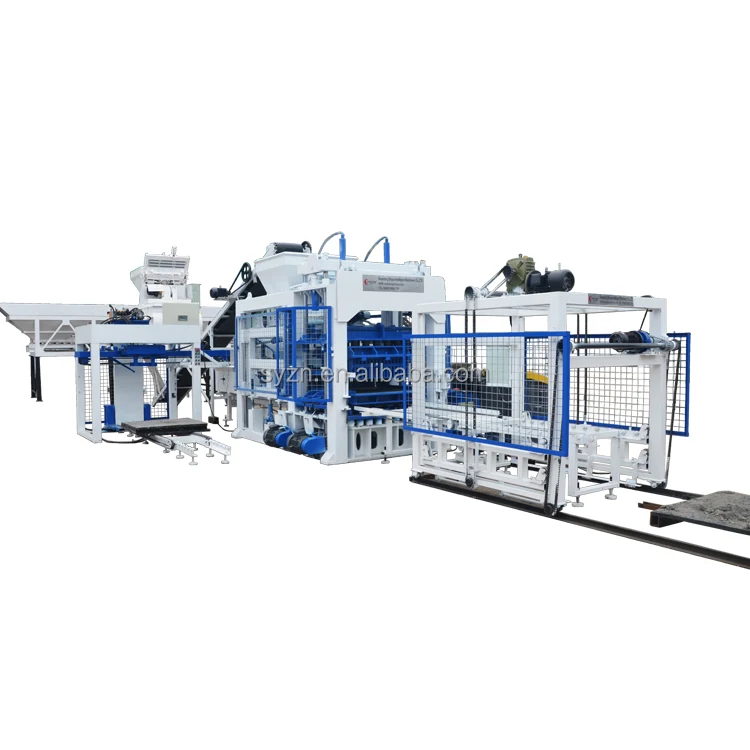
Matched System Integration — Every upstream feeder, mixer, and downstream stacker in this stationary block machine production line is specified against the QT10-15 cycle timing so no station idles while another catches up.
Technical Specifications
| Parameter | Value |
|---|---|
| Model | QT10-15 |
| Product Type | Stationary Automatic Concrete Block Making Machine |
| Vibration Acceleration | 20g |
| Vibration Technology | Dynamic and static table with frequency conversion, four-axis vibration |
| Feeding System | Press-in arch breaker with 360° rotation |
| Vibration Damping | Flexible pressure head damping + adjustable air bag damping in mold box |
| Mould Compatibility | Hollow blocks, interlocking bricks, porous bricks, pavement bricks, slope protection bricks |
| Automation Level | Full automatic |
| Control System | Frequency conversion control |
| Hydraulic Pressure | Source value not stated — confirm with manufacturer |
| Vibration Force | Source value not stated — confirm with manufacturer |
| Pallet Size | Source value not stated — confirm with manufacturer |
| Cycle Time per Format | Source value not stated — confirm with manufacturer |
| Output Capacity | Basis to be confirmed (depends on block format, material, and thickness) |
| Overall Dimensions | Source value not stated — confirm with manufacturer |
| Net Weight | Source value not stated — confirm with manufacturer |
| Rated Power | Source value not stated — confirm with manufacturer |
| Voltage & Frequency | Source value not stated — confirm with manufacturer |
| Mould Change Time | Source value not stated — confirm with manufacturer |
| Standards | CE (implied; verify declaration) |
Application Suitability
| Application | Material or Output |
|---|---|
| Hollow block production for commercial and residential building | Crushed stone, sand, cement, and lightweight aggregates |
| Interlocking brick manufacturing for paving and retaining walls | Graded aggregates with cement binder |
| Porous brick production for permeable urban surfaces | Open-graded aggregate mixes with controlled cement content |
| Pavement brick output for roads and walkways | Dense aggregate blends with high cement ratios |
| Slope protection brick forming for embankments | Heavy aggregate mixes with structural fibre reinforcement |
What "Cycles Per Hour" Leaves Out of Your Line Calculation
A press quoted at a single cycle rate will stall the entire stationary block machine production line the moment upstream batching or downstream pallet handling cannot keep pace.
I have watched lines in West Africa and Southeast Asia where the block press sat idle for several seconds between every cycle because the mixer discharged too slowly, or the pallet return conveyor could not clear cured boards fast enough. The quoted hourly output dropped by a noticeable margin once the full sequence was timed on site [NEED_CITE: real-world line throughput versus quoted cycle rate]. When a buyer evaluates a stationary block machine production line, the honest number is the throughput measured across every station, not the press cycle in isolation.
How the QT10-15 Sits Inside a Connected Line
The QT10-15 press occupies the centre of a stationary block machine production line where raw material feeding, mixing, pallet transport, stacking, and curing rack handling all converge on one timing constraint. The four-axis vibration table with frequency conversion control compacts each mould in a cycle that must be matched by the feeder rotation speed and the pallet feed conveyor rate. If the upstream batch plant delivers mixed material slower than the press hopper empties, the feeder arch breaker cannot maintain its 360° rotation rhythm and the press waits.
Pallet Flow and Downstream Synchronisation
Once a compacted block leaves the mould, the wet product rides a pallet through the stacking station and on to the curing racks. The pallet size chosen for this line must match both the curing area footprint and the forklift capacity the buyer already operates [NEED_CITE: pallet sizing against existing curing infrastructure]. Adjustable air bag damping inside the mould box reduces structural vibration transmission to neighbouring conveyors, protecting the stacking mechanism and the curing rack integrity over long production shifts. When the pallet return loop clears boards back to the press fast enough, the QT10-15 never idles between presses.
Reading the Specs That Matter for Line Balance
Vibration acceleration rated at 20g indicates a high compaction force that shortens the pressing phase of each cycle, shifting the bottleneck upstream to batching and downstream to pallet handling. The press-in arch breaker with 360° rotation feeds material into the mould box from multiple angles, reducing the feed time per cycle and helping the press stay aligned with the mixer discharge rate. Flexible pressure head damping works alongside the adjustable air bag system to isolate vibration from the machine frame, which matters when the press sits on a shared foundation with pallet conveyors and a stacker. Frequency conversion control across the system allows operators to tune motor speeds at each station so the entire stationary block machine production line runs at one coordinated tempo rather than at the speed of its slowest link.
The Hidden Cost of a Press-Only Quotation
When a quotation covers only the press and omits pallet handling, stacking, and curing rack systems, the buyer is left to source those stations separately and integrate timing on site. Mismatched conveyor speeds cause pallets to queue before the stacker, and wet blocks sit too long before entering the curing area, losing surface moisture and compromising strength [NEED_CITE: block curing delay effects on compressive strength]. The additional cost of retrofitting a pallet return loop or replacing a stacker that cannot match the press cycle often exceeds the savings of a press-only quote. Line-level specification from the start avoids this rework.
Why Source the Full Line From One Supplier
Block machinery as a single focus means the QT10-15 press, moulds, pallets, and handling equipment are specified as one matched system rather than assembled from separate vendors. Configuration is set against the buyer’s actual mix design, local aggregate characteristics, and target block format, not a catalogue default. Mould design covers the formats the buyer’s market sells, with custom drawings available for non-standard shapes. Automation level is selectable so a plant can begin semi-automatic and add full stacking and cubing later. Installation support includes operator training on the coordinated line, not just the press in isolation [NEED_CITE: integrated line commissioning versus standalone press setup].
Documentation & Verification
- Line layout drawing showing every station from raw material feeding to cubing with cycle times stated per block format
- Capacity calculation naming the specific block format assumed for daily output projections
- Pallet specification matched to the buyer’s curing area dimensions and forklift capacity
- Voltage, frequency, and PLC display language confirmation sheet for the entire line
- Factory test record on the buyer’s target block format before dispatch
- Hydraulic and electrical schematics for line integration with existing plant infrastructure
Installation, Commissioning & Support
- Foundation plan specifying load points for the QT10-15 vibration table and adjacent pallet conveyors
- Dedicated electrical circuit sized for the press and all line motors at the confirmed voltage and frequency
- Machine dismantling for container loading with reassembly sequence documented for site crews
- First-run parameter setting covering vibration frequency, feeder rotation speed, and pallet feed timing
- Operator training on mould change procedure and frequency conversion control adjustments
- Wear parts and mould list provided with initial spare stock for hydraulic and vibration components
What to Include in Your Inquiry
Share your target block formats, daily output goal, and the local aggregate and cement types available at your site. Confirm the voltage, frequency, and control language required so the entire line is built to match before production begins. Provide your curing area dimensions and existing forklift capacity so pallet sizing is coordinated from the start. If you are integrating the QT10-15 into an existing plant, send details of your current conveyors and curing rack system so the line layout accounts for every connection point.
Frequently Asked Questions
Q: How is the QT10-15 cycle time matched to upstream batching and downstream stacking so the press is not idle between cycles?
A: The line layout specifies the mixer discharge rate, feeder rotation speed, and pallet return conveyor speed against the press cycle for each block format. Frequency conversion control allows motor speeds at every station to be tuned so the full sequence runs without the press waiting for material or pallet clearance.
Q: What pallet size and material does this line require, and can it use the pallets already in the buyer’s curing area?
A: Pallet dimensions are chosen to match the mould size and the buyer’s existing curing rack spacing and forklift capacity. The pallet specification is confirmed during the line layout stage so that new pallets integrate with the current curing infrastructure without requiring facility modifications.
Q: Which stations are included in the line quotation — does it cover raw material feeding, mixing, pallet return, stacking and cubing, or only the press?
A: The quotation covers every station from raw material feeding through to cubing, with each component specified to match the QT10-15 cycle timing. This ensures the buyer receives a complete stationary block machine production line rather than a standalone press that requires separate integration work.
Q: How are voltage, frequency, and control language confirmed across the entire line before shipment?
A: A confirmation sheet covering electrical specifications and PLC display language is signed off before production begins. The electrical schematics provided with the documentation package show how every station connects to the shared control system for coordinated operation.
Q: What is the installation sequence for connecting the QT10-15 to existing conveyors and curing rack systems on site?
A: The foundation is prepared for the press and pallet conveyors first, followed by mechanical installation and alignment of the pallet return loop to the existing curing racks. Electrical connections are completed station by station, and the full line is tested with the buyer’s target block format before handover.


