
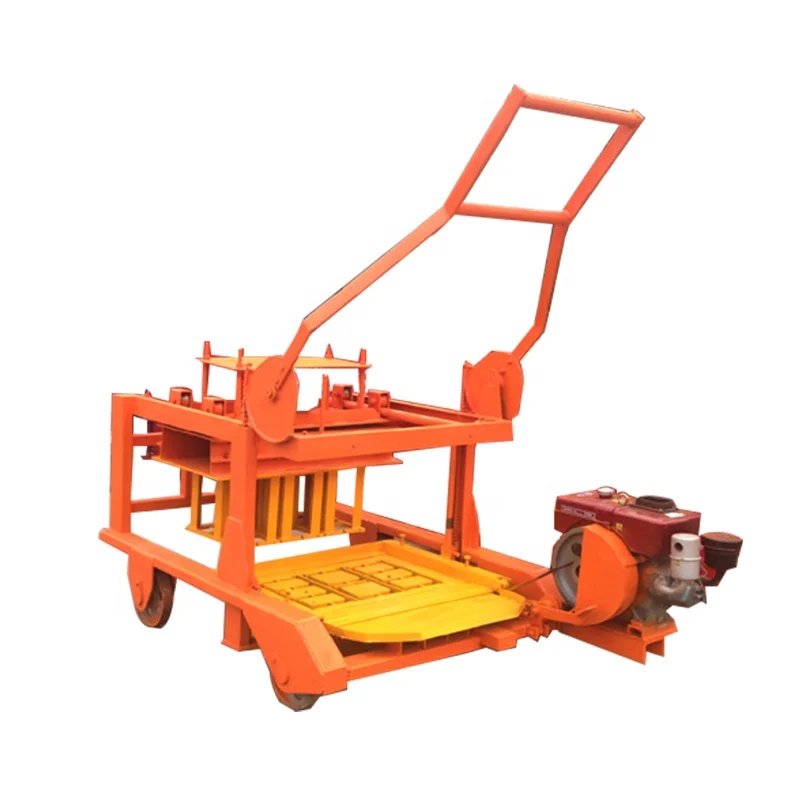
Matched mobile line setup — press, mixer and trolley leave our factory as one coordinated unit so the forming station is never waiting on material mixing or manual transport.
Technical Specifications
| Parameter | Value |
|---|---|
| Model | QMR4-45 |
| Product Type | Mobile Concrete Block Making Machine |
| Power Source | Diesel engine / Petrol engine / Electric motor (selectable) |
| Overall Dimensions (L×W×H) | 1100 × 950 × 2100 mm |
| Net Weight | 810 kg |
| Molding Cycle | 30–45 s |
| Output Capacity | 2560 pcs/day (basis not stated in source — confirm block format / material / thickness) |
| Pallet Requirement | None (egg-laying / mobile type) |
| Compatible Block Formats | Paver brick, hollow block, concrete block, solid brick, fly ash brick |
| Basic Equipment Included | JZC350 diesel concrete mixer or JQ350 diesel concrete mixer with electric generating unit; trolley |
| Automation Level | Manual / Semi-automatic (mobile egg-laying operation) |
| Warranty | 1 Year |
Application Suitability
| Application | Material or Output |
|---|---|
| On-site masonry block production for building contractors | Hollow and solid concrete blocks formed directly on the construction slab without a fixed plant |
| Small-scale paver brick supply for local yards | Interlocking and rectangular paver bricks from crushed stone, sand and cement |
| Fly ash brick production near thermal power plants | Fly ash blended with lime and sand in mobile egg-laying mode |
| Housing project phased construction | Machine relocated between sites as different phases of a development open |
| First plant for entrepreneurs entering the block market | Low-capital start with manual operation, expandable later to pallet-based stationary lines |
What the Quoted Cycle Time Hides When You Change Moulds
A 30–45 s cycle on the QMR4-45 refers to a specific block format and mix consistency — swap to a different mould and both the cycle and daily output shift.
Catalogue sheets for mobile block making machines often quote a single cycle time without naming the block size, vibration duration or concrete slump behind that number. On a project site in the Gulf, I once watched a contractor lose half a shift because the quoted output assumed a thin paver brick while the actual job required a 200 mm hollow block. The mixer kept running but the press could not complete its longer vibration phase fast enough, and material sat in the hopper losing workability [NEED_CITE: effect of concrete slump loss on block forming consistency]. Stating the assumed format up front keeps a mobile block making machine production line plan grounded in what the machine will actually produce on your slab.
How Mixer Output and Press Cycle Must Stay in Step
A mobile block making machine only forms blocks as fast as fresh concrete arrives at its hopper. The QMR4-45 package pairs the press with a JZC350 diesel mixer or a JQ350 electric-unit mixer so batch volume aligns with the 30–45 s moulding cycle. When the mixer batch is too small, the press idles between fills; when it is too large, concrete stiffens before the next cycle. Matching these two stations on paper before the equipment ships prevents the bottleneck that turns a mobile block making machine production line into a single working station surrounded by idle labour.
Why the Egg-Laying Mode Removes a Whole Layer of Handling
Because the QMR4-45 lays blocks directly onto the cured floor, no pallets circulate through the press and no pallet-return conveyor is needed. This eliminates the pallet stacker, pallet feeder and pallet cleaning station that a stationary line requires. For a contractor moving between sites, fewer ancillary items mean faster dismantling, a lighter container load and a smaller curing-area footprint [NEED_CITE: typical pallet handling equipment cost share in stationary block plants]. The trade-off is that the finished blocks remain on the ground until they gain enough strength to be moved, so the casting yard must be level and large enough to hold a full day’s output.
Reading the Specs That Actually Shape Daily Output
The 810 kg net weight of the QMR4-45 keeps the machine portable, yet it also limits the vibration force and hydraulic pressure available compared with a stationary pallet press — a trade-off that directly affects block density and early strength. The 30–45 s moulding cycle therefore includes a longer vibration phase to compensate for the lower static pressure, and the mix design must supply enough fines to allow compaction under these conditions. Dual power source availability, diesel or electric, means the machine can follow the utility situation of each project phase: diesel where grid connections are temporary, electric where site generators already run other equipment. Because no pallet size has to match an existing curing rack or forklift, the contractor can plan the casting yard dimensions freely around the block format being produced.
The Cost of Ignoring the Supporting Stations
When a mobile block making machine production line is ordered as a press only, the contractor must source a mixer, trolley and water supply locally. Mismatched mixer output leaves the press waiting, and a trolley that cannot tip cleanly into the hopper spills material and slows the cycle. These small delays accumulate across a shift and push daily output below the figure the buyer used to justify the purchase [NEED_CITE: common causes of throughput shortfall on small mobile block lines]. Specifying the press, mixer and trolley together avoids the hidden rework cost that appears only after the first week of production.
Why Buyers Source This Mobile Line From Us
Block machinery is our single focus, so the QMR4-45, its mixer and trolley are selected as a matched set rather than assembled from unrelated catalogues. We set the configuration against the buyer’s actual mix design, local aggregate and target block format instead of defaulting to a generic sheet. Moulds for the formats the buyer’s market actually sells — including custom drawings — are offered alongside the machine. Automation level is selectable, so an entrepreneur can start on manual egg-laying and later add a pallet-based stationary line without replacing the entire operation. Installation support and operator training cover both the press and the mixer, keeping responsibility inside one supply chain.
Documentation & Verification
- Line layout stating the block format behind the 2560 pcs/day figure
- Specification sheet confirming diesel or electric power source choice
- Mould drawing and format list showing included and optional moulds
- Voltage, frequency and control language confirmation before dispatch
- Factory test record on the buyer’s selected block format
- Packing photographs and customs documentation for the destination port
Installation, Commissioning & Support
- Level concrete yard prepared to 1100 × 950 mm machine footprint plus curing area
- Power feed matched to selected diesel or electric motor rating and site frequency
- Machine delivered assembled; only mixer and trolley separated for container loading
- First-day commissioning covers mould change procedure and vibration timing adjustment
- Operator training on mix consistency, hopper loading rhythm and egg-laying technique
- Mould and hydraulic wear parts list supplied with initial spare set
What We Need Before Sending a Quotation
Tell us the block format your market buys most, the daily volume you plan to reach and the aggregate sources available near your site. Confirm whether grid power is stable or a diesel setup is preferred, and share the yard dimensions you can allocate for casting and curing. With that information we can calculate the realistic output per format and size the mixer and trolley accordingly.
Frequently Asked Questions
Q: How is the 2560 pcs/day capacity calculated, and how does it change when I switch from hollow block to paver brick?
A: That figure is derived from the 30–45 s cycle and an eight-hour shift, but the exact block format and dimensions behind it are not stated in the source sheet. Switching from a small paver to a larger hollow block lengthens vibration time and reduces daily output. We provide a per-format capacity table once your target block size and mix design are confirmed.
Q: How do the mixer output and press cycle time need to match so the QMR4-45 is not left waiting for material?
A: The JZC350 or JQ350 mixer supplied with the QMR4-45 is sized so one batch arrives at the hopper just as the previous cycle finishes. If the mixer runs too slowly the press idles; if batches are too large the concrete loses workability. We confirm batch volume and mixing time against your selected mould before dispatch.
Q: What supporting equipment should I plan for around a pallet-free mobile machine?
A: Because the QMR4-45 lays blocks directly on the ground, no pallet feeder or return conveyor is needed. You will still need a water supply for curing, a flat yard large enough for a full day’s output and basic hand tools for block movement after initial set. We include these requirements in the line layout.
Q: Can I upgrade from this mobile egg-laying setup to a stationary line with automatic pallet feeding and stacking later?
A: Yes. The QMR4-45 can remain in service for smaller site jobs while a stationary pallet-based line handles higher volume. Because the mixer and material handling logic are already established, adding a pallet press and stacking station is a line extension rather than a full replacement.
Q: What voltage, frequency and control language options are confirmed before shipment?
A: Before production we record your site voltage, frequency and preferred control-panel language, then match the electric motor or generating unit accordingly. This confirmation prevents commissioning delays caused by a motor wound for a different grid standard or an interface the operator cannot read.


