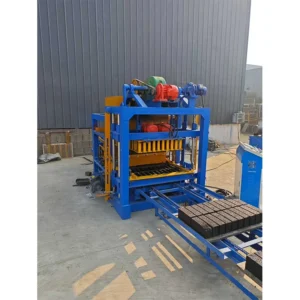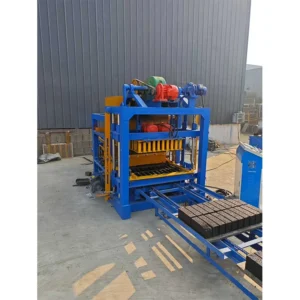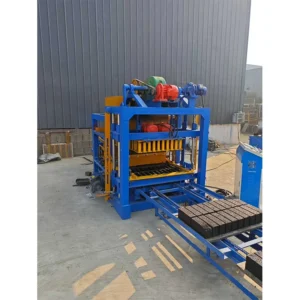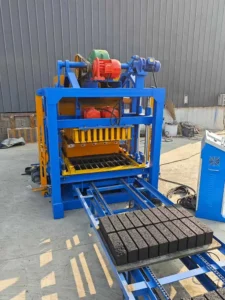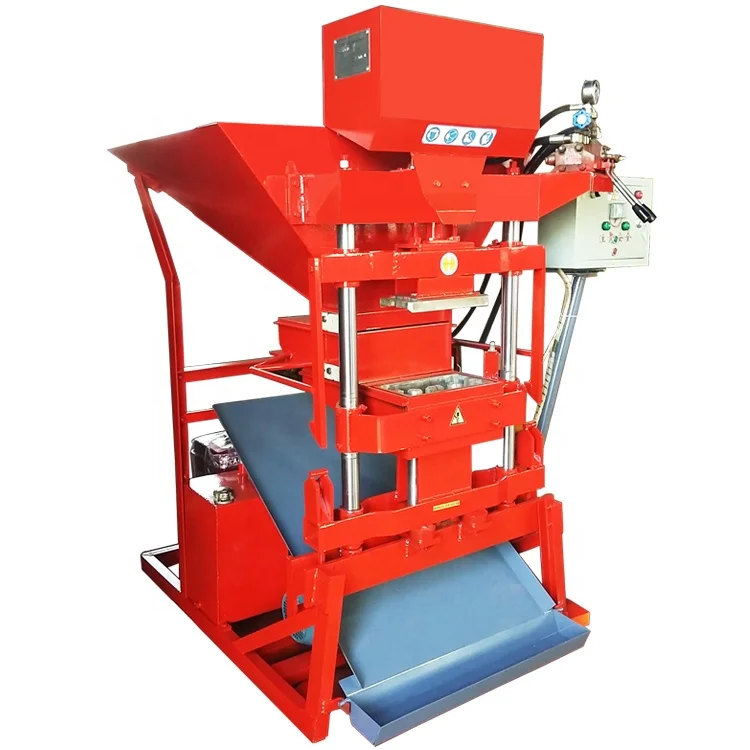
Compact line integration — the ECO 2700 clay block making machine production line / supporting equipment is specified against your workshop footprint and curing area, not quoted as a standalone press that leaves upstream and downstream stations to chance.
Technical Specifications
| Parameter | Value |
|---|---|
| Model | ECO 2700 |
| Product Type | Clay Block Making Machine |
| Rated Power | 5.5 kW |
| Overall Dimensions (L×W×H) | 1000 × 1000 × 1800 mm |
| Net Weight | 1000 kg |
| Hydraulic Pressure | 16 MPa |
| Cycle Time | 15–20 seconds (basis not stated in source — confirm block format / material / thickness) |
| Voltage & Frequency | 380V, 3-phase, 50Hz (customizable to local supply) |
| Automation Level | Manual operation |
| Certification | CE |
| Warranty | 1 year |
Application Suitability
| Application | Material or Output |
|---|---|
| Small-scale clay brick workshop | Locally sourced soil and clay mixes with manual pallet circulation |
| On-site block forming for building contractors | Clay and soil blends pressed in confined construction yard spaces |
| High-density clay brick production | Compacted clay with 16 MPa hydraulic forming for structural use |
What the "One Machine Quotation" Leaves Out of Your Clay Block Line
A press without matched upstream mixing and downstream pallet handling will never reach its cycle time potential.
I once visited a small clay brick operation where the owner had purchased a compact block press at a fair price but received no guidance on what else the line required. Workers were mixing clay by hand in a wheelbarrow while the press sat idle waiting for material. Finished pallets stacked up on the floor because there was no curing rack system planned. The daily clay block making machine production line / supporting equipment output ended up far below what the press was technically capable of delivering [NEED_CITE: block plant bottleneck analysis methodology].
The ECO 2700 completes a cycle every 15 to 20 seconds, but that throughput only matters if a mixer discharges consistent batches at matching intervals and if pallets circulate back to the press without manual bottlenecks. Specifying the press alone gives you a machine, not a working line.
Upstream Mixing Must Match the Press Cycle
The clay block making machine production line / supporting equipment around the ECO 2700 begins with mixing. A pan mixer or twin-shaft mixer must produce a uniform clay batch at a rate that keeps pace with the press cycle. If the mixer takes too long to discharge, the press waits; if the mix is inconsistent in moisture content, the 16 MPa hydraulic pressure will produce blocks of varying density across the same batch. Mixer capacity should be calculated against the number of blocks per pallet and the number of pallets the press handles per hour.
Downstream Pallet Circulation and Curing Coordination
Every pallet that leaves the press carrying freshly formed clay blocks needs a destination. On a small line, this means a defined curing area with rack space sized to hold at least one full day of output before blocks can be moved or sold. Pallets must return to the press feed station in a continuous loop. Without planning the pallet quantity and return path before the ECO 2700 ships, the line stalls at the stacking stage [NEED_CITE: pallet circulation requirements for small block plants].
Reading the Specs That Matter for Line Planning
The 5.5 kW rated power tells you the ECO 2700 places modest demand on a workshop’s electrical supply, but the total line power must include the mixer, any conveyor motors, and lighting for the curing area — all sized for the buyer’s local voltage and frequency before shipment. The 1000 × 1000 × 1800 mm footprint is compact enough for a restricted workshop, yet the surrounding line needs clear floor space for pallet staging and mixer placement on either side. The 16 MPa hydraulic pressure sets a baseline for block density, but that density only materializes when the clay mix arrives at the mold with consistent moisture and particle distribution from upstream processing.
The Cost of Leaving Stations Off the Order
Buyers who receive a quotation covering only the press often discover after delivery that pallet handling, stacking, and curing infrastructure were never discussed. The result is workers moving heavy wet pallets by hand, which slows the cycle and introduces drop damage [NEED_CITE: manual handling losses in block production]. Pallets ordered separately may not match the press feed dimensions, causing jams or misalignment during pressing. Without a line capacity calculation tied to a specific block format, the buyer cannot verify whether the stated cycle time translates into realistic daily volume.
Why Specifying the Full Line Here Matters
The ECO 2700 and its supporting equipment are configured as one matched system rather than sourced from separate suppliers who cannot guarantee station-to-station timing. Line layout and capacity calculations state the block format assumed, so buyers know exactly what throughput to plan around. Pallet size, material, and circulation quantity are confirmed against the buyer’s existing curing area and handling method before production begins. Voltage, frequency, and control language are locked in at the quotation stage to prevent delays after the equipment arrives on site [NEED_CITE: commissioning delays from electrical mismatches].
Documentation & Verification
- Line layout drawing showing ECO 2700 placement relative to mixer and curing racks
- Capacity calculation sheet stating the block format behind the cycle time figure
- Pallet specification matched to press feed dimensions and curing area capacity
- Voltage and control language confirmation signed before production release
- Factory test record with all line stations running at matched cycle intervals
Installation, Commissioning & Support
- Foundation pad leveled to support the 1000 kg ECO 2700 weight without vibration transfer
- Dedicated 3-phase electrical circuit sized for 5.5 kW press plus mixer and auxiliary motors
- Machine delivered assembled; pallet return tracks and curing racks configured on site
- First production run supervised to verify mixer discharge timing against press cycle
- Operator training covers mold change procedure and pallet circulation discipline
- Wear parts list provided for hydraulic seals and mold surfaces at handover
Preparing Your Line Inquiry
To specify the clay block making machine production line / supporting equipment around the ECO 2700 accurately, share your target block dimensions, the clay or soil material available locally, and the workshop floor area you have allocated. Include your site voltage and frequency so that the press and all supporting motors can be wound and configured before shipment. If you already have a mixer or curing racks in place, provide their specifications so the line proposal accounts for existing infrastructure.
Frequently Asked Questions
Q: What stations are needed around the ECO 2700 to form a complete clay block line?
A: Beyond the press itself, a working line requires a mixer sized to discharge batches at press cycle intervals, a pallet feed station to deliver empty pallets continuously, a defined curing area with rack capacity for daily output, and a pallet return path. Each station must be specified together so no single point constrains the throughput the ECO 2700 can technically achieve.
Q: How must mixer batch size and discharge rate match the press cycle?
A: The mixer must produce enough uniform clay per batch to fill the mold for the number of pallets the press processes between discharges. If the ECO 2700 cycles every 15 to 20 seconds, the mixer should complete and discharge a batch before the press exhausts the previous one. Moisture consistency across each batch is equally critical to maintaining block density under 16 MPa pressure.
Q: What pallet size and circulation quantity does a continuous line require?
A: Pallet dimensions must match the ECO 2700 mold feed area exactly. The total quantity in circulation should cover the number of pallets in the press, on the curing racks, and returning to the feed station simultaneously. Underestimating pallet count forces the press to idle while workers retrieve pallets from the curing area.
Q: Is the 5.5 kW power supply sufficient for the full line, or only the press?
A: The 5.5 kW rating covers the ECO 2700 press alone. The mixer motor, any conveyor drives, and workshop utilities add to the total electrical load. Your line proposal should include a combined power calculation so that the site transformer and dedicated circuits can support all stations running simultaneously at your local voltage and frequency.
Q: How is curing rack handling and stacking integrated when daily output scales up?
A: At small scale, workers move pallets to racks manually. As output grows, a roller conveyor or rack shuttle can transfer pallets from the press exit to the curing zone without manual carrying. The curing rack capacity must expand in step with the line throughput so finished blocks remain undisturbed for the required setting time before demolding or sale.