
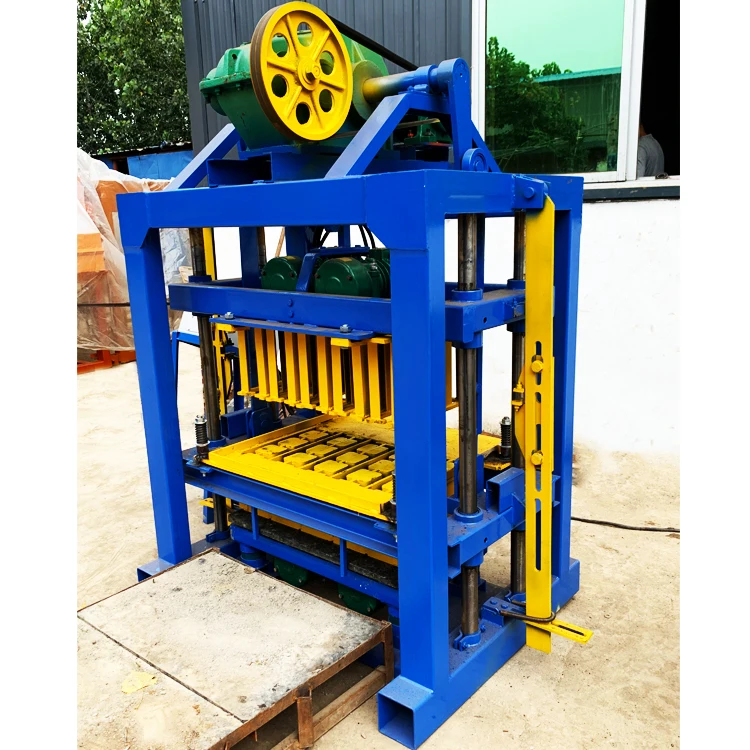
Matched Line Configuration — the QTJ4-40 semi-automatic press is specified alongside its mixer, pallet and handling stations so cycle times align across the entire block production setup.
Technical Specifications
| Parameter | Value |
|---|---|
| Model | QTJ4-40 |
| Product Type | Semi-Automatic Concrete Block Making Machine |
| Overall Dimensions (L×W×H) | 1350 × 1460 × 1800 mm |
| Net Weight | 1.2 T |
| Rated Power | 10.4 kW |
| Molding Cycle | 40 s |
| Vibration System | Bed mould vertical vibration + upper mould compression vibration |
| Pallet Size | 850 × 450 × 20 mm |
| Mould Format | Hollow, solid, paver (8", 6", 5", 4" nominal) |
| Automation Level | Semi-automatic |
| Raw Material Compatibility | Concrete, sand, cement, fly ash, lime, gypsum |
| Voltage | Configured to local voltage and frequency (basis to be confirmed) |
| Output — Hollow 400×200×200 mm | 4 pcs/mould, 360 pcs/h, 2 880 pcs/day (based on 400×200×200 mm hollow block) |
| Output — Hollow 400×150×200 mm | 5 pcs/mould, 450 pcs/h, 3 600 pcs/day (based on 400×150×200 mm hollow block) |
| Output — Solid 225×112.5×60 mm | 9 pcs/mould, 800 pcs/h, 6 400 pcs/day (based on 225×112.5×60 mm solid block) |
| Assembly State | Host machine, block mould, pallets (mixer optional) |
Application Suitability
| Application | Material or Output |
|---|---|
| Small-to-medium block plant | Hollow and solid concrete blocks from local aggregate, sand and cement |
| On-site contractor production | Hollow blocks for housing or development projects using site-available sand and fly ash |
| First block plant setup | Pavers and solid blocks from cement, sand and crushed stone |
| Existing manufacturer adding formats | Smaller solid block and paver sizes alongside current hollow block range |
Why "2 500 Pieces per Shift" Rarely Matches Reality
A capacity figure means nothing until the block format behind it is named.
Buyers often receive a single daily output number on a semi-automatic block making machine production line quotation, only to find real throughput falls short once their specific block size enters the mould. The discrepancy grows wider when pallet handling, mixer discharge rate and curing rack turnover are not calculated together [NEED_CITE: common causes of block line output shortfall]. When one station runs faster than the press, material piles up; when the press outruns the mixer, every cycle waits for the next batch.
Stations That Must Keep Pace with a 40-Second Cycle
The QTJ4-40 completes one moulding cycle every 40 seconds, which sets the tempo for every upstream and downstream station. A pan mixer must discharge a full batch within that window, and the pallet feeder must deliver the next pallet before the press is ready to close. If any station lags, the Semi-Automatic Block Making Machine production line accumulates idle seconds that add up across an eight-hour shift.
Where the Line Bottlenecks First
In my experience configuring block lines across Shandong workshops, the mixer is usually the first station to fall behind. A mixer sized for a larger press may discharge too slowly for a 40-second cycle, while an undersized unit forces the operator to wait. Pallet return conveyors also introduce delays when their travel speed is not matched to the press rhythm [NEED_CITE: belt conveyor speed matching in block production]. Aligning these intervals at the design stage removes the most common source of unplanned downtime.
Reading the Specifications Behind the Output Numbers
The rated power of 10.4 kW is split between the vibration motor and the hydraulic clamping system. Dual vibration — vertical excitation beneath the bed mould combined with compression vibration from the upper mould — compacts the concrete mix from both directions, which improves block density without requiring higher hydraulic pressure. The 850 × 450 × 20 mm pallet size determines how many blocks cure on each rack tier; choosing a pallet dimension that fits the buyer’s existing forklift and curing area avoids costly retrofits later. Mould formats covering 8-inch to 4-inch nominal sizes allow the same host machine to produce hollow blocks, solid blocks and pavers by swapping the mould box, though each swap requires the operator to re-align the vibration heads.
The Hidden Cost of Skipping Line-Level Planning
When a semi-automatic block making machine production line is ordered as a standalone press and connected to mismatched auxiliary equipment, the first symptom is usually inconsistent block weight. Vibration energy dissipates if the pallet arrives late and the mix sits in the hopper too long. Over weeks, uneven compaction leads to breakage during curing, and the buyer blames the press rather than the upstream timing gap [NEED_CITE: block breakage causes related to feed timing]. Rectifying these issues after installation means rewiring PLC signals, adjusting conveyor lengths and re-training operators — work that could have been prevented by specifying the entire line together.
Why Buyers Source the Full Line Here
Block machinery is our single focus, so the QTJ4-40 press, its mould, pallet and supporting handling equipment are specified as one matched system. Configuration starts with the buyer’s actual mix design and local aggregate, not a catalogue default. Mould designs cover the formats the buyer’s market demands, and custom drawings are available when standard sizes do not fit. Automation level is selectable: a buyer can begin with semi-automatic pallet handling and add automatic stacking later. Installation support includes on-site commissioning and operator training so the line reaches stable output from the first shift.
Documentation & Verification
- Line layout with capacity calculation stating the block format assumed for each output figure
- Machine specification sheet confirming rated power, pallet size and vibration type
- Mould drawing and format list covering every hollow, solid and paver size in the order
- Pallet specification detailing material, thickness and compatibility with existing curing racks
- Voltage and control language confirmation record signed before production begins
- Factory test record on the buyer’s chosen block format before dispatch
Installation, Commissioning & Support
- Foundation pad must accommodate the 1350 × 1460 mm footprint with clearance for pallet return
- Dedicated 10.4 kW circuit required; voltage and frequency confirmed against local supply before wiring
- Host machine ships assembled; mould box and pallet stack arrive separately for on-site mounting
- First-day commissioning includes vibration amplitude tuning to the buyer’s mix and aggregate
- Operator training covers mould change procedure, pallet alignment and daily lubrication points
- Wear parts list and mould inventory provided for the first replacement cycle
Planning Your Line Inquiry
To move from a general interest to a workable proposal, we need your target block format and daily output requirement, the raw materials available at your site, and the curing area dimensions you have planned. Confirming local voltage, frequency and preferred control language early prevents commissioning delays. Let us also know whether you already have a mixer or conveyor in place so the Semi-Automatic Block Making Machine production line can be configured around your existing equipment.
Frequently Asked Questions
Q: How is daily output calculated and which block format does each figure assume?
A: Every output figure on this page is tied to a specific block size. For example, 2 880 pieces per day assumes 400 × 200 × 200 mm hollow blocks at four per mould, while 6 400 pieces per day assumes 225 × 112.5 × 60 mm solid blocks at nine per mould. No single "up to" number is quoted without its format.
Q: What stations surround the press and how must their cycle times match the 40-second moulding cycle?
A: The mixer, pallet feeder, host machine and curing rack handler each have a cycle time. If the mixer takes longer than 40 seconds to discharge, the press idles. We calculate each station’s timing during layout design so no station waits on another.
Q: Is the mixer included or can I use my existing one, and what capacity must it deliver per cycle?
A: The mixer is optional. If you supply your own, it must discharge a full batch within the 40-second moulding window. We confirm the required batch volume based on your chosen mould size and block density target.
Q: What pallet material options are available and how do they integrate with my curing area?
A: Pallets ship at 850 × 450 × 20 mm in bamboo, PVC or steel depending on block weight and curing method. We match the pallet to your existing forklift tine spacing and curing rack slot width to avoid modification.
Q: How is voltage, frequency and PLC display language confirmed before the line ships?
A: A confirmation sheet listing voltage, frequency and control panel language is signed by the buyer before production starts. This prevents rewiring and reprogramming work after the equipment arrives on site.


