
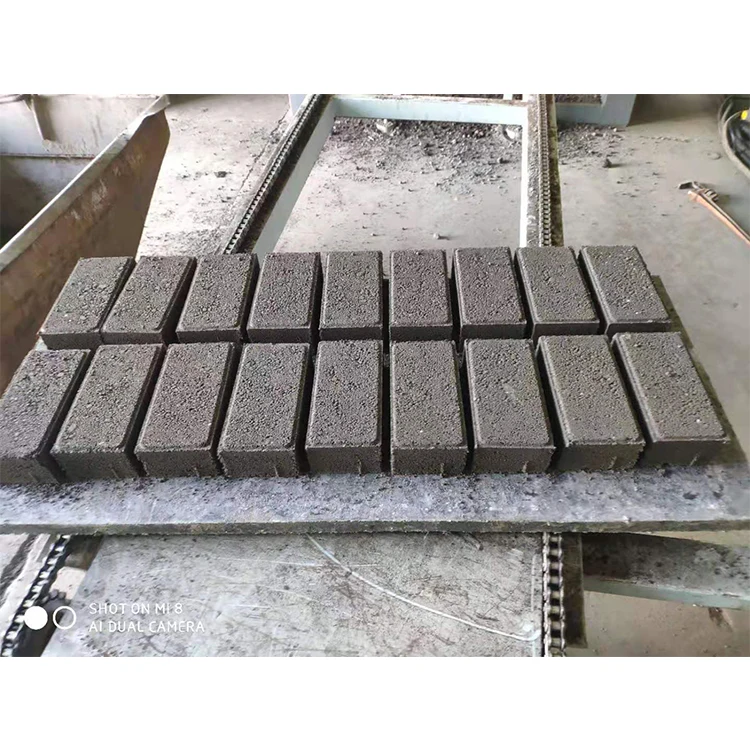
Stationary block machine turnkey — Every upstream and downstream station from batching through curing is timed to the QT5-15 press cycle, so the line runs as one matched system rather than a collection of independent machines.
Technical Specifications
| Parameter | Value |
|---|---|
| Model | QT5-15 |
| Product Type | Fully Automatic Hydraulic Block Making Machine |
| Overall Dimensions (L×W×H) | 7400×1950×2800mm |
| Rated Hydraulic Pressure | 21 MPa |
| Vibration Form | Platform Vibration |
| Vibration Frequency | 2800~4500 r/min |
| Pallet Size | 1100×550mm |
| Molding Cycle | 15-25s |
| Overall Power | 26.5 kW |
| Demolding Method | Hydraulic |
| Automation Level | Fully Automatic |
| Control System | PLC Engine Control System |
| Output Capacity (Hollow brick 400×200×200mm) | 1800 pcs/h (basis: 5 pcs/mold, 16-20s cycle) |
| Output Capacity (Hollow block 400×150×200mm) | 1300 pcs/h (basis: 6 pcs/mold, 15-20s cycle) |
| Output Capacity (S paver 225×112.5×60mm) | 3700 pcs/h (basis: 16 pcs/mold, 15-17s cycle) |
| Applied Products | Concrete blocks, hollow/solid blocks, pavers, interlocking blocks, curbstone, colored pavers |
| Raw Material | Crushed stone, sand, cement, dust, fly ash, gravel, slag |
| Voltage & Frequency | Configurable (basis to be confirmed) |
| Net Weight | (basis to be confirmed) |
Application Suitability
| Application | Material or Output |
|---|---|
| Hollow block production for building walls | Crushed stone, sand, cement, fly ash |
| Solid block manufacturing for load-bearing structures | Gravel, sand, cement, slag |
| Paver and interlocking brick production for landscaping | Cement, dust, colored aggregates |
| Curbstone production for road and infrastructure projects | Heavy aggregate mixes, cement |
| On-site production for housing development projects | Locally sourced sand, stone, cement |
Why Quoted Line Capacity Rarely Matches Actual Daily Output
A press rating only matters if every station feeding it and taking from it can keep pace.
When a block production line equipment proposal lists a single hourly figure without stating which block format and cycle time it assumes, the number is meaningless for daily planning. I have seen lines where the mixer batch size was too small for the press cycle, leaving the QT5-15 waiting empty for thirty seconds every cycle. [NEED_CITE: common causes of throughput shortfall in block production lines] Over a ten-hour shift, those gaps erase thousands of blocks from the day’s output. The block production line equipment must be specified station by station, with cycle times matched across the entire chain.
Matching Station Cycle Times Across the Block Line
The QT5-15 molding cycle runs between 15 and 25 seconds depending on the block format and mix design. Every upstream station — raw material feeding, batching, mixing — must deliver a fresh batch to the hopper within that window. Every downstream station — pallet feeding, block stacking, curing rack handling — must clear the finished pallet before the next cycle begins. When any station runs slower than the press, the entire block production line equipment system drops to the pace of its slowest link.
How Pallet Flow Determines Real Throughput
The 1100×550mm pallet is the physical link that connects every station in the line. Pallets must be fed to the press, loaded with wet blocks, transported to the curing area, stripped after curing, cleaned, and returned. If the curing rack spacing does not match the pallet dimensions, or the forklift capacity cannot handle a loaded rack, pallets pile up and the press stops. [NEED_CITE: pallet handling bottlenecks in concrete block plants] Specifying pallet size and material against the buyer’s existing curing infrastructure is a mandatory step before the line is finalized.
Reading the Specifications for Production Reality
The 21 MPa rated hydraulic pressure works together with the platform vibration at 2800~4500 r/min to compact the mix into the mold. Higher vibration frequency densifies fine aggregates, while hydraulic pressure ensures the block holds its shape during demolding. The 26.5 kW overall power must be matched by a stable supply at the correct voltage and frequency — a detail confirmed before production, not after arrival. The 7400×1950×2800mm footprint determines the minimum building envelope and foundation requirements for the stationary block machine turnkey installation.
The Hidden Cost of Stations That Do Not Talk to Each Other
When the mixer, pallet feeder, and stacker are sourced from separate suppliers without a single line layout tying them together, mismatched cycle times become the buyer’s problem to solve on site. I have watched a pallet feeder that could not keep up with a 16-second press cycle force the operator to manually insert pallets every third cycle, cutting actual output well below the quoted figure. [NEED_CITE: integration failures in multi-supplier block lines] These mismatches are invisible in individual machine quotations and only appear when the full line runs under load.
Why the Line Is Specified as One System
Block machinery is our single focus, which means the press, molds, pallets, and handling equipment are configured together against the buyer’s actual mix design and target block format. The line layout and capacity calculation state the exact block format assumed for every throughput figure, so there is no guesswork about daily output. Pallet specification is matched to the curing area dimensions and forklift capacity the buyer already has on site. Voltage, frequency, and PLC display language are confirmed before production begins. Automation level is selectable, allowing a buyer to start with semi-automatic pallet handling and move to fully automatic stacking and cubing as production volume grows. [NEED_CITE: automation upgrade paths in block production] Molds are designed for the specific formats the buyer’s market sells, including custom drawings when standard formats do not match local demand.
Documentation & Verification
- Line layout drawing with capacity calculation stated per block format and cycle time
- Machine specification sheet covering hydraulic pressure, vibration frequency, and power rating
- Pallet specification matched to buyer’s curing rack spacing and forklift capacity
- Voltage, frequency, and PLC display language confirmation sheet signed before production
- Hydraulic and electrical schematic for on-site maintenance reference
- Factory test record on buyer’s target block format before dispatch
Installation, Commissioning & Support
- Foundation plan sized to the 7400×1950×2800mm machine footprint and dynamic vibration loads
- Dedicated power circuit rated for the 26.5 kW overall power draw at confirmed voltage and frequency
- Machine dismantled into press, mixer, and handling modules for container loading and reassembled on site
- First-run commissioning includes cycle timing verification across every station in the line
- Operator training covers mold change procedure, PLC navigation, and daily maintenance checkpoints
- Wear parts list with hydraulic seals and vibration components identified for first reorder cycle
What to Share When Requesting a Line Proposal
To size a block production line equipment configuration accurately, share the block formats your market sells, the daily output target for each format, and the raw materials available locally including aggregate type and grading. Confirm the voltage and frequency standard at your site, the PLC display language your operators need, and the curing area dimensions you have or plan to build. If you already own forklifts or handling equipment, provide their capacity so pallet and rack specifications can be matched.
Frequently Asked Questions
Q: How is line capacity calculated and which block format is assumed in the quoted throughput?
A: Every throughput figure is stated with the specific block format, mold cavity count, and cycle time it assumes. For example, 1800 pieces per hour is based on a 400×200×200mm hollow block at five pieces per mold with a 16-20 second cycle. The line layout document lists capacity for each format the buyer plans to produce, so daily planning uses real numbers rather than a single peak rating.
Q: How do upstream stations match the QT5-15 cycle time so the press is never left waiting?
A: The mixer batch volume, feeder conveyor speed, and hopper capacity are all calculated against the 15-25 second molding cycle window. If the press runs a 16-second cycle on pavers, the mixer must deliver a full batch within that interval. Every station timing is documented in the line layout before the equipment enters production.
Q: What pallet size and material are specified, and how do they align with existing equipment?
A: The standard 1100×550mm pallet dimension determines curing rack spacing, forklift tine width, and stacking station geometry. Pallet material — bamboo, PVC, or steel — is selected based on the curing method and expected service life. Before finalizing the order, the buyer’s existing curing area and handling equipment are reviewed to confirm compatibility.
Q: Which automation level is included in the line quotation?
A: Automation is selectable from manual pallet handling through fully automatic stacking and cubing. A buyer can start at a semi-automatic level with manual pallet return and upgrade the stacking and cubing stations later as production volume increases. The quotation clearly states which stations are automatic and which require operator involvement.
Q: How is voltage, frequency, and control language confirmed before shipment?
A: A confirmation sheet listing the exact voltage, frequency, and PLC display language is signed by the buyer before production begins. This prevents the common situation where a machine arrives on site and the electrical supply or control interface does not match local standards, delaying commissioning by days or weeks.


