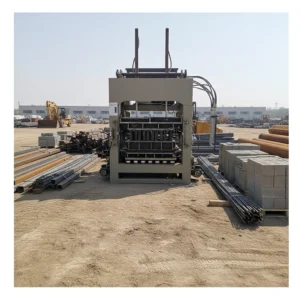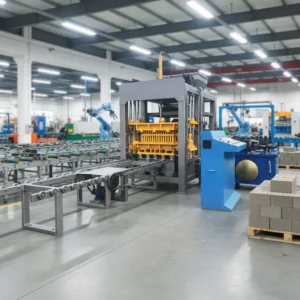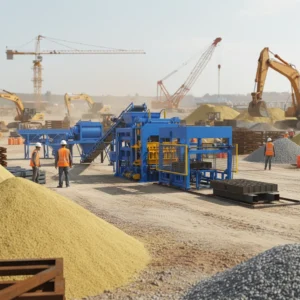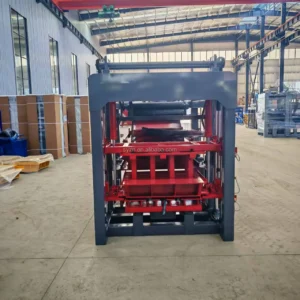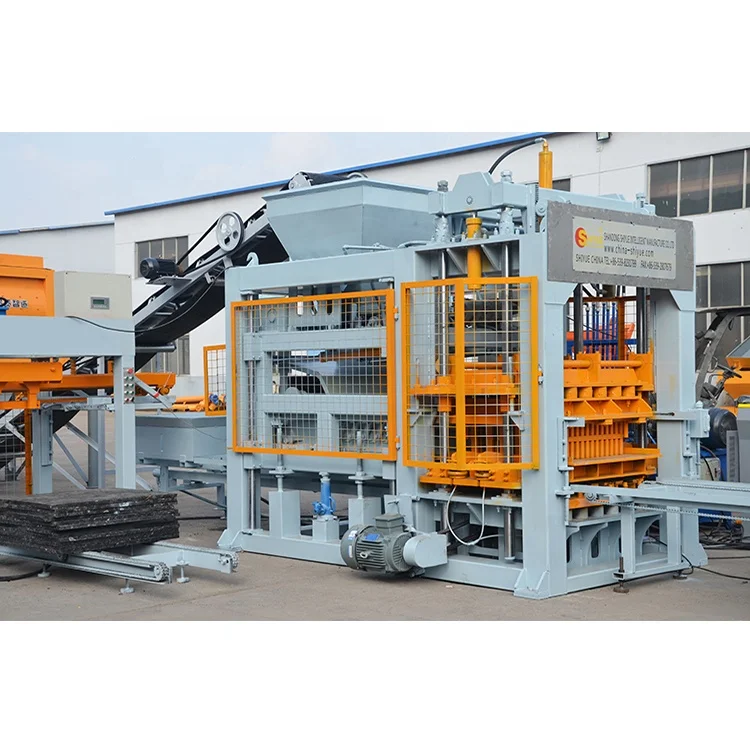
Balanced Line Integration — the QT6-15 block making machine production line is specified as a coordinated system where the JS750 mixer batch size, 1020×900 mm pallet feeder, and block conveyor cadence are calculated so the press never waits for material or pallets during continuous operation.
Technical Specifications
| Parameter | Value |
|---|---|
| Product Type | Automatic Hydraulic Concrete Block Making Machine |
| Model | QT6-15 |
| Overall Dimensions (L×W×H) | 8300×1860×3000 mm |
| Cycle Time | 15–20 s (basis not stated in source) |
| Vibration Force | 55 kN |
| Rated Power | 37.2 kW |
| Mixer Model | JS750 |
| Pallet Size | 1020×900 mm |
| Net Weight | 8 T |
| Control System | PLC control system |
| Automation Level | Automatic |
| Applied Products | Paver, solid block, hollow block, curbstone |
| Raw Materials | Crushed stones, sand, cement, dust, fly ash |
| Hydraulic Station | Included |
| Pallet Feeder | Included |
| Material Feeder | Included |
| Block Conveyor | Included |
| Block Sweeper | Included |
| Mould | Included |
Application Suitability
| Application | Material or Output |
|---|---|
| Hollow block production for structural walls | Crushed stone, sand, cement, fly ash |
| Solid block manufacturing for load-bearing masonry | Aggregates blended with cement and stone dust |
| Paver and interlocking block for walkways and yards | Fine sand and cement with pigment additives |
| Curbstone pressing for roadside infrastructure | Coarse aggregate with high cement content |
What the Cycle Time Figure Never Tells You About Your Daily Output
A cycle time only becomes real throughput when every upstream and downstream station is matched to the same rhythm.
Sellers quote a block making machine production line by its press cycle alone — fifteen to twenty seconds per mould drop — and buyers assume the math is straightforward. But a mixer that batches slower than the press consumes material means the press sits idle between cycles. A pallet feeder that cannot keep the rail loaded means the press operator manually pulls pallets. I saw a QT6-15 line in a West African yard where the host machine was rated for consistent output, yet the plant consistently fell short because the JS750 mixer had not been matched to the press cadence and the conveyor was pulling blocks slower than the press released them. [NEED_CITE: concrete block plant throughput calculation methodology]. The loss is never visible on the specification sheet.
How Each Station Must Match the Press Cadence
A turnkey concrete block plant operates as a chain, and the press is the station that sets the tempo. The JS750 twin-shaft mixer must discharge a batch large enough to fill the hopper for the next moulding cycle before the current cycle completes. If the mixer is undersized, the material feeder starves and the press pauses — a pattern that repeats hundreds of times per shift and quietly erodes daily output. This block making machine production line includes the material feeder and block sweeper in the same specification so that no station is left to be sourced separately.
Pallet Flow and Curing Rack Alignment
The 1020×900 mm pallet size on the QT6-15 determines more than mould capacity. It dictates the curing rack slot width, the forklift tine spacing needed to move stacks, and the square footage of the curing yard. When pallets arrive at the plant but the curing racks were built for a different dimension, every wet block must be manually transferred off the pallet before curing — negating the reason an automatic line was purchased in the first place. [NEED_CITE: pallet dimension coordination in block plant layout]. Line layout must lock pallet size from the press through to the curing area before any equipment is fabricated.
Reading the Specification Sheet Against Real Aggregate Conditions
The 55 kN vibration force works in concert with hydraulic pressure to compact the mix into a dense block. However, the actual block strength depends on how well that force pair matches the buyer’s local aggregate grading and cement content. A high proportion of fine dust in the sand requires more vibration energy to consolidate, while coarse crushed stone demands greater hydraulic clamping pressure. The QT6-15 includes both a hydraulic station and PLC control, but the settings must be tuned to the specific raw material blend available at the project site — crushed stones, sand, cement, dust, and fly ash behave very differently from one region to the next. A factory test record run on generic aggregate means little if the on-site material is significantly different.
When One Mismatched Station Costs You the Entire Shift
Oversizing the press while undersizing the supporting stations is the most common layout error I encounter. A buyer specifies the highest-tier host machine but treats the mixer, conveyor, and pallet feeder as commodity items. The result is a press that could produce more blocks if the rest of the line could keep up, yet the daily tally never reflects that capacity. On a recent project, the pallet feeder jammed because the pallet thickness tolerance did not match the feeder rail gap — a mismatch that was not caught until the first production week. [NEED_CITE: block plant downtime causes from supporting equipment mismatch]. These failures never appear in the quotation comparison.
Why the Line Must Be Quoted as One System
Every component of the QT6-15 block making machine production line is specified together because separation invites mismatch. The JS750 mixer, pallet feeder, material feeder, block conveyor, block sweeper, and mould are all included in the same line quotation so that cycle timing is validated across every station before fabrication begins. This turnkey concrete block plant approach means the buyer receives a hydraulic and electrical schematic showing how the PLC control system sequences each station, rather than a collection of standalone machines that must be integrated on site.
Documentation & Verification
- Line layout drawing with capacity calculation per block format and per station
- Hydraulic and electrical schematic showing PLC control sequence across all stations
- Factory test record run with actual mould installed on the complete line
- Pallet specification sheet confirming 1020×900 mm size and material grade
- Machine specification covering press, mixer, feeder, and conveyor as one system
Installation, Commissioning & Support
- Foundation plan sized for the 8300×1860 mm footprint and 8 T operating weight
- Power supply confirmation for the 37.2 kW rated load on three-phase supply
- JS750 mixer and press assembled and aligned as one line on arrival
- PLC control language and display confirmed before electrical commissioning
- Operator training on mould change, pallet loading, and daily maintenance points
- Hydraulic and vibration wear parts list supplied at dispatch
What We Need Before Quoting Your Line
A block making machine production line can only be sized when the target block format, local aggregate type, and daily output expectation are known. Please provide the block formats you sell, the raw materials available on your site, and the curing yard area you can allocate. With these details, each station from the JS750 mixer to the block conveyor can be matched to deliver balanced throughput.
Frequently Asked Questions
Q: How is line capacity calculated and what block format is assumed?
A: Capacity for each station on the QT6-15 line is calculated based on a specific block format and cycle time. The press cycle, mixer batch volume, pallet feeder speed, and conveyor rate must all be stated for the same format — typically a standard hollow block — before daily output can be estimated. Without a format reference, any throughput figure is incomplete.
Q: How are the mixer batch size and press cycle coordinated?
A: The JS750 mixer must discharge enough material to fill the press hopper before the current moulding cycle ends. If the batch is too small or the mixing time too long, the press waits between cycles. The block making machine production line is configured so that mixer output matches press consumption at the rated cycle time.
Q: What pallet size and curing rack setup match this line?
A: The QT6-15 runs 1020×900 mm pallets, which means the curing rack slots, forklift tine spacing, and yard layout must all accommodate that dimension. The line quotation includes pallet specifications so the buyer can verify curing area compatibility before the pallets are manufactured.
Q: How does the PLC sequence the line stations together?
A: The PLC control system on this turnkey concrete block plant integrates the material feeder, press, pallet feeder, block sweeper, and block conveyor into one automated sequence. Each station triggers the next based on sensor feedback, so the press does not cycle until a pallet is in position and the hopper is charged.
Q: What supporting equipment is included and what must be sourced separately?
A: The QT6-15 line includes the hydraulic station, JS750 mixer, pallet feeder, material feeder, block conveyor, block sweeper, and mould. The buyer must arrange curing racks, a forklift matched to the 1020×900 mm pallet, and water supply for the mixer and curing area.