
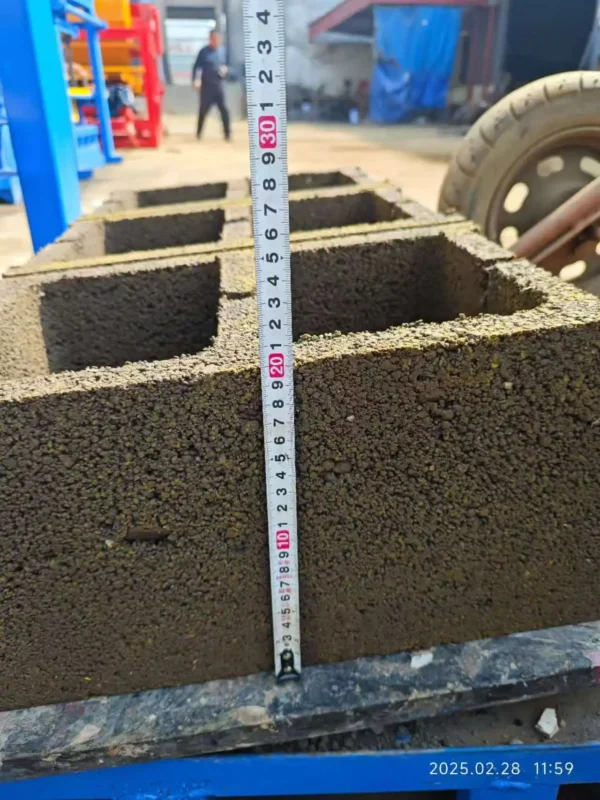
Matched Line Integration — Every station from mixer to pallet feeder is timed against the QTJ4-40’s 40-second molding cycle before dispatch, preventing the press from sitting idle waiting for upstream material.
Technical Specifications
| Parameter | Value |
|---|---|
| Model | QTJ4-40 |
| Product Type | Stationary Block Machine |
| Overall Dimensions (L×W×H) | 1350 × 1460 × 1800 mm |
| Machine Weight | 1.2 T |
| Machine Power | 10.4 kW |
| Molding Cycle | 40 s |
| Vibration Type | Bed mould vertical vibration with upper mould compression vibration |
| Pallet Size | 850 × 450 × 20 mm |
| Automation Level | Semi-automatic |
| Output Capacity (Hollow Block 400×200×200 mm) | 360 pcs/h, 2,880 pcs/day based on 4 pcs/mould |
| Output Capacity (Hollow Block 400×150×200 mm) | 450 pcs/h, 3,600 pcs/day based on 5 pcs/mould |
| Output Capacity (Solid Block 225×112.5×60 mm) | 800 pcs/h, 6,400 pcs/day based on 9 pcs/mould |
| Raw Materials | Concrete, sand, cement, fly ash, lime, gypsum |
| Voltage | Configurable to local supply (rating to be confirmed) |
Application Suitability
| Application | Material or Output |
|---|---|
| 8-inch hollow block production for load-bearing walls | Crushed stone, cement, sand mix |
| 6-inch hollow block for partition and infill walls | Fly ash, cement, sand blend |
| Solid paving brick for walkways and yards | Cement, sand, fine aggregate |
| 4-inch and 5-inch block for residential construction | Local aggregate with cement binder |
| Small to medium plant setup with room to expand | Semi-automatic line with future upgrade path |
Why the "Pieces per Hour" Figure Can Mislead Your Stationary Block Machine Production Line
Cycle time only means something when every station around the press can keep the same rhythm.
I once watched a block plant lose an entire week of output because the mixer fed material slower than the press could consume it. The QTJ4-40 was cycling fine, but it sat idle for half of every molding sequence waiting for the hopper to fill. That is the kind of mismatch no catalogue spec sheet warns you about [NEED_CITE: line synchronization principles for block production]. When buyers compare stationary block machines purely on quoted output, the supporting stations — mixer throughput, pallet feed rate, curing rack capacity — rarely enter the conversation until commissioning day reveals the bottleneck.
How Each Station Connects to the Press
A stationary block machine production line is only as fast as its slowest link. The QTJ4-40 completes a molding cycle every 40 seconds, which means the upstream mixer must deliver a fresh batch within that same window and the downstream pallet feeder must present a clean pallet before the press opens. When these intervals drift apart, the press either starves for material or the operator stacks cured blocks by hand because the rack system cannot accept them fast enough. Line layout starts with the press cycle and works outward in both directions.
Pallet Handling as the Hidden Constraint
Pallet size is not just a press parameter — it dictates your curing rack spacing, forklift tine width, and how many blocks you can move per trip. The QTJ4-40 uses 850 × 450 × 20 mm pallets, and that dimension must match the racking already on your site or the racking you plan to buy [NEED_CITE: pallet and curing rack compatibility standards]. If a supplier ships pallets sized for their default rack while your forklift expects a different footprint, you end up re-palletizing by hand before the blocks can move to the curing yard.
Reading the Specs That Actually Matter
Vibration type determines whether your blocks come out with uniform density or soft edges. The QTJ4-40 combines bed mould vertical vibration with upper mould compression vibration — the bed shakes the mix into the mould cavity while the upper head compresses from above. This dual action matters most when your local aggregate has a high proportion of fines or irregular particle shapes, because compression alone leaves voids that vibration would otherwise close. The semi-automatic configuration means pallet feeding and block removal involve manual labour, but the automation level is selectable so you can add automatic stacking later as volume grows. Power draw sits at 10.4 kW, which keeps the electrical infrastructure requirement manageable for small-plant setups without dedicated transformer upgrades.
What Happens When Stations Are Not Cross-Checked
Choosing a mixer with too high a capacity wastes energy and lets the mix begin setting before it reaches the hopper. Choosing one with too low a capacity turns the press into a very expensive timer that counts idle seconds. Either way, the quoted daily output of your stationary block machine production line never materializes, and the buyer blames the press rather than the mismatched station upstream [NEED_CITE: common causes of block line throughput shortfall]. The same logic applies downstream: if your curing yard can only hold half a day’s output, the line stops regardless of how fast the press can mold.
Why Line Buyers Choose This Setup
Block machinery is our single focus, so the QTJ4-40 does not ship as an isolated press — it is specified alongside the mixer, pallet feeder, and handling equipment as one matched system. Every configuration is set against the buyer’s actual mix design and local aggregate rather than a catalogue default. Mould design covers the formats the buyer’s market actually sells, with custom drawings available. Automation level is selectable, so a first-time buyer can start semi-automatic and add stacking stations later. Installation support includes on-site commissioning with operator training so the line runs at target cycle from day one.
Documentation & Verification
- Line layout drawing with capacity stated per block format and per station
- Machine specification sheet covering vibration force, hydraulic pressure, and pallet size
- Mould drawing and format list matched to your target market products
- Voltage and control language confirmation signed off before production
- Factory test record run on your specified mix proportions and block type
- Packing photographs and customs documentation support for your port of entry
Installation, Commissioning & Support
- Foundation plan drawn to the QTJ4-40 footprint of 1350 × 1460 × 1800 mm
- Electrical circuit sized for 10.4 kW draw with local voltage and frequency confirmed
- Machine dismantled for container loading and reassembled on site with alignment checks
- Commissioning run verifying the 40-second cycle across your chosen block format
- Operator training covering mould change procedure and daily maintenance intervals
- Wear parts list with hydraulic seals and mould liners identified for first reorder
What We Need to Size Your Line
To build a station-by-station layout around the QTJ4-40, share the block formats your market demands, the daily volume you need per format, and the raw materials available locally including aggregate type and source. Let us know your site voltage and frequency, the curing yard dimensions you have available, and whether existing forklifts or racks constrain pallet size. If you already run a mixer or other upstream equipment, provide its throughput rating so we can verify the feed rate match before anything ships.
Frequently Asked Questions
Q: How is line capacity verified when different block formats run on the same press?
A: We calculate cycle time and daily output separately for each mould installed — for example, 400×200×200 mm hollow blocks at 4 pcs per mould versus 400×150×200 mm at 5 pcs per mould. Each station upstream and downstream is then checked against the slowest format to confirm no bottleneck exists.
Q: What pallet size and material are required to match my existing curing racks and forklift?
A: The QTJ4-40 uses 850 × 450 × 20 mm pallets. Before production, we confirm your rack slot width and forklift tine spacing so the pallets integrate directly into your curing yard without re-handling or modification on arrival.
Q: Which supporting stations must be synchronized to the 40-second molding cycle?
A: The mixer must deliver a full batch within 40 seconds, the pallet feeder must present a clean pallet in that same window, and the curing rack system must accept finished pallets at the rate the press produces them. Any station falling short becomes the line bottleneck.
Q: Can the semi-automatic QTJ4-40 be upgraded later to automatic pallet feeding and stacking?
A: Yes. The semi-automatic configuration leaves interface points for automatic pallet feeding, stacking, and cubing stations. Upgrades can be added as production volume grows without replacing the press itself, protecting the original investment.
Q: How is voltage and PLC display language confirmed before the line arrives on site?
A: Voltage and frequency are confirmed in writing during the quotation stage, and the PLC display language is specified to match your operator team. Both items are locked in before production starts, avoiding commissioning delays caused by mismatched electrical supply or unreadable controls.


