
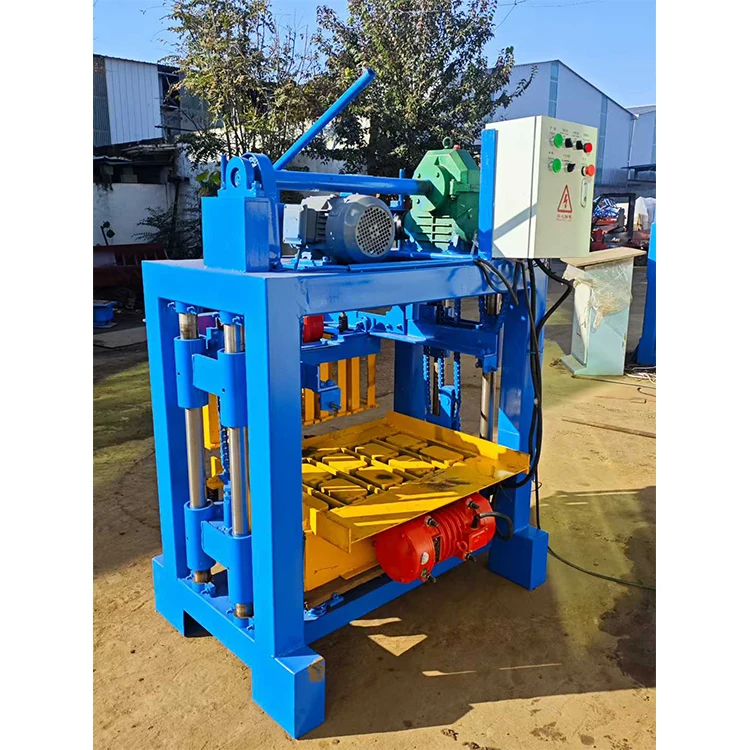
Integrated line pacing — the QTJ4-40 is specified with mixer and pallet sizing so the press never waits between 40-second cycles.
Technical Specifications
| Parameter | Value |
|---|---|
| Model | QTJ4-40 |
| Product Type | Stationary Concrete Block Making Machine |
| Rated Power | 10.4 kW |
| Overall Dimensions (L×W×H) | 1350 × 1460 × 1800 mm |
| Net Weight | 1200 kg |
| Molding Cycle | 40 s |
| Pallet Size | 850 × 450 × 20 mm |
| Vibration Frequency | 2800 r/min |
| Output Capacity | 2400 pcs/hour, 19200 pcs/day (based on 400×200×200mm hollow block, 5 pcs/mould) |
| Vibration System | Table vibration feeding, fluctuation vibration molding |
| Control | Electric control and mechanical parts interworking |
| Configuration | Host machine 1 set, block mould 1 set, JQ350 mixer |
| Automation Level | Manual pallet handling |
| Mould Format | 400×200×200mm hollow block (5 pcs/mould) |
Application Suitability
| Application | Material or Output |
|---|---|
| Small-scale hollow block production | Cement-based mix with local aggregate |
| On-site block production for contractors | 400×200×200mm hollow blocks using crushed stone and cement |
| Entry-level block plant startups | Manual pallet handling line producing standard hollow blocks |
Why Upstream Mixer Timing Breaks Small Block Lines
The mixer must finish a batch before the press completes its 40-second cycle, or the press sits idle.
Many small stationary block machine production line quotations list the press capacity without checking whether the included JQ350 mixer can deliver a fresh batch every 40 seconds. When the mixer is undersized or placed too far from the hopper, the press waits for material and real daily output drops noticeably below the quoted figure. I have seen operators standing around while the hopper refills — that downtime adds up across a full shift [NEED_CITE: common causes of output shortfall in small block lines].
Mixer Batch Volume and Press Cycle Alignment
The JQ350 mixer must produce enough wet mix to fill five mould cavities every 40 seconds, including the time needed to move material from the mixer discharge to the press hopper. If the mixer is positioned at ground level and material must be lifted manually, the effective cycle stretches well beyond the nominal 40 seconds. Confirming batch volume against the mould cavity count before the stationary block machine production line ships prevents this mismatch.
Pallet Flow and Curing Rack Matching
The 850 × 450 × 20 mm pallet size dictates how many pallets fit on a standard curing rack and how they align with the buyer’s existing forklift tines. Pallets that do not match the curing infrastructure force the buyer to rebuild racks or handle blocks by hand off the pallet. Specifying pallet material — wood, bamboo, or composite — against local humidity and curing duration ensures pallets survive repeated cycles without warping [NEED_CITE: pallet material selection for block curing environments].
Reading the Core Parameters for Line Performance
Vibration frequency at 2800 r/min combined with table vibration feeding means the mix settles into the mould cavity in two stages: initial fill and final compaction. This mechanical vibration system relies on the mix being neither too dry nor too wet — a moisture range that must match local aggregate absorption. The 10.4 kW rated power covers vibration motor and feed mechanism only; no hydraulic system is present, so block density depends entirely on vibration force and mix consistency. The manual pallet handling configuration means labour must be budgeted for retrieving cured pallets and returning empty ones to the press. Overall dimensions of 1350 × 1460 × 1800 mm allow the press to fit inside a compact workshop, but clearance around the machine must allow pallet movement in and out without bottleneck.
The Cost of Skipping Line-Level Pacing Checks
When the mixer, press, and pallet handling are not paced as one system, the buyer discovers the gap only after commissioning. The press runs below capacity, workers are paid for idle time, and daily block counts fall short of the project schedule. Correcting this after installation means repositioning equipment, adding conveyors, or replacing the mixer entirely — all more expensive than specifying correctly at the quotation stage [NEED_CITE: cost of post-installation line rebalancing].
Why Buyers Source the Full Line Here
The QTJ4-40 is quoted as a matched set with the JQ350 mixer, one block mould, and pallet specification confirmed against the buyer’s curing area — not as a standalone press with gaps left for the buyer to fill. Line layout and capacity calculation state the 400×200×200mm hollow block format assumed, so there is no ambiguity about what "19,200 per day" means. Voltage and control language are confirmed before production begins, avoiding commissioning delays when the machine arrives. Mould and wear parts lists ship with the machine so the first replacement cycle is planned, not discovered mid-shift. The stationary block machine production line configuration is adjustable: a buyer can start with manual pallet handling and add semi-automatic stacking later as production volume grows.
Documentation & Verification
- Line layout drawing showing mixer-to-press material flow path
- Capacity calculation sheet stating 400×200×200mm hollow block basis
- Pallet specification confirming material and 850 × 450 mm dimensions
- Voltage and control language confirmation before dispatch
- Factory test record on buyer’s target block format
- Wear parts and mould list included in shipment documents
Installation, Commissioning & Support
- Foundation pad sized for 1350 × 1460 mm footprint with anchor bolt layout
- Dedicated 10.4 kW circuit with voltage and frequency matched to site supply
- Mixer positioned for gravity feed to press hopper minimizing cycle gap
- First production run supervised to verify 40-second molding cycle holds
- Operator training covering vibration feed adjustment and mould change procedure
- Spare vibration motor and mould wear parts identified before shipment
What to Include in Your Inquiry
Provide your target daily block count, the 400×200×200mm hollow block format or other mould sizes needed, and your available curing area dimensions so pallet sizing can be confirmed. State your site voltage and frequency, and whether you have existing forklift or pallet handling equipment the line must integrate with. Include local aggregate type so mixer batch timing can be checked against your actual mix.
Frequently Asked Questions
Q: How does the JQ350 mixer batch cycle align with the 40-second press cycle?
A: The mixer must discharge a full batch into the press hopper before the current mould cycle ends. We calculate the mixer batch volume against five mould cavities and confirm the material transfer path so the press does not wait between cycles.
Q: What pallet material works best with the 850 × 450 mm size?
A: Pallet material depends on local humidity and curing duration. We specify wood, bamboo, or composite based on your curing environment and confirm the pallet dimensions match your existing curing racks and forklift tine spacing.
Q: Which line stations are included and which must be sourced separately?
A: The standard configuration includes the host machine, one block mould, and the JQ350 mixer. Curing racks, additional moulds, pallets beyond the initial set, and stacking equipment are specified separately based on your production volume.
Q: How is voltage confirmed before the machine ships?
A: We request your site voltage, frequency, and phase before production begins. The electrical panel and motor wiring are set to match, and the control language is confirmed so commissioning starts immediately on arrival.
Q: What is the realistic daily output considering the full line?
A: The quoted 19,200 pieces per day is based on 400×200×200mm hollow blocks at 5 pieces per mould with uninterrupted pallet flow. Real output depends on mixer batch timing, pallet handling speed, and shift duration — all confirmed in the line capacity calculation.


