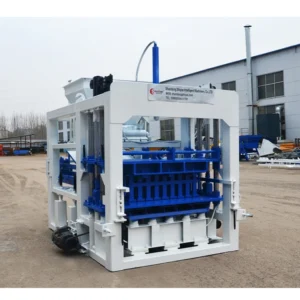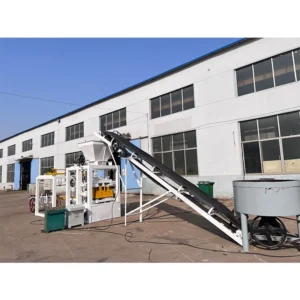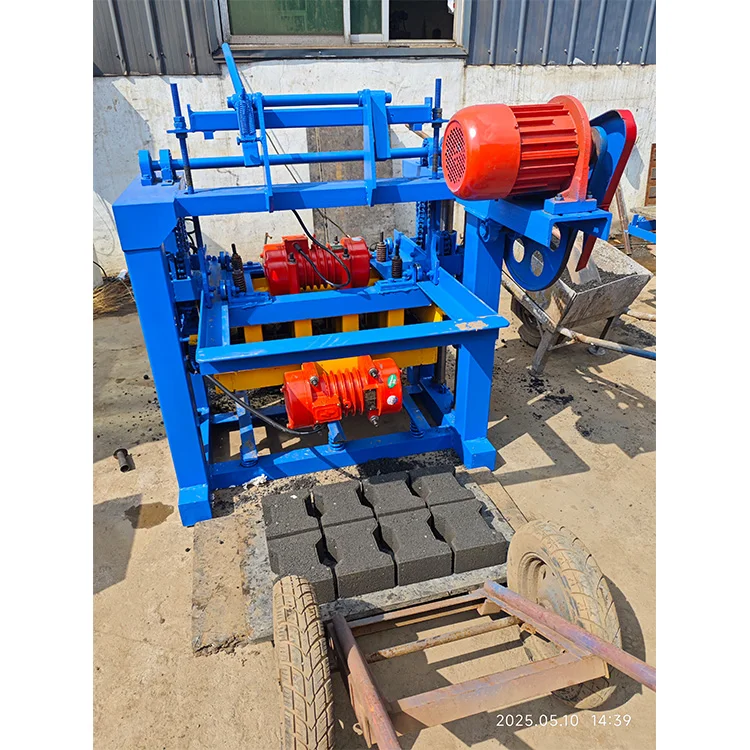
Line-Level Cycle Matching — the QTJ4-40 press is specified alongside mixer throughput, pallet return speed and stacking rhythm so the host machine never idles while upstream or downstream stations catch up.
Technical Specifications
| Parameter | Value |
|---|---|
| Model | QTJ4-40 |
| Product Type | Semi-Automatic Hydraulic Block Making Machine |
| Overall Dimensions (L×W×H) | 1350×1460×1800 mm |
| Net Weight | 1.2 T |
| Rated Power | 10.4 kW |
| Voltage & Frequency | Configured to buyer’s local supply (basis to be confirmed) |
| Control System | Semi-automatic operation |
| Moulding Cycle Time | 40 s (basis to be confirmed per block format) |
| Output Capacity | 2000–2500 pcs / 8 h (basis to be confirmed per block format) |
| Theoretical Output — 400×200×200 mm Hollow Block | 360 pcs/h, 2800 pcs/day (4 pcs/mould) |
| Theoretical Output — 400×150×200 mm Block | 450 pcs/h, 3600 pcs/day (5 pcs/mould) |
| Theoretical Output — 225×112.5×60 mm Interlocking Block | 800 pcs/h, 6400 pcs/day (9 pcs/mould) |
| Pallet Size | 850×450×20 mm |
| Pallet Material | Fiberglass (wood pallets also compatible) |
| Vibration Method | Bed mould vertical vibration + upper mould compression vibration |
| Mould Change | Manual |
| Assembly State | Host machine + block mould + pallets; mixer required (optional if buyer has one) |
| Raw Materials | Concrete, sand, cement, fly ash, lime, gypsum |
Application Suitability
| Application | Material or Output |
|---|---|
| Hollow block production for load-bearing walls | Crushed stone, sand and cement mix, 400×200×200 mm format |
| Solid wall block for partition and infill | Sand-cement or fly ash blend, 400×150×200 mm format |
| Interlocking paver for walkways and driveways | Fine aggregate and cement, 225×112.5×60 mm format |
| On-site block production for housing projects | Local aggregate with cement binder, multiple formats per mould set |
| Small plant first-line setup | Concrete or fly ash mix, semi-automatic workflow with manual pallet handling |
Why "Cycles per Hour" Means Nothing Without the Block Format
Capacity is only honest when tied to the exact block size the buyer actually sells.
Every buyer I have worked with on semi-automatic block making machine production line layouts has asked one question first: how many blocks per day? The problem is that a single cycle-time figure hides the format assumption behind it. A 40-second cycle producing four hollow blocks per mould yields a very different daily total than the same cycle producing nine interlocking pavers. Without stating the format, the quoted number is meaningless, and the buyer discovers the gap only after the line is running and orders are waiting [NEED_CITE:block output calculation methods in small-scale concrete plants].
Where the QTJ4-40 Fits Inside a Complete Line
This press sits at the centre of a semi-automatic block making machine production line that includes raw material feeding, a pan or ribbon mixer, pallet circulation and a stacking station. The 10.4 kW rated power and 40-second base cycle mean the upstream mixer must deliver a fresh batch within that window, otherwise the press sits idle. On the downstream side, pallets carrying wet blocks must be moved to the curing area before the next cycle ejects onto the same pallet position. Matching these three rhythms is what separates a line that runs smoothly from one that bottlenecks at the press.
Pallet Size as a Line-Planning Constraint
The 850×450×20 mm pallet is not an isolated specification — it determines the curing rack dimensions, the forklift tine spacing and the floor area needed for seven-day curing. Fiberglass pallets resist moisture warping across repeated wet-dry cycles, while wood pallets lower initial cost but require more frequent replacement. Choosing pallet material and size before the line ships prevents a situation where the curing racks built on-site do not accept the pallets the machine actually produces [NEED_CITE:pallet material selection for concrete block curing].
Reading the Vibration and Pressure Specs
The bed mould vertical vibration combined with upper mould compression vibration works in two stages: the bed vibration settles the concrete mix into the mould cavity, while the upper mould compression compacts the surface layer. This dual action matters most when the local aggregate contains a higher proportion of fines, because vibration alone may leave voids in the lower section of the block. The semi-automatic control lets the operator adjust dwell time within the cycle to compensate for mix variations across batches.
When One Station Slows the Entire Line
A mixer that takes 90 seconds per batch against a 40-second press cycle creates dead time that cuts daily output nearly in half. I have seen lines where the contractor added a second mixer only to find the pallet return conveyor was the real bottleneck. Every station in a semi-automatic block making machine production line must be calculated against the slowest link, and that link is rarely the press itself [NEED_CITE:bottleneck analysis in small concrete product lines].
What We Configure Before the Line Ships
The host machine, mould set, pallet specification and mixer are quoted as one matched package, so the buyer receives a line where cycle times align rather than a collection of standalone units. Voltage, frequency and control language are confirmed in writing before production starts, avoiding commissioning delays on arrival. Mould drawings and a format list ship with the machine, so replacement moulds and wear parts can be sourced from day one. The assembly state — host machine, mould and pallets, with mixer optional — lets buyers who already own a mixer avoid paying for duplicate equipment. Line layout documentation states the block format behind every output figure, so the buyer can plan curing area and labour against real numbers.
Documentation & Verification
- Line layout drawing with capacity stated per block format for the QTJ4-40
- Pallet specification sheet matched to the buyer’s curing rack and forklift dimensions
- Voltage and frequency confirmation signed before production begins
- Mould drawing and format list included so replacements can be ordered immediately
- Factory test record showing cycle times on the buyer’s chosen block format
Installation, Commissioning & Support
- Foundation pad sized to the 1350×1460 mm footprint with anchor bolt template provided
- Dedicated circuit rated for the 10.4 kW load with correct voltage and frequency confirmed pre-shipment
- Host machine, mould and pallets shipped assembled; mixer connected on-site to match batch cycle
- First-run commissioning includes cycle timing adjustment against the buyer’s actual mix design
- Operator training covers mould change procedure and vibration dwell settings per format
- Wear parts and mould inventory list supplied so spares can be ordered before first replacement is due
What We Need to Size Your Line
Send us the block formats your market sells, the daily volume you need for each, and the local aggregate you plan to use. Include your site voltage, frequency and available curing floor area so we can match pallet circulation and rack layout. If you already have a mixer or forklift on-site, share the model so we confirm compatibility before the semi-automatic block making machine production line ships.
Frequently Asked Questions
Q: How is daily capacity calculated for each block format on this line?
A: Each output figure is tied to a specific mould cavity count and a 40-second base cycle. For example, the 400×200×200 mm hollow block uses four cavities per mould, yielding 360 pieces per hour under continuous operation. Actual daily totals depend on mixer batch speed, pallet return time and curing area availability across the full shift.
Q: Which supporting stations are required to prevent idle time at the press?
A: The mixer must deliver a batch within the moulding cycle, the pallet feeder must return empty pallets before the next press stroke, and the stacking station must clear loaded pallets from the output conveyor. We calculate each station’s cycle against the QTJ4-40 so no single point holds the line back.
Q: How do I choose pallet material and size for my existing curing setup?
A: The 850×450×20 mm pallet dimension must match your curing rack spacing and forklift tine width. Fiberglass pallets suit high-moisture environments with repeated wet-dry cycles, while wood pallets lower upfront cost but need more frequent replacement as edges degrade under vibration.
Q: What electrical details must be confirmed before the line enters production?
A: Voltage, frequency and control panel language are confirmed in a signed document before manufacturing starts. This prevents a situation where the motor winding or PLC display does not match the buyer’s local supply, which would otherwise delay commissioning by weeks.
Q: Can the semi-automatic line be upgraded to higher automation later?
A: The press itself remains the same unit. Upgrading involves adding automatic pallet feeding, stacking and cubing stations around the existing QTJ4-40, along with a PLC control panel to coordinate the new stations. This staged approach lets buyers match investment to actual order volume.