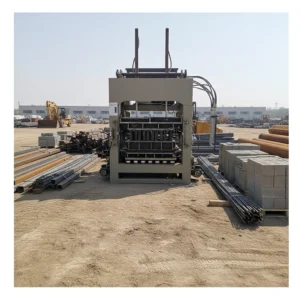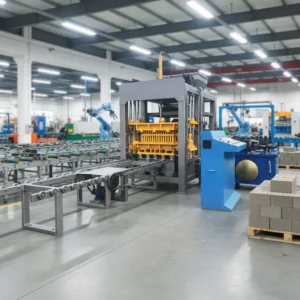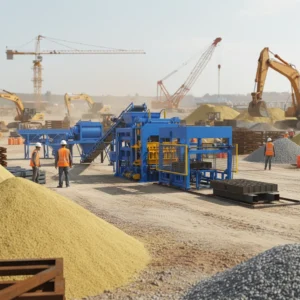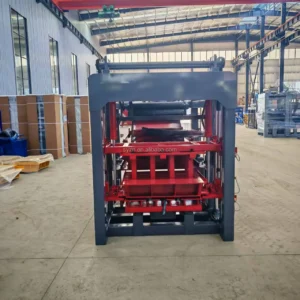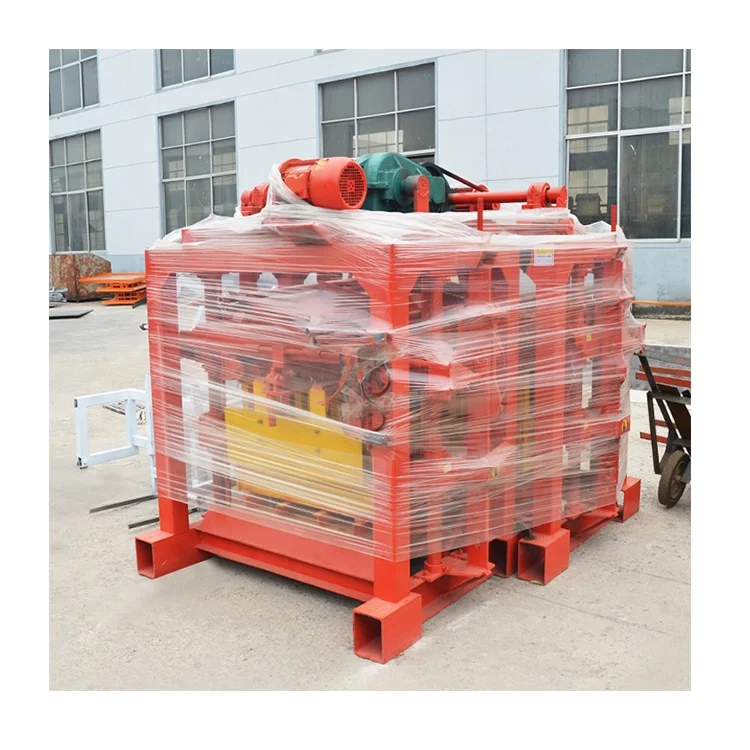
Line-level cycle matching — the QTJ4-40 is specified alongside its mixer batch size and pallet return path so the 40-second press cycle is never starved for material or blocked by downstream congestion.
Technical Specifications
| Parameter | Value |
|---|---|
| Model | QTJ4-40 |
| Product Type | Semi-Automatic Concrete Block Making Machine |
| Rated Power | 9.5 kW |
| Molding Cycle | 40 s |
| Theoretical Output (400×200×200 mm hollow block, 4 pcs/mould) | 360 pcs/h, 2800 pcs/day |
| Theoretical Output (400×150×200 mm hollow block, 5 pcs/mould) | 450 pcs/h, 3600 pcs/day |
| Theoretical Output (225×112.5×60 mm solid brick, 9 pcs/mould) | 800 pcs/h, 6400 pcs/day |
| Output Capacity (basis to be confirmed) | 2000–2500 pcs/8h |
| Pallet Size | 850 × 450 mm |
| Overall Dimensions (L×W×H) | 1350 × 1460 × 1800 mm |
| Net Weight | 1 T |
| Vibration System | Bed mould vertical vibration + upper mould compression vibration |
| Automation Level | Semi-automatic (top die push-pull, automatic scraper, manual pallet handling) |
| Raw Material Compatibility | Concrete, sand, cement, fly ash, lime, gypsum |
| Voltage & Frequency | Configured to buyer’s local standard |
Application Suitability
| Application | Material or Output |
|---|---|
| Small to medium block and paver plants | Hollow blocks and paving blocks from crushed stone, sand, and cement |
| On-site production for construction contractors | Solid and hollow blocks using locally available aggregate |
| Fly ash brick manufacturing | Fly ash, lime, gypsum, and cement mixes |
| Interlocking and porous brick production | Specialized mould formats for local building material markets |
What a "40-Second Cycle" Means When the Rest of the Line Falls Behind
A press cycle only sets the ceiling — upstream mixing and downstream pallet handling decide whether you ever reach it.
The QTJ4-40 completes a moulding cycle in 40 seconds, but that number assumes a fresh batch of mixed material is waiting in the hopper and an empty pallet is positioned on the table. In many small plants I have visited across East and West Africa, the mixer finishes a batch in three minutes while the press burns through two cycles in that same window, leaving the operator standing idle. Downstream, if a worker is manually pulling loaded pallets off the press table and carrying them to the curing area, a slow pallet return chokes the entire Semi-Automatic Block Making Machine production line at the exit side [NEED_CITE: typical cycle loss from pallet handling bottlenecks in semi-automatic plants].
Matching Mixer Output to Press Appetite
The 9.5 kW rated power of this unit tells you the electrical headroom, but the mixer motor on the same panel often draws comparable load. A Semi-Automatic Block Making Machine production line only holds its cycle rhythm when the mixer can deliver a full batch in time for the next feed. We size the mixer drum volume and motor rating against the mould cavity count and cycle time so material never sits waiting — or worse, sets up in the hopper between cycles.
Pallet Flow as the Real Bottleneck
The 850 × 450 mm pallet dimension is not just a press specification — it dictates the spacing of every curing rack slot, the fork pocket width on your existing forklift, and how many pallets a worker can shuttle per minute. When the pallet size is chosen without consulting the curing yard layout, the result is a press that finishes a block every 40 seconds and a pallet return loop that takes 55. That mismatch is invisible in the quotation and painfully obvious on the first production day [NEED_CITE: pallet logistics impact on semi-automatic block line throughput].
Vibration Matching for Local Aggregate
The dual vibration setup — vertical vibration under the bed mould combined with compression vibration from the upper mould — is designed to compact a range of mix designs, from fine fly ash blends to coarse crushed-stone hollow block mixes. The effectiveness of this system depends on matching vibration amplitude to the specific gravity and grading of your local aggregate. A mix that works in one region may produce weak blocks in another if the vibration force is not adjusted to suit.
Reading the Numbers That Actually Matter
The theoretical outputs — 360 pieces per hour for 400×200×200 mm hollow blocks, 450 for the 150 mm width variant, and 800 for solid bricks — are calculated from the 40-second cycle and the cavity count per mould. They assume uninterrupted material feed, instant pallet exchange, and zero downtime for mould change or maintenance. In a working Semi-Automatic Block Making Machine production line, actual throughput reflects how well the mixer, pallet handler, and curing logistics keep pace with those theoretical intervals.
The Cost of Ignoring Line Integration
When a buyer orders the press alone and sources the mixer, conveyor, and pallets separately, the gaps between stations become the owner’s problem. I have seen lines where the hopper starves because the belt conveyor runs slower than the press cycle, and others where wet blocks stack on the floor because no curing rack was planned for the pallet size. These are not machine failures — they are planning failures, and they show up as lost production hours that no warranty covers [NEED_CITE: consequences of uncoordinated block line equipment sourcing].
Why the Line View Changes the Purchase
Our approach treats the QTJ4-40 as one station in a sequence. The machine, mould, pallet, and handling equipment are specified as a matched system so that cycle times align across every point where material or pallets transfer. Configuration is set against the buyer’s actual mix design, local aggregate, and target block format rather than a catalogue default. Mould design covers the formats the local market actually buys, including custom drawings when standard options do not fit. The automation level is selectable — a buyer can start with the semi-automatic pallet handling configuration and add automatic stacking later without replacing the press. Installation support includes operator training focused on line rhythm, not just button sequences.
Documentation & Verification
- Line layout drawing showing station spacing and pallet flow path from QTJ4-40 to curing area
- Capacity calculation stating which block format the quoted output assumes
- Pallet specification sheet matched to your curing rack dimensions and forklift capacity
- Voltage and control language confirmation document signed before dispatch
- Wear parts and mould list with part numbers for line maintenance planning
- Factory test record on your target block format before shipment
Installation, Commissioning & Support
- Foundation pad leveled for the 1350 × 1460 mm footprint with anchor bolt template provided
- Dedicated circuit sized for the 9.5 kW press plus mixer motor on a shared panel
- Machine arrives as a single skid unit — no major sub-assembly required on site
- First-run commissioning includes cycle timing verification with your local aggregate mix
- Operator training covers mould change procedure and daily vibration system inspection
- Wear parts catalogue with mould plate and scraper blade reorder intervals
Before You Send an Inquiry
A useful quotation for a Semi-Automatic Block Making Machine production line starts with your target block format, daily output requirement, and the raw materials available in your area. We also need your local voltage and frequency standard, the dimensions of your curing yard, and whether you already own pallets or forklifts. Share those details and the proposal will address the full line, not just the press.
Frequently Asked Questions
Q: How do I verify daily output when the press cycle is matched to mixer batch size and pallet return speed?
A: The capacity calculation in our proposal states the exact block format and mould cavity count behind every output figure. We model mixer batch time against press cycle and pallet return loop so the daily projection reflects line rhythm, not just press speed in isolation.
Q: What upstream mixing capacity is needed to keep the QTJ4-40 fed without idle time?
A: The mixer must deliver a full batch within the press cycle window. We calculate drum volume and motor rating against the 40-second moulding cycle and the specific mould cavity count so material feed never forces the operator to pause between cycles.
Q: How should I select pallet size and material based on my existing curing racks and forklift?
A: The 850 × 450 mm pallet is the starting point. We cross-reference your curing rack slot spacing and forklift fork width to confirm compatibility, and recommend pallet material — timber, bamboo, or composite — based on your climate and expected service life.
Q: Where in the line can I add automatic stacking without disrupting the current semi-automatic workflow?
A: Automatic stacking is typically inserted at the pallet exit point after the press table. We design the station spacing so the upgrade slots in without relocating the mixer or altering the pallet return conveyor path already in place.