
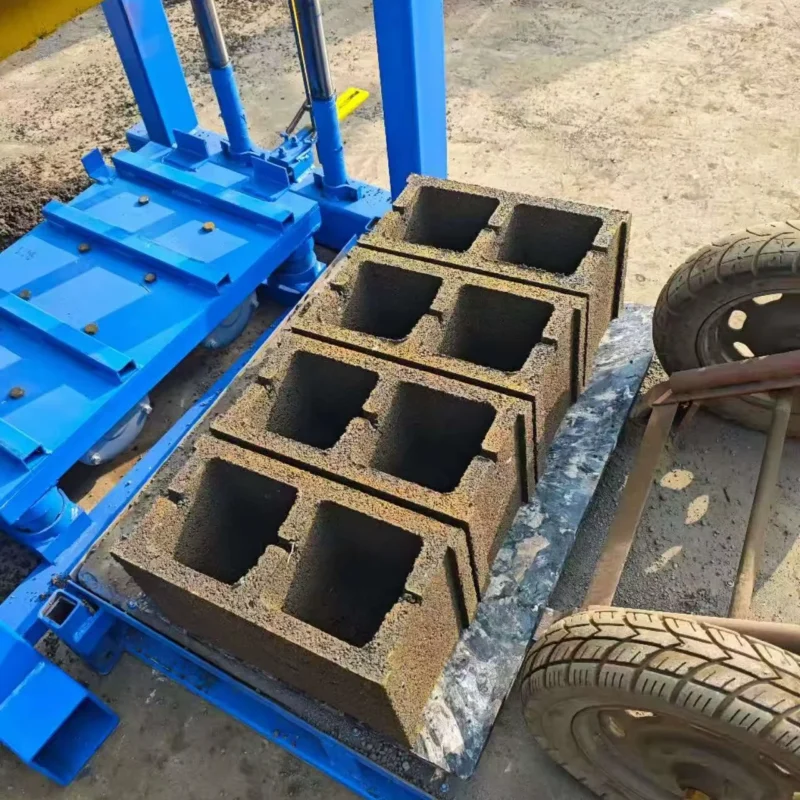
Matched system configuration — every station from mixer to curing rack is specified around the QTJ4-40 press cycle so no unit sits idle waiting for material or pallets.
Technical Specifications
| Parameter | Value |
|---|---|
| Model | QTJ4-40 |
| Product Type | Stationary Semi-Automatic Concrete Block Making Machine |
| Rated Power | 10.4 kW |
| Voltage & Frequency | Configurable to buyer local standard (confirm before order) |
| Control System | Semi-automatic operation (PLC availability to confirm) |
| Overall Dimensions (L×W×H) | 1350 × 1460 × 1800 mm |
| Net Weight | 1.2 T |
| Moulding Cycle | 40 s |
| Output Capacity | 360 pcs/h based on 400×200×200 mm hollow block, 4 pcs/mould |
| Theoretical Capacity | 450 pcs/h based on 400×150×200 mm block, 5 pcs/mould |
| Theoretical Capacity | 800 pcs/h based on 225×112.5×60 mm interlocking brick, 9 pcs/mould |
| Pallet Size | 850 × 450 × 20 mm |
| Raw Materials | Concrete, sand, cement, fly ash, lime, gypsum |
| Vibration System | Bed mould vertical vibration + upper mould compression vibration |
| Block Formats Supported | Hollow, solid, paver (8", 6", 5", 4"; other sizes on request) |
| Mould Change | Manual |
| Stacking Method | Manual (no automatic stacking included) |
| Assembly State | Fully assembled press with separate mixer, moulds and pallets |
| Hydraulic Pressure | To be confirmed |
| Vibration Force | To be confirmed |
Application Suitability
| Application | Material or Output |
|---|---|
| Small to medium block plant | Hollow and solid blocks from crushed stone, sand and cement |
| On-site contractor production | Pavers and kerbstones mixed from local aggregate |
| First block plant startup | Interlocking bricks from fly ash, lime and gypsum blends |
| Secondary line for format expansion | 4-inch to 8-inch block formats on a single pallet size |
Why "2500 Pieces per Day" Rarely Matches What Leaves the Yard
A stationary block machine production line delivers its stated output only when every upstream and downstream station keeps pace with the press cycle.
Many quotations quote the QTJ4-40 at 2000–2500 pieces per 8-hour shift without naming the block format behind that number. I have watched a plant owner in Shandong expect 2500 hollow blocks daily, only to find the mixer discharged slower than the 40-second press cycle demanded, and the crew spent half the shift moving pallets by hand. The real bottleneck was never the press itself [NEED_CITE: common causes of output shortfall in semi-automatic block plants]. When the mixer, pallet feed and curing rack handling are sized as one system, the daily count becomes predictable.
Matching Every Station to the 40-Second Cycle
The QTJ4-40 completes a moulding cycle in 40 seconds, which means the mixer must discharge a fresh batch into the hopper within that same window. In a stationary block machine production line, a pan mixer rated below the press volume forces the operator to wait, dropping actual throughput well below the rated figure. We size the mixer drum and discharge gate so material arrives before the press finishes its vibration and compression stroke.
Pallet Size Decides the Curing Layout
The 850 × 450 × 20 mm pallet is not just a press accessory; it governs how many wet blocks fit on each curing rack tier and which forklift can carry a loaded rack. If the curing shed was planned around a different pallet dimension, the racks will not accept the QTJ4-40 output without re-spacing. Confirming pallet size against the existing curing area and forklift capacity avoids costly rack modifications after the line arrives [NEED_CITE: pallet dimension impact on curing yard planning].
Reading the Specs That Shape Block Quality
The dual vibration system — bed mould vertical vibration combined with upper mould compression vibration — compacts the concrete mix from two directions simultaneously. This is what gives a hollow block its wall density and a paver its surface finish. Hydraulic pressure, once confirmed, must align with the vibration force so the mix is not over-compacted into brittle blocks or under-compacted into weak ones. The 40-second cycle allows enough dwell time for a semi-dry mix to settle, but only if the raw material moisture and aggregate grading match the vibration amplitude. A mix designed for a high-pressure hydraulic press will not perform the same way on a mechanical vibration unit, so the recipe must be validated against this machine class.
What Happens When the Line Is Quoted Press-Only
Leaving the mixer, pallet feed and stacking out of the quotation shifts those costs to the buyer, often after the press has already shipped. I have seen plants where the crew manually dragged pallets from the curing yard back to the press, adding labour and slowing the cycle beyond 40 seconds. The quoted output then becomes a theoretical ceiling no one reaches [NEED_CITE: hidden costs in press-only block machine quotations]. When stacking and curing rack handling are excluded, the line is only half a line.
Why Sourcing the Whole Line From One Supplier Matters
Block machinery is our single focus, so the QTJ4-40, its moulds, pallets and handling equipment are specified as one matched system rather than assembled from separate vendors. We set the configuration against your actual mix design and local aggregate, not a catalogue default. Mould design covers the formats your market sells, including custom drawings. The semi-automatic architecture leaves an upgrade path to automatic stacking and cubing when volume justifies it. Installation support includes operator training so the crew understands the 40-second rhythm from day one.
Documentation & Verification
- Line layout with capacity calculation per block format for the QTJ4-40
- Mould drawing and format list matching your market dimensions
- Pallet specification confirmed against your curing rack spacing
- Voltage, frequency and control language confirmed before production
- Factory test record on your specified block format before dispatch
- Operation and maintenance manual with wear parts list
Installation, Commissioning & Support
- Foundation pad leveled to 1350 × 1460 mm press footprint with anchor bolts
- Dedicated circuit sized for 10.4 kW rated power at confirmed local voltage
- Press arrives fully assembled; mixer and pallets shipped separately for container loading
- First-run parameter setting for vibration duration and cycle timing
- Operator training on 40-second cycle rhythm and manual pallet handling workflow
- Wear parts list and mould maintenance schedule provided at handover
Before You Send the Inquiry
To size the stationary block machine production line around the QTJ4-40, we need your target block format with dimensions, daily output goal, local raw material type and grading, and the voltage and frequency at your site. If you already have a curing yard, share the rack dimensions and forklift capacity so the 850 × 450 mm pallet can be validated. Mention any upstream equipment you plan to keep, so we can match discharge rates and avoid station idle time.
Frequently Asked Questions
Q: How is the QTJ4-40 daily output verified per block format?
A: We state capacity with the exact block dimensions and pieces per mould, such as 360 pieces per hour based on 400×200×200 mm hollow blocks at 4 per mould. The daily figure then multiplies by actual running hours minus pallet handling and mould change time, giving a realistic shift target rather than a theoretical peak.
Q: Which supporting equipment is included and which must I supply?
A: The quotation can include the mixer, pallets and moulds as a matched set. Pallet feeding, stacking and curing rack handling are optional additions. If excluded, the scope is clearly marked so you can source locally or plan for a later upgrade to automatic handling.
Q: How does the 850 × 450 mm pallet affect my curing yard?
A: Every tier of your curing rack must accept that pallet footprint, and your forklift must lift a fully loaded rack. If the yard was built for a different size, rack re-spacing or a forklift change may be needed. We confirm pallet size against your existing layout before production starts.
Q: Can I start semi-automatic and add automation later?
A: The QTJ4-40’s semi-automatic architecture allows you to add automatic pallet feeding, stacking and cubing when volume grows. The press frame and vibration system remain the same; only the handling stations are added, protecting your initial investment while reducing manual labour in later phases.


