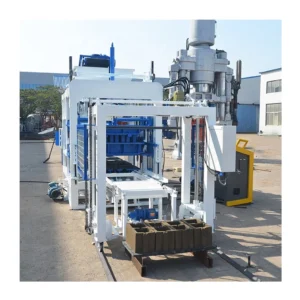
Matched Material Flow — The QTJ4-35 line stations are timed so the JQ350 mixer discharge and belt conveyor feed never leave the press waiting for material or forcing a half-mixed batch into the mould.
Technical Specifications
| Parameter | Value |
|---|---|
| Model | QTJ4-35 |
| Product Type | Semi-Automatic Concrete Block Making Machine |
| Line Configuration | JQ350 mixer, belt conveyor, host machine |
| Mould Format Capability | Hollow blocks, solid blocks, pavers (mould change required) |
| Capacity per Format | 400×200×200mm: 400 pcs/hour; 400×150×200mm: 500 pcs/hour; 225×112.5×60mm: 900 pcs/hour |
| Daily Output | 2500–3000 pcs/day (basis not stated in source — confirm block format / material / thickness) |
| Stacking Method | Manual |
Application Suitability
| Application | Material or Output |
|---|---|
| Small-scale block plants | Hollow and solid concrete blocks for local masonry supply |
| First-time block entrepreneurs | Standard hollow blocks from cement, sand, and crushed stone |
| On-site contractor production | Solid blocks and pavers produced directly at the construction project |
| Concrete product manufacturers | Adding paver formats to an existing block range using fly ash or concrete mix |
What "3200 Pieces per Day" Leaves Out When the Mixer Cannot Keep Up
A block machine is only as fast as the station feeding it.
I have watched small block plants in Shandong run a QTJ4-35 with an undersized mixer. The press cycles through its vibration and pressure sequence, but the belt conveyor delivers a batch that was only mixed for half the proper time. The result looks like a block coming off the line on schedule, but the cement was never fully distributed through the aggregate. Those blocks cure with weak spots and crumble under load on the job site. The daily output number looks good on paper while the reject pile grows quietly at the end of the curing yard [NEED_CITE: common causes of block strength failure in small-scale plants].
When planning a semi-automatic block making machine production line, the question is never just how fast the press cycles. It is whether the JQ350 mixer batch volume and mixing time align with the host machine cycle so that every mould receives a fully homogeneous mix. This is where most small-line quotations fall short — they list the press capacity without stating the mixer duty cycle that supports it.
Three Stations That Must Breathe Together
The QTJ4-35 is configured as a three-station semi-automatic block making machine production line: the JQ350 mixer prepares each batch, the belt conveyor transfers it to the host machine hopper, and the press forms the blocks on pallets. Each station has its own rhythm. The mixer needs a set number of minutes per batch depending on your aggregate size and moisture content. The conveyor runs continuously but must deliver material at a rate the press hopper can absorb without overflow or starvation. The press itself cycles through feed, vibration, compression, and demoulding in a sequence that cannot be rushed without sacrificing block density.
Where the Line Boundary Ends and Your Planning Begins
This three-station setup covers material preparation through block forming. What happens after the press — pallet handling, manual stacking, moving racks into the curing area, and final cubing for dispatch — sits outside the quoted line boundary. Many buyers discover this gap only after the machine arrives and realize they need to plan curing yard space, pallet inventory, and manual labour for the downstream steps. Understanding this split before you sign a quotation prevents the surprise of having freshly pressed blocks piling up on the floor because no one budgeted for curing racks [NEED_CITE: block plant downstream equipment planning checklist].
Reading the Capacity Table Honestly
The capacity figures for the QTJ4-35 vary significantly depending on which block format you run. A 400×200×200mm hollow block yields 4 pieces per mould and approximately 400 pieces per hour, which translates to around 3200 pieces across an 8-hour shift. Switch the mould to a 400×150×200mm format and you get 5 pieces per mould at roughly 500 per hour. Drop down to a 225×112.5×60mm paver and the count jumps to 9 per mould at around 900 per hour. These numbers are not interchangeable — quoting a single daily output without naming the format is meaningless. When you evaluate any semi-automatic block making machine production line, always ask the supplier to state capacity per format and confirm which format their headline number assumes.
Mixer Batch Size and the Two-Second Rule
The JQ350 mixer capacity and the host machine hopper volume define a rhythm that either works or does not. If the mixer discharges a batch that is too large for the conveyor to carry smoothly, material backs up and partially sets before reaching the press. If it is too small, the press sits idle waiting for enough material to fill the mould box. In my experience setting up lines around this class of machine, I would rather the press wait two extra seconds between cycles than accept a short-mixed batch. Consistent block strength comes from consistent material, not from keeping the press running at all costs. The belt conveyor speed is adjustable to match, but only within a range — the mixer batch time is the true bottleneck that must be calculated against your specific aggregate and cement ratio.
The Cost of Skipping Line Integration Checks
When the mixer, conveyor, and press are sourced from different suppliers without a coordinated layout, the gaps show up during commissioning. The conveyor may be too short to reach the press hopper at the correct angle, causing material spillage. The mixer discharge height may not align with the conveyor inlet, requiring on-site steelwork modifications. Voltage mismatches between stations — one motor wired for 380V/50Hz and another arriving with a 440V rating — can stall the entire line until a transformer or motor swap is arranged [NEED_CITE: voltage and frequency standards by export market]. These are not catastrophic problems, but they cost days of production time and local electrician fees that were never in the project budget.
Why a Matched Line Matters More Than a Standalone Press
Block machinery is the single focus here, which means the JQ350 mixer, belt conveyor, and QTJ4-35 host machine are specified as one coordinated system rather than assembled from separate catalogue pages. The configuration starts from your actual mix design and local aggregate — not a default setting — because the mixer speed and batch time must match what your materials demand. Mould design covers the formats your local market actually buys, and custom moulds can be produced from your drawings when standard formats do not fit. The semi-automatic level means you can start with manual pallet handling and stacking now and add automation stations later as volume grows. Installation support includes operator training focused on the rhythm between mixer, conveyor, and press so your team understands why the line is timed the way it is.
Documentation & Verification
- Line layout drawing showing mixer, conveyor, and press positions with material flow direction
- Capacity calculation sheet stating which block format each hourly and daily figure assumes
- Mould drawing and format list for every mould included in your quotation
- Voltage and control language confirmation document signed before production begins
- Factory test record using your specified mix design and block format before dispatch
- Operation and maintenance manual covering all three line stations
Installation, Commissioning & Support
- Foundation requirements for the three-station layout including mixer pad, conveyor supports, and press footing
- Power supply specification covering total connected load for the JQ350 mixer, belt conveyor, and host machine motors
- Assembly sequence for the belt conveyor sections and hopper alignment with the press feed opening
- First-run commissioning with mixer batch timing adjusted to your local aggregate and cement ratio
- Operator training on mould change procedure and the correct mixer-to-press cycle rhythm
- Wear parts list covering mixer blades, conveyor belt splices, and press vibration components
What We Need to Size Your Line Correctly
To prepare a line layout that actually fits your site, share your target block formats, the daily volume you plan to run for each, and the local raw materials you will use including aggregate type and cement source. Your available workshop floor space and ceiling height determine how the mixer, conveyor, and press are positioned relative to your curing yard. Confirm your site voltage, frequency, and the language your operators need on any control displays so the electrical package is built correctly before the line ships.
Frequently Asked Questions
Q: How is daily output calculated for the QTJ4-35, and which block format does each figure assume?
A: The output varies by mould format. For a 400×200×200mm hollow block, the press produces 4 pieces per mould at roughly 400 per hour. A 400×150×200mm block yields 5 per mould at around 500 per hour, while a 225×112.5×60mm paver gives 9 per mould at approximately 900 per hour. Always confirm which format a quoted daily figure assumes.
Q: What downstream equipment do I need beyond the mixer, conveyor, and press?
A: The three quoted stations cover batching through block forming. You still need pallets for the press to form on, a method for moving loaded pallets to a curing area, curing racks or yard space, and labour or equipment for final stacking once blocks are dry. Plan these before the line arrives.
Q: How do the JQ350 mixer batch size and conveyor speed match the press cycle time?
A: The mixer must complete a full batch within the time the press consumes one hopper load. The belt conveyor speed is set to bridge the two without overflow or starvation. If your aggregate requires longer mixing, the press will pause briefly between cycles — this is intentional to protect block strength.
Q: Can this semi-automatic line be upgraded with automatic pallet feeding or stacking later?
A: Yes. The semi-automatic configuration leaves room to add automatic pallet feeding, stacking, or cubing stations as your volume grows. The press and mixer remain in place while downstream automation is bolted on. Confirm the pallet size and spacing early so future additions align.
Q: What voltage and frequency options are available for the full line?
A: Voltage and frequency must be confirmed for all three stations — mixer, conveyor, and press — before production. Different export markets use different standards, and a mismatch at any station delays commissioning. Specify your site supply details during the quotation stage, not after the machines are built.