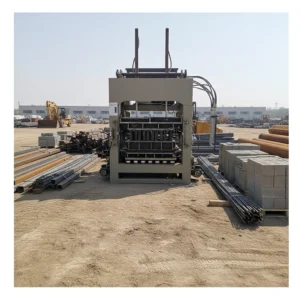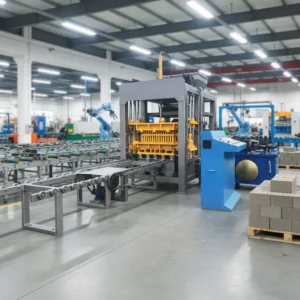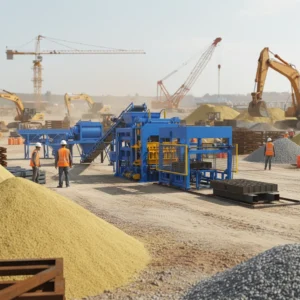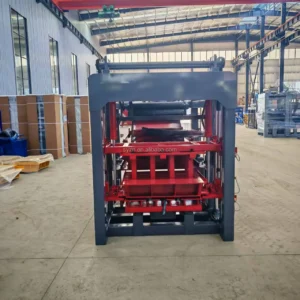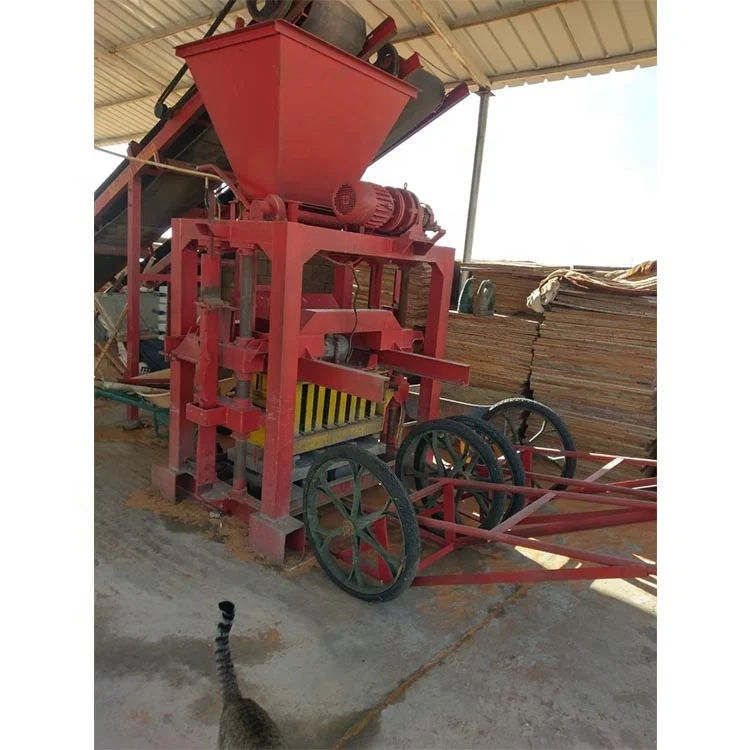
Complete Line Integration — Every station from raw material mixing to pallet stacking is specified as one matched system around the QTJ4-35, so cycle times connect and the press never waits for the next feed.
Technical Specifications
| Parameter | Value |
|---|---|
| Model | QTJ4-35 |
| Product Type | Concrete Block Making Machine |
| Overall Dimensions (L×W×H) | 1350×1460×1800 mm |
| Molding Cycle | 35 s |
| Vibration Frequency | 2800 r/min |
| Vibration Force | 30 kN |
| Total Power | 11.15 kW |
| Mixer Model | JQ350 |
| Pallet Size | 850×450×20 mm |
| Net Weight | 1500 kg |
| Applied Products | Concrete hollow blocks (8 inch, 6 inch), solid bricks |
| Raw Materials | Crushed stones, sand, cement, dust, fly ash |
| Output Capacity (Hollow Block 400×200×200 mm) | 408 pcs/h, 3264 pcs/8hr (4 pcs/mould) |
| Output Capacity (Hollow Block 400×150×200 mm) | 510 pcs/h, 4080 pcs/8hr (5 pcs/mould) |
| Output Capacity (Solid Brick 240×115×53 mm) | 2100 pcs/h, 17000 pcs/8hr (18 pcs/mould) |
| Automation Level | Semi-automatic |
| Stacking Method | Manual (basis not stated in source) |
Application Suitability
| Application | Material or Output |
|---|---|
| Small-scale block production plants | Hollow and solid blocks from crushed stone, sand, cement, and fly ash |
| On-site construction block production | 8-inch and 6-inch concrete hollow blocks for masonry walls |
| First block plant with limited investment | Standard solid bricks at 2100 pcs/h (basis: 240×115×53 mm) |
| Contractor yard adding block formats | Interlocking pavers and kerbstones with custom mould options |
What the Quoted Hourly Capacity Actually Means
The output figure only holds true when every station in the concrete block making machine production line keeps pace with the press cycle.
A buyer once told me their daily throughput dropped to nearly half of what was quoted. The host machine was fine, but the mixer discharged material slower than the 35-second molding cycle demanded. The press spent half its shift waiting. Supporting equipment like the JQ350 mixer must be sized so that batch discharge, raw material feeding, and pallet delivery all arrive before the next cycle begins. When any station lags, the entire line bottlenecks. [NEED_CITE: production line bottleneck analysis in small block plants]
How the Mixer Feeds the Press Without Idle Time
The JQ350 mixer paired with this concrete block making machine production line handles batch volumes that align with the 35-second cycle. Raw material — crushed stone, sand, cement, fly ash — enters the mixer and discharges in time for the next mold fill. When the mixer capacity is too small, the operator waits between batches and real daily output shrinks. Line layout must account for the distance between mixer discharge and the press hopper, because gravity feed or conveyor length adds seconds that accumulate across a full shift.
Pallet Size, Curing Area, and the Hidden Mismatch
Pallets measure 850×450×20 mm, and that dimension must match the curing racks and forklift the buyer already operates on site. I have seen yards receive a complete block line only to discover their existing fork tines are too narrow for the pallet width, or their curing shelves have a 25 mm gap that leaves the pallet unsupported at the edges. Before production starts, the pallet specification should be checked against every piece of downstream handling equipment. When pallets warp under wet block weight, the press jams on the return stroke. [NEED_CITE: pallet material selection for concrete block curing environments]
Reading the Vibration and Power Figures
The 30 kN vibration force at 2800 r/min works with the 11.15 kW total power to compact the mix into a dense block within 35 seconds. Vibration frequency and force together determine how thoroughly the aggregate particles settle, which directly affects block strength and surface finish. For hollow blocks at 400×200×200 mm, this vibration profile produces four units per mold cycle. For solid bricks at 240×115×53 mm, eighteen units fill the same pallet area. The power rating covers the vibration motor, mixer, and pallet feed motor combined, so buyers should verify that their site supply can sustain continuous draw at this level without voltage drop.
When the Quotation Misses a Station
Buyers sometimes receive a quote that covers only the press and assumes the rest of the supporting equipment already exists on site. Then the pallet handling, stacking, and curing stations fall outside the budget. Operators end up carrying wet blocks off the press by hand, slowing the cycle and cracking freshly formed units. A concrete block making machine production line quotation should name every station included — mixer, pallet feeder, and any stacking arrangement — so the buyer knows exactly what arrives in the container and what must be sourced locally. [NEED_CITE: common omissions in block machine quotation scope]
Why Specify the Line Here
Machine, mould, pallet, and handling equipment are configured as one system rather than assembled from separate suppliers. The capacity calculation states which block format the output figure assumes, so there is no guesswork after the line arrives. Mould design covers the formats the buyer’s market actually sells, and custom mould drawings are available when standard formats do not match local demand. Automation level is selectable — a buyer can start with manual pallet handling and add automatic stacking later. Voltage, frequency, and PLC display language are confirmed before production begins, so commissioning does not stall on electrical mismatches. Installation support includes operator training on the full line, not just the press.
Documentation & Verification
- Line layout showing station spacing and pallet flow path for the QTJ4-35
- Capacity calculation stating block format for each output figure
- Pallet specification confirming size, material, and quantity shipped
- Voltage, frequency, and control language confirmation sheet
- Factory test record on buyer’s target block format before dispatch
Installation, Commissioning & Support
- Foundation must level within tolerance for the 1350×1460 mm press footprint
- Dedicated circuit rated for 11.15 kW continuous draw at confirmed voltage
- Mixer and press arrive in separate crates and require on-site assembly
- First run tests the 35-second cycle with buyer’s local aggregate mix
- Operator training covers mould change, pallet loading, and daily maintenance
Before You Request a Quote
Tell us your target block format, daily output requirement, and the raw materials available locally so the mixer and press can be matched to your mix design. Confirm your site voltage, frequency, and preferred control language early in the conversation. Share the dimensions of your existing curing area and forklift so the 850×450 mm pallet specification can be validated against your current setup.
Frequently Asked Questions
Q: How is the daily output calculated, and which block format does it assume?
A: Every output figure states the exact block format it assumes. For example, 408 pieces per hour applies only to 400×200×200 mm hollow blocks at four per mould. Different formats change the pieces per mould and therefore the hourly total. Always check the capacity table for your specific product before comparing machines.
Q: Are the mixer, pallet supply, and stacking covered in the quotation?
A: The quotation lists each station included — the JQ350 mixer, pallet feeder, and press. Stacking method is semi-automatic with manual pallet handling. If you need automatic stacking or cubing added, specify this during the proposal stage so the line layout accounts for it.
Q: Does the 850×450 mm pallet fit my existing curing racks and forklift?
A: You should measure your curing shelf width and forklift tine spacing before confirming the order. A mismatch here causes production delays after the line arrives. Share your existing equipment dimensions and we will confirm compatibility or adjust pallet size.
Q: What voltage, frequency, and control language will the machine ship with?
A: These are confirmed with the buyer before production starts. Providing your local electrical standard and preferred operator language avoids commissioning delays. The control panel display and wiring diagram will match the confirmed specification upon arrival.
Q: How long does a mould change take, and is a format list provided?
A: Mould change time depends on the operator and the specific format. A format list is included with the quotation showing every mould option available. Custom moulds can be designed from buyer drawings when local market formats differ from the standard range.