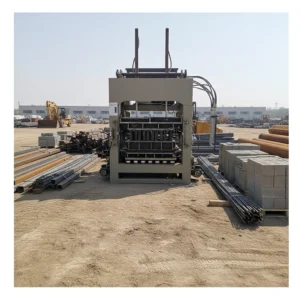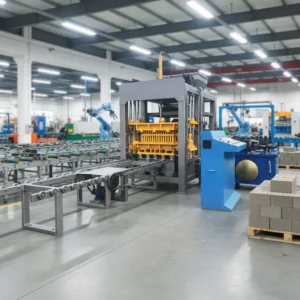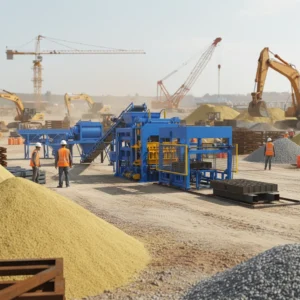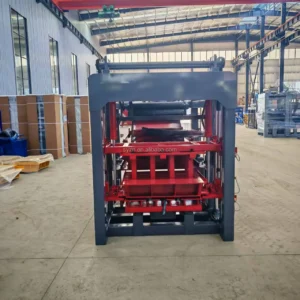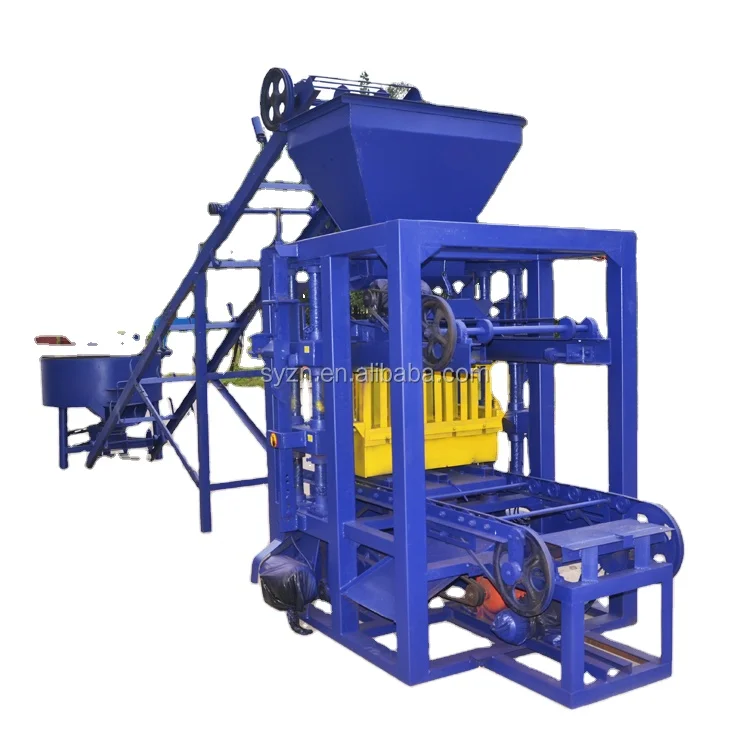
Matched System Design — the QTJ4-26 is specified alongside its mixer, pallet return loop and curing rack so the press never outpaces the stations around it.
Technical Specifications
| Parameter | Value |
|---|---|
| Product Type | Concrete Block Making Machine |
| Model | QTJ4-26 |
| Overall Dimensions (L×W×H) | 2060×1730×2580 mm |
| Molding Cycle | 26 s |
| Vibration Frequency | 4200 r/min |
| Exciting Power (Vibration Force) | 35.5 kN |
| Rated Power | 14.25 kW |
| Mixer Model | JQ350 |
| Pallet Size | 850×450×20 mm |
| Net Weight | 1800 kg |
| Guide Pillar System | Four guide pillars with automatic mould movement |
| Vibration Type | Dual vibrating motors under mould, direct vertical vibration combined with upper mould pressing |
| Output Capacity (Hollow Block 390×190×190 mm) | 480 pcs/h, 3800 pcs/8h |
| Output Capacity (Hollow Block 400×150×200 mm) | 600 pcs/h, 4800 pcs/8h |
| Output Capacity (Solid Brick 240×115×53 mm) | 2100 pcs/h, 17000 pcs/8h |
| Applied Products | Concrete blocks, hollow block (8 inch, 6 inch), solid brick |
| Raw Materials | Crushed stones, sand, cement, dust, fly ash |
Application Suitability
| Application | Material or Output |
|---|---|
| Small to medium block plants | Hollow blocks (390×190×190 mm and 400×150×200 mm) from crushed stone, sand and cement |
| On-site contractor production | Solid bricks (240×115×53 mm) for housing projects using locally sourced aggregates |
| Format-diverse manufacturing | Hollow block and solid brick formats switched within a single shift using fly ash blends |
What a "3800 Blocks per Day" Figure Leaves Out of Your Concrete Block Making Machine Production Line
Cycle time only matters when every station around the press keeps pace.
I shipped a mid-tier press to a plant in the Philippines years ago. The press itself cycled exactly as the spec sheet promised, but workers were hauling pallets by hand from the curing yard back to the feed conveyor. Output barely reached half the quoted figure. The bottleneck was never the press — it was the line around it [NEED_CITE: typical semi-automatic block line throughput losses from manual pallet handling]. When sizing a concrete block making machine production line, the real question is whether the mixer batch time, pallet return speed and stacking rhythm all resolve to the same 26-second beat.
How the Mixer and Press Stay in Sync
The JQ350 mixer paired with this line must deliver a fresh batch before the QTJ4-26 finishes the previous one. A 26-second molding cycle means the press consumes material continuously. If the mixer output drops or the conveyor stalls, the press idles and the cycle advantage disappears. The concrete block making machine production line is designed so the raw material feed configuration and mixing interval are confirmed against the press consumption rate before the quotation is finalised.
Pallet Return and the Curing Yard Constraint
Pallets leave the press wet, travel to the curing rack, dry, and must come back clean. The 850×450×20 mm pallet dimension is not arbitrary — it has to match the spacing on the buyer’s existing curing racks and the fork pocket width of the forklift already on site. When pallet size is chosen without checking the curing area, operators end up restacking blocks by hand onto whatever rack fits, adding a full station of unpaid labour to every shift [NEED_CITE: block plant pallet circulation design principles].
Reading the Specs That Actually Matter
Vibration force at 35.5 kN combined with upper mould pressing determines how densely the concrete is compacted into each cavity. Higher force is not automatically better — it must match the buyer’s specific mix design and local aggregate gradation. A fly ash blend behaves differently under vibration than a crushed stone mix. The four guide pillar system with automatic mould movement reduces the time needed to swap between hollow block and solid brick moulds, which matters when a plant runs two formats in one day. The 14.25 kW rated power covers both vibration motors and the hydraulic circuit, so the electrical supply must be sized with headroom for startup surge.
When Line Stations Are Chosen Separately
Buyers who source the mixer, pallets and stacking equipment from different suppliers often discover mismatches during commissioning. A pallet that is too thick jams the return rail. A mixer that batches too slowly forces the press to wait between cycles. A curing rack with the wrong slot spacing means every pallet must be manually repositioned. These issues do not show up in a quotation that only lists the press [NEED_CITE: common block line integration failures from split-supply procurement].
Why This Line Is Configured as One System
The mixer, pallet specification, guide pillar mould change mechanism and stacking layout are proposed together, not assembled from separate catalogues. Capacity calculations state which block format each figure assumes — 480 pcs/h for 390×190×190 mm hollow block, 600 pcs/h for 400×150×200 mm, and 2100 pcs/h for solid brick. Voltage, frequency and control language are confirmed in writing before production begins. Mould design covers the formats the buyer’s market actually sells, including custom drawings. Automation level is selectable, so a plant can start with semi-automatic pallet handling and add automatic stacking later.
Documentation & Verification
- Line layout drawing showing mixer, press, pallet return and curing rack positions with dimensions
- Capacity calculation sheet stating block format assumed for each output figure
- Pallet specification confirming size, material and quantity included in the quotation
- Machine specification sheet with vibration force matched to buyer’s mix design
- Voltage, frequency and PLC display language confirmation before production
Installation, Commissioning & Support
- Foundation plan sized to the 2060×1730 mm footprint with vibration isolation requirements
- Electrical circuit rated for 14.25 kW with dedicated breaker and startup surge allowance
- Machine arrives partially assembled; guide pillars and vibration motors pre-mounted
- Commissioning includes first-run cycle timing across all three block formats
- Operator training covers mould change procedure using the four-pillar guide system
- Wear parts list covering vibration motor brushes and hydraulic seals with reorder intervals
What We Need to Quote Your Line Accurately
Tell us the block formats your market sells and the daily volume you need per format. Share your local aggregate type and any existing mix design data. Confirm the voltage and frequency at your site, the curing yard dimensions, and the forklift model you plan to use for pallet handling.
Frequently Asked Questions
Q: How is QTJ4-26 capacity verified per block format, and which format does the headline figure assume?
A: Output is stated per format: 480 pcs/h for 390×190×190 mm hollow block, 600 pcs/h for 400×150×200 mm, and 2100 pcs/h for 240×115×53 mm solid brick. Each figure assumes the corresponding block dimension and a standard mix. The quotation includes a capacity calculation document so daily targets are set against your actual format mix.
Q: What supporting equipment is included in the line quotation?
A: The JQ350 mixer, pallet specification, pallet return system and stacking layout are proposed alongside the press. Curing racks and forklifts are typically sourced locally. The line layout drawing shows every station so nothing is left ambiguous at delivery.
Q: How does the 850×450 mm pallet align with my existing curing setup?
A: We confirm your curing rack slot spacing and forklift fork dimensions before finalising the pallet order. Mismatched pallets are one of the most common causes of line stoppages after commissioning, so this check is built into the proposal stage.
Q: What is the mould change time when switching formats mid-shift?
A: The four guide pillar system with automatic mould movement allows a trained operator to change between hollow block and solid brick moulds without extended downtime. Exact change time depends on the mould set and is confirmed during operator training on your specific formats.
Q: How are voltage and control language confirmed before shipment?
A: Voltage, frequency and PLC display language are confirmed in writing during the proposal stage and verified again before production. This prevents commissioning delays that occur when control panels arrive with the wrong language or voltage rating for the local grid.