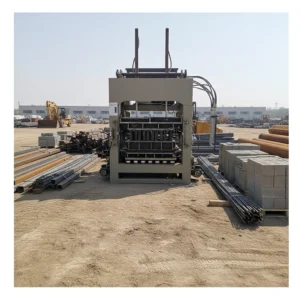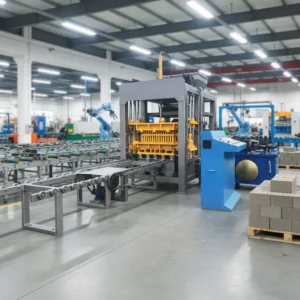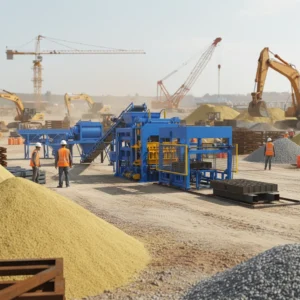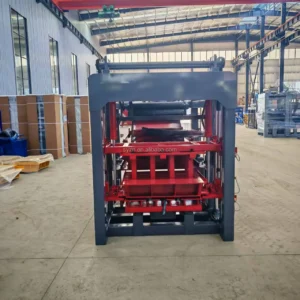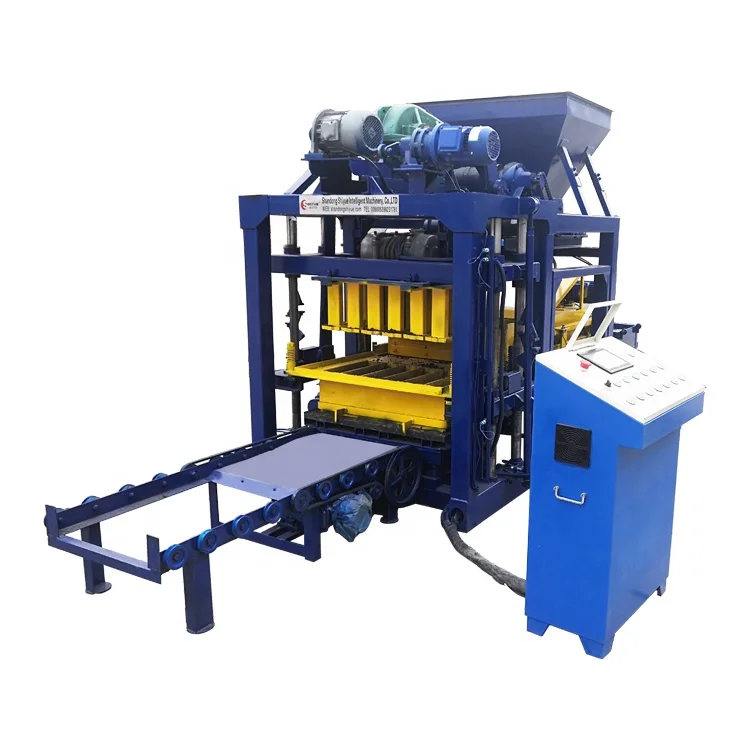
Line-Matched Equipment — every station from mixer to pallet discharge is specified against the QTJ4-25 cycle time so the press never sits idle waiting for upstream material or downstream handling.
Technical Specifications
| Parameter | Value |
|---|---|
| Model | QTJ4-25 |
| Product Type | Automatic Concrete Block Making Machine |
| Overall Dimensions (L×W×H) | 6400×1500×2700 mm |
| Molding Cycle | 25 s |
| Vibration Frequency | 2800–5100 r/min |
| Exciting Force | 60 kN |
| Rated Power | 17.9 kW |
| Mixer Model | JQ350 |
| Pallet Size | 850×550×20 mm |
| Net Weight | 2500 kg |
| Control System | PLC control with automatic plate-supplying, material-disturbing, and brick-discharging |
| Vibration Type | Flat vibration with squeeze compression vibration |
| Output Capacity (Hollow Block 390×190×190 mm) | 480 pcs/h, 3800 pcs/8 hr (basis: specific format) |
| Output Capacity (Hollow Block 400×150×200 mm) | 600 pcs/h, 4800 pcs/8 hr (basis: specific format) |
| Output Capacity (Solid Brick 240×115×53 mm) | 2100 pcs/h, 17000 pcs/8 hr (basis: specific format) |
| Raw Materials | Crushed stones, sand, cement, dust, fly ash |
| Assembly State | Fully assembled, nude packing in 20GP container |
Application Suitability
| Application | Material or Output |
|---|---|
| 8-inch and 6-inch concrete hollow block production | Crushed stone, sand, cement, fly ash blends |
| Solid brick manufacturing for masonry walls | Cement, dust, and fine aggregate mixes |
| On-site block production for housing projects | Locally sourced river sand and crushed stone |
| Small-to-medium block plant setup | Fly ash and industrial dust utilization |
Why Mixer Output Matters More Than Press Speed
A block press only runs as fast as the mixer can feed it consistent material.
When sizing a QTJ4-25 block making line supporting equipment, plant owners often focus entirely on the 25-second molding cycle and overlook the batching station upstream. I have watched lines stall because a pan mixer could not deliver a uniform batch every 25 seconds, leaving the press vibrating an empty mould or a half-filled one. The result is blocks with uneven density, rejected on the curing rack hours later. The JQ350 mixer specified with this line is chosen to match the volume and consistency the press demands per cycle, not simply to fit a budget line in a quotation [NEED_CITE: mixer sizing principles for concrete block lines].
How Stations Connect Around the Press
A complete QTJ4-25 block machine production line functions as a chain where every link must hold the same tempo. Raw material feeding delivers aggregate to the JQ350 mixer, which discharges a uniform batch into the press hopper within the 25-second cycle window. The PLC-controlled automatic plate-supplying system feeds an 850×550 mm pallet into position, the press vibrates and compresses, and the brick-discharging station pushes the loaded pallet out — all in one continuous loop.
If any station runs slower, the press waits. If any station runs faster without buffering, pallets pile up on the floor. The QTJ4-25 block machine production line is configured so that mixer discharge, pallet indexing, and discharge conveyor speed are all set against the same cycle reference, eliminating the bottleneck guessing game that plagues lines assembled from mismatched suppliers.
Where the Pallet Path Defines Real Throughput
Pallet handling is the station most frequently left out of block line quotations, yet it determines whether your quoted output actually reaches the curing area. The QTJ4-25 line uses an 850×550×20 mm pallet format, and the automatic plate-supplying mechanism must return empty pallets from the curing rack fast enough to keep the press fed. When pallet return falls behind, operators start pulling pallets by hand from the stack — and the 25-second cycle stretches into a 40-second reality.
Confirming pallet size against the buyer’s existing curing racks and forklift fork width before production prevents a situation where the line arrives and the pallets do not fit the infrastructure already on the ground [NEED_CITE: pallet and curing rack compatibility in block plants]. The block making line supporting equipment specification must include the pallet return conveyor or rack handling system, not assume the buyer will improvise.
Reading the Specs That Actually Shape Output
The 60 kN exciting force combined with flat vibration and squeeze compression vibration determines how densely the mix is compacted into the mould — and density directly governs block strength at demoulding. A lower exciting force on a stiff, low-slump mix leaves hollow blocks fragile at the corners, while excessive force on a wetter mix can cause segregation. The 2800–5100 r/min vibration frequency range allows the operator to tune the shake to the specific aggregate grading available locally.
The 17.9 kW rated power covers both the vibration motor and the hydraulic or mechanical press action, meaning the electrical supply must be sized with enough headroom for the starting surge. Voltage and frequency must be confirmed against the buyer’s local grid before the motor is wound — a 50 Hz motor on a 60 Hz supply runs faster and hotter, shortening bearing life and altering the vibration frequency the process depends on [NEED_CITE: voltage and frequency standards by export market]. The PLC control system manages automatic plate-supplying, material-disturbing, and brick-discharging sequences, and the display language should match the operator’s working language to prevent misinterpretation during fault conditions.
The Cost of Ignoring Line-Wide Matching
When a block plant is assembled by selecting the cheapest option at each station, the hidden costs surface during commissioning. A mixer that cannot keep up forces the press into an intermittent duty cycle, producing fewer blocks per shift than the brochure promised. Pallets ordered in the wrong thickness warp under repeated vibration and jam the automatic plate-supplying mechanism. Electrical panels wired for the wrong voltage trip breakers during motor start-up, delaying the first production run by days while replacement components are shipped internationally [NEED_CITE: CE machinery directive requirements for industrial equipment].
These are not warranty issues — they are specification failures, and they fall squarely on whoever assembled the quotation without checking the line as a single system.
Why Source the Line as One Package
The QTJ4-25 block machine production line is specified as a matched system, meaning the JQ350 mixer output, the pallet dimensions, and the press cycle are validated together before the quotation is issued. Capacity calculations are stated per block format — 480 pcs/h for 390×190×190 mm hollow blocks, 600 pcs/h for 400×150×200 mm hollow blocks, and 2100 pcs/h for 240×115×53 mm solid bricks — so the buyer can plan against the format they actually sell.
Moulds and pallets are designed in-house to match the machine’s vibration table and pallet size, eliminating the interface problems that arise when moulds are sourced from a third party. The automation level is selectable, allowing a buyer to start with semi-automatic pallet handling and add automatic stacking later without replacing the press. Installation support includes operator training on the PLC interface and routine maintenance schedules specific to the line configuration delivered.
Documentation & Verification
- Line layout drawing showing station positions, pallet path, and curing rack flow for the QTJ4-25 configuration
- Capacity calculation sheet stating output per block format with assumed mix and cycle time
- Machine specification sheet covering press, JQ350 mixer, pallet dimensions, and rated power
- Hydraulic and electrical schematic matching the voltage and frequency confirmed for your site
- Factory test record run on the buyer’s specified block format before container loading
- Wear parts and mould format list with part numbers for reordering
Installation, Commissioning & Support
- Foundation plan sized for the 6400×1500×2700 mm machine footprint and vibration isolation requirements
- Electrical supply confirmation for 17.9 kW rated power with dedicated circuit and correct voltage and frequency
- Fully assembled dispatch in 20GP container with on-site positioning and utility connection guidance
- First-run commissioning with PLC parameter adjustment to match local aggregate and mix design
- Operator training on automatic plate-supplying, material-disturbing, and brick-discharging sequences
- Wear parts list and mould maintenance schedule provided at handover
What to Share Before Quoting
To size the QTJ4-25 block machine production line correctly, provide the target block formats you intend to produce and the daily output you need per format. Share your local aggregate type and any available sieve analysis or lab report, as this affects mixer selection and vibration tuning. Confirm your site voltage, frequency, and preferred PLC display language so the electrical panel and control interface are built to your standard before production begins.
Frequently Asked Questions
Q: How is the QTJ4-25 line capacity calculated per block format?
A: Each output figure is tied to a specific block dimension and assumes a 25-second molding cycle. For example, 480 pcs/h applies to 390×190×190 mm hollow blocks, while 600 pcs/h applies to 400×150×200 mm hollow blocks. Daily output is calculated on an 8-hour shift basis and stated alongside the format assumption so buyers can plan against the product they actually sell.
Q: How does the JQ350 mixer match the press cycle time?
A: The JQ350 is selected so that a full batch discharges into the press hopper within the 25-second cycle window, preventing the press from idling while waiting for material. Mixer capacity and discharge speed are validated against the press demand per cycle, ensuring continuous production without upstream bottlenecks.
Q: What pallet size is used, and why must it be confirmed early?
A: The line uses 850×550×20 mm pallets, and this dimension must match the buyer’s existing curing racks and forklift fork width. Confirming pallet size before production avoids a situation where the line arrives and the pallets do not fit the curing infrastructure already installed on site.
Q: Which electrical details must be confirmed before production?
A: Voltage, frequency, and PLC display language must all be locked in before the motor is wound and the control panel is assembled. A mismatch in frequency changes motor speed and vibration behavior, while the wrong display language slows fault diagnosis during commissioning and daily operation.
Q: What supporting equipment is included in the line quotation?
A: The quotation covers the QTJ4-25 press, JQ350 mixer, automatic plate-supplying and brick-discharging mechanisms, and the PLC control system. Raw material feeding conveyors, stacking equipment, and curing rack handling are specified separately based on the buyer’s automation level preference and site layout requirements.