
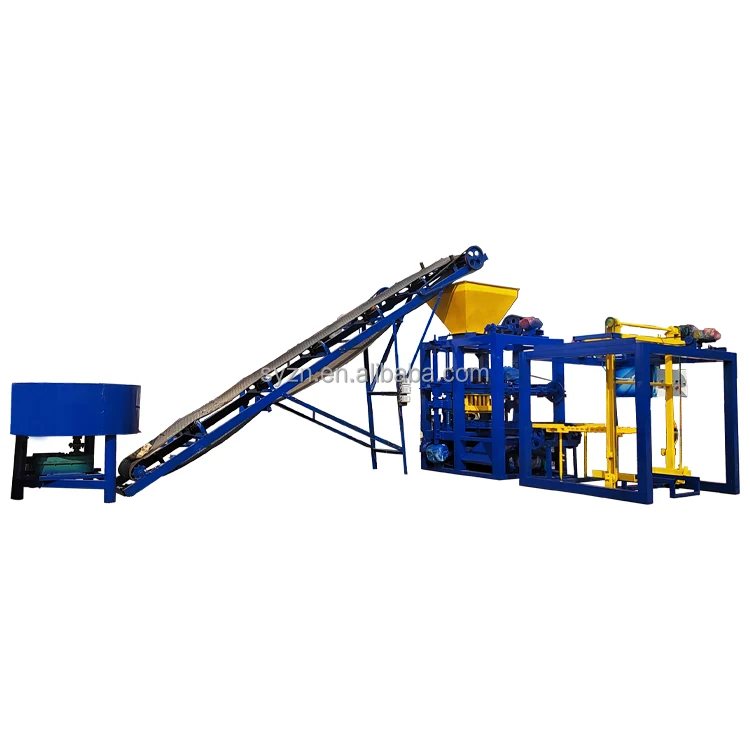
Matched line rhythm — every station from spiral feeding to pallet return is timed to the QTJ4-24’s 24–26 s press cycle so the machine does not stand idle waiting for upstream or downstream equipment.
Technical Specifications
| Parameter | Value |
|---|---|
| Model | QTJ4-24 |
| Product Type | Stationary Block Making Machine |
| Overall Dimensions (L×W×H) | 3600×1700×2560 mm |
| Pallet Size | 850×450 mm |
| Molding Cycle | 24–26 s (basis not stated in source — confirm block format) |
| Overall Power | 11.95 kW |
| Vibration Force | 45 kN (2×3 kW lower + 2×1.5 kW upper vibrators) |
| Total Mass | 2 T |
| Molding Method | Mechanical |
| Material Distribution | Full-automatic spiral |
| Reducer for Mold Lifting | 350-type |
| Automation Level | Semi-automatic (mechanical press with automatic material feeding) |
| Mould Format | Interlocking, paving, hollow, solid |
| Warranty | 1 year for whole machine (excluding spare parts) |
Application Suitability
| Application | Material or Output |
|---|---|
| Hollow block production for residential wall construction | Cement, sand, crushed stone |
| Solid block manufacturing for load-bearing structures | Cement, sand, stone aggregates |
| Interlocking brick laying for pavement and driveway | Cement, fine sand, coarse aggregate |
| Paving brick production for walkways and public areas | Cement, sand, stone with fine grading |
Why a Stationary Block Making Machine Production Line Needs More Than a Fast Press
A press that outpaces its own line is a press spending half the shift standing still.
I spent years on commissioning sites across Southeast Asia and watched the same pattern repeat: a buyer orders the host machine based on its cycle time, then discovers the mixer batches too slowly, the pallet feeder jams every few minutes, or the curing rack handler cannot keep up. The QTJ4-24 completes a stroke every 24–26 seconds, but if your spiral feeder takes 30 seconds to charge the mold box evenly, that press advantage evaporates. A stationary block making machine production line only delivers its rated output when every station — material intake, mixing, feeding, pressing, pallet return, stacking — shares the same heartbeat. [NEED_CITE: synchronization of cycle times across block production stations]
Feeding Rhythm Meets Press Cadence
The full-automatic spiral material distribution on the QTJ4-24 charges the mold box in a controlled sweep, matching the mechanical press cycle rather than dumping material in a single rush. On a stationary block making machine production line, uneven feeding causes density variation across the block face, and operators end up scraping excess material off the mold table between strokes. The spiral system meters the mix so the next charge is ready the moment the mold lifts, keeping the 24–26 s cycle intact without manual intervention.
Vibration Tuned for Mechanical Press Timing
The dual-layer vibration configuration — two 3 kW lower vibrators and two 1.5 kW upper vibrators producing a combined 45 kN — is timed to the mechanical stroke rather than running continuously. On a stationary block making machine production line, vibration that fires out of sync with the mold close causes surface cracks and weak edges. This setup delivers force from both directions simultaneously during the compression phase, compacting the mix evenly before the mold opens. [NEED_CITE: upper and lower vibration synchronization in mechanical block presses]
Pallet Size as a Line-Wide Constraint
The 850×450 mm pallet is the physical link between the press and every downstream station: the pallet return conveyor, the curing rack dimensions, and the forklift tine spacing. A pallet that does not match the buyer’s existing curing racks forces a complete rack replacement or leaves gaps that waste curing space. Before the QTJ4-24 ships, the pallet specification must be checked against the pallet feeder magazine width, the return conveyor roller spacing, and the stacking station grip range so nothing bottlenecks at the exit end.
What the 350-Type Reducer Means for Daily Uptime
The mold lifting mechanism on a mechanical press endures thousands of load reversals per shift. The 350-type reducer specified for the QTJ4-24’s mold lift is sized to handle continuous cycling at line speed without overheating or gear slippage. An undersized reducer on a stationary block making machine production line shows up as intermittent lifting failures around the third or fourth hour of production, forcing the operator to stop and let the gearbox cool. Correct reducer sizing is one of the quietest contributors to full-shift availability.
The Hidden Cost of Skipping Line Integration
When supporting equipment is sourced separately and bolted onto the press after arrival, cycle mismatches surface during the first production run. A mixer that delivers half a batch per press cycle means the mold box waits for material, cutting actual output in half regardless of the press rating. A pallet return conveyor running too slowly causes finished blocks to queue on the press table, risking green block damage. These problems are not mechanical failures — they are integration gaps that only show up once the full line is running. [NEED_CITE: block production line integration failure modes during commissioning]
Why Procure the Full Line Here
The QTJ4-24 and its supporting stations are specified as one matched system, not assembled from unrelated suppliers after the press is chosen. Capacity calculations state the block format assumed, so daily output expectations are grounded in your actual product, not a catalogue maximum. Pallet size, material, and return path are confirmed against your curing area layout before the order is placed. Voltage, frequency, and control language are documented in writing so commissioning does not stall over a mismatched panel. Moulds for the formats your market sells — hollow, solid, paving, interlocking — are designed and supplied alongside the press so the line produces saleable blocks from day one.
Documentation & Verification
- Line layout drawing showing station spacing and pallet flow path for the QTJ4-24 configuration
- Capacity calculation sheet stating the block format and mix assumed for cycle time
- Factory test record on your specified mould and pallet combination before dispatch
- Pallet specification matched to your curing rack dimensions and forklift capacity
- Electrical schematic with confirmed voltage, frequency, and control language
Installation, Commissioning & Support
- Foundation plan reflecting the QTJ4-24’s 3600×1700 mm footprint and 2 T operating mass
- Dedicated power circuit sized for 11.95 kW total draw with correct voltage and frequency
- Mold lifting reducer inspected and grease-filled before first shift of continuous cycling
- Spiral feeder calibrated on-site to match your local aggregate gradation and moisture
- Operator training covering mould change procedure and pallet return conveyor timing
- Wear parts list with reorder intervals for vibration pads, spiral flights, and mold liners
What to Share Before Quoting the Line
To size the QTJ4-24 within your stationary block making machine production line, provide the block formats you intend to produce and the target daily volume for each. Confirm your site voltage and frequency, the control panel language your operators read, and the pallet dimensions already in use at your curing area. If you have existing mixers, conveyors, or stacking stations that the new press must connect to, share their specifications so the line rhythm can be verified before equipment leaves the factory.
Frequently Asked Questions
Q: What block format is assumed when quoting the 24–26 s cycle time, and how does real daily output vary?
A: The cycle time is measured without specifying which block format, mix design, or thickness was used. Hollow blocks, solid blocks, and paving bricks each fill the mold differently and may require adjusted vibration duration. Request a capacity calculation that names the exact format and mix so you can compare quoted output against your actual product mix.
Q: How do I ensure the QTJ4-24 cycle matches my mixer, pallet feeder, and stacking station?
A: Each station must complete its task within or before the 24–26 s press cycle. Confirm your mixer batch size delivers one full mold charge per cycle, the pallet feeder releases and positions within the press window, and the stacking station clears finished blocks before the next pallet arrives. A line timing chart from the supplier makes these dependencies visible before shipment.
Q: Is pallet handling and curing equipment included in the quotation?
A: Pallets, pallet feeders, return conveyors, and curing racks are supporting stations that must be specified alongside the press. If they are not listed in the quotation, you will need to source them separately and verify compatibility with the 850×450 mm pallet size and the line cycle time yourself.
Q: What voltage, frequency, and control language options are available?
A: Voltage and frequency must match your site supply, and the control display language should match your operators’ reading ability. These parameters are confirmed in writing before production begins so the electrical panel arrives ready for connection without rewiring or reprogramming on site.
Q: How long does a mould change take and can the line afford the downtime?
A: Mould change time depends on the lifting mechanism, bolt configuration, and operator familiarity with the procedure. On a line where multiple formats run daily, frequent long changeovers erode the output advantage of a fast press. Ask for the documented change procedure and practice it during commissioning so your team reaches a consistent swap rhythm.


