
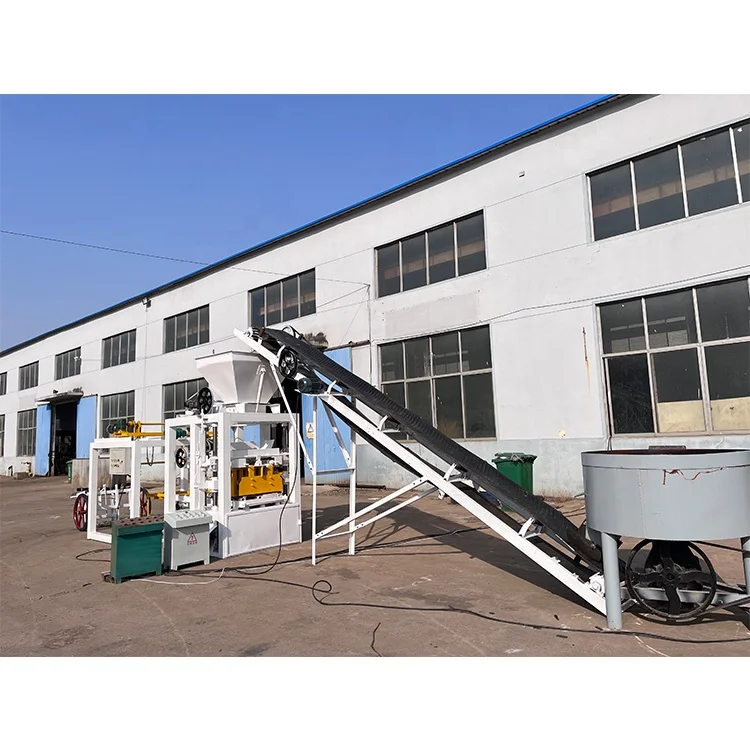
Matched Line Throughput — every station from mixer to stacker timed against the QTJ4-24’s 24–26 second cycle so the press never waits on upstream supply or downstream pallet clearance.
Technical Specifications
| Parameter | Value |
|---|---|
| Model | QTJ4-24 |
| Product Type | Stationary Concrete Block Making Machine |
| Molding Method | Mechanical (gear drive) |
| Molding Cycle | 24–26 s |
| Vibration Force | 45 KN |
| Vibration Configuration | 2×3 kW lower vibrators + 2×1.5 kW upper vibrators |
| Material Distribution | Full-automatic spiral |
| Pallet Size | 850×450 mm |
| Reducer (mold lifting) | 350-type |
| Overall Power | 11.95 kW |
| Control System | PLC Controlled |
| Drive Type | Engine Powered, Gear Drive |
| Overall Dimensions (L×W×H) | 3600×1700×2560 mm |
| Total Mass | 2 T |
| Raw Materials | Cement, sand, stone |
| Automation Level | Semi-automatic (mechanical molding with automatic material distribution) |
| Capacity | basis not stated in source — confirm block format, material and thickness |
Application Suitability
| Application | Material or Output |
|---|---|
| Hollow block production for wall construction | Cement, sand, crushed stone aggregate |
| Solid brick manufacturing for load-bearing structures | Cement, sand, fine aggregate |
| Interlocking brick for paving and landscaping | Cement, sand, coarse aggregate |
| Paving brick for walkways and yards | Cement, sand, stone dust |
| On-site block production for housing projects | Locally sourced cement and aggregate |
Why Mixer Sizing Decides Your Real Output
The press cycle means nothing if the mixer cannot feed it.
Many buyers focus on the molding cycle when evaluating a stationary block making machine production line, but I have watched a well-timed press sit idle because the upstream mixer could not keep a consistent batch ready. With the QTJ4-24 completing a cycle every 24–26 seconds, the material demand is continuous. If the mixer batch size or discharge rate falls short, the press operator is left waiting on a hopper that is only half full, and the spiral distributor pulls air instead of mix. Over a shift, those pauses add up to a significant portion of lost capacity [NEED_CITE: industrial batch cycle synchronization for block production]. The correct approach is to calculate the mixer output in kilograms per minute against the volume each mold draw consumes, and then add margin so the hopper never runs below one-third full.
Feeding Rhythm and the Spiral Distributor
The full-automatic spiral material distribution on the QTJ4-24 moves mix from hopper into the mold cavity in a controlled sweep. In a balanced stationary block making machine production line, the spiral must receive a steady stream of material at consistent moisture and slump. If the upstream batch varies — too dry one cycle, too wet the next — the spiral fills unevenly and the resulting block density shifts from piece to piece. Keeping the mixer discharge synchronized with the spiral intake is what holds block strength within tolerance across a full shift.
Vibration Transfer Through a Dual-Layer System
The QTJ4-24 carries four vibrators in a dual-layer arrangement: two 3 kW units below and two 1.5 kW units above the mold. This configuration pushes vibration energy from both directions, compacting aggregate toward the center of the cavity rather than leaving a dense base and a weak top face. On a stationary block making machine production line, consistent vibration transmission depends on the mold sitting flush against the table and the pallet staying flat. Any gap introduced by a warped pallet or worn table surface absorbs energy before it reaches the mix [NEED_CITE: vibration damping in concrete block molding]. The 45 KN total vibration force is adequate for standard hollow and solid formats, but the actual density achieved also depends on the mix design and aggregate grading used at the site.
Gear Drive, Reducer and Continuous Line Duty
The 350-type reducer handles mold lifting through a mechanical gear drive rather than a hydraulic circuit. This keeps the electrical and hydraulic systems simpler, which matters when the maintenance crew is small and spare hydraulic seals are hard to source locally. For a stationary block making machine production line running two shifts, the gear and reducer must be greased at the intervals stated in the manual, and the gear teeth inspected for wear every few months. Because the engine-powered drive is independent of the vibration circuit, a fault in one does not automatically halt the other, giving the operator a chance to finish the current batch before stopping for repair.
Reading the Specs That Actually Matter
The 850×450 mm pallet size determines how many blocks fit on a single board and therefore how many boards the curing area must hold at peak output. If the buyer already has a forklift and curing racks sized for a different pallet, the entire downstream handling plan needs to change. The 11.95 kW total power draw is modest, but the site still needs a dedicated circuit with voltage and frequency matching the motor ratings — running a 380 V machine on a 220 V supply will burn out the vibration motors within days. The PLC control allows integration with upstream batching signals and downstream pallet conveyor triggers, but only if the language and communication protocol are confirmed before the panel is wired at the factory.
What Happens When the Line Is Not Balanced
I once saw a plant owner purchase a press based on its quoted cycles per hour without asking which block format that figure assumed. The machine arrived, the first test ran on a hollow block, and the output looked acceptable. Then the buyer switched to a thicker interlocking paver and the cycle stretched well past the quoted range because the vibration time needed to fully compact a denser format was longer. Meanwhile, the mixer was still batching at the faster hollow-block rate, so mix sat in the hopper losing moisture and workability. The result was a surface finish that crumbled on demolding and a curing yard full of rejects [NEED_CITE: block density variance from unbalanced line timing]. None of this was the press’s fault — it was a line that had never been specified as one system.
Why Buyers Source the Line Here
Block machinery is a single focus for the supplier behind this stationary block making machine production line, which means the press, mold, pallet, and handling equipment are specified as one matched set rather than sourced from separate vendors. Configuration is based on the buyer’s actual mix design and local aggregate, not pulled from a catalogue default. Molds are designed and supplied for the formats the buyer’s market actually sells, including custom drawings. The automation level is selectable, so a buyer can start with semi-automatic pallet handling and add stacking later. Installation support includes operator training so the crew knows how to read the PLC alarms and adjust feed timing before the first production run [NEED_CITE: operator training impact on block plant commissioning].
Documentation & Verification
- Line layout drawing showing every station from mixer to curing rack with cycle times matched to the QTJ4-24 press
- Capacity calculation sheet stating the exact block format, wall thickness and mix ratio assumed for each output figure
- Pallet specification matched to the buyer’s existing forklift fork width and curing rack spacing
- Voltage, frequency and PLC display language confirmation signed off before the control panel is wired
- Factory test record run on the buyer’s specified block format before the machine is dismantled for shipment
Installation, Commissioning & Support
- Foundation pad poured level within tolerance to support the 3600×1700 mm footprint and 2 T operating mass of the QTJ4-24
- Dedicated power circuit matching the confirmed voltage and frequency for the 11.95 kW total load, with isolated breaker for vibration motors
- Machine arrives dismantled for container loading; reassembly on site follows a marked sequence with bolt torque checks at each station
- First-run commissioning includes adjusting the spiral feed timing and vibration duration against the buyer’s local aggregate and cement
- Operator training covers PLC alarm response, mold change procedure using the 350-type reducer, and daily greasing of the gear drive
- Wear parts list provided with mold liner and vibrator mount dimensions so local fabrication is possible if original spares are delayed
Preparing Your Inquiry
Before requesting a quotation, gather the block formats you need to produce along with target daily output for each, your workshop dimensions and clear height, and the voltage and frequency available at the site. Also note whether you already have a mixer, pallet conveyor, or curing racks, and whether the PLC display needs to be in a specific language. This information allows the line to be configured around your actual conditions rather than a generic template.
Frequently Asked Questions
Q: How is realistic daily output calculated for the QTJ4-24, and which block format is assumed?
A: Daily output is calculated by multiplying the confirmed molding cycle for a specific block format by the number of blocks per pallet, then applying a realistic shift utilization factor. The 24–26 second cycle applies to standard hollow blocks; denser formats like interlocking pavers require longer vibration and extend the cycle. We provide a per-format capacity sheet rather than a single headline number.
Q: What supporting equipment must be matched to the QTJ4-24 cycle time?
A: The mixer batch size and discharge rate must refill the hopper before the spiral distributor draws it down. The pallet feeder must present a fresh board within the mold change window. Downstream, the stacking and curing rack system must clear finished pallets fast enough that the press output table never backs up. Each station is sized against the 24–26 second cycle.
Q: Can the pallet size be changed to match my existing curing area and forklift?
A: The standard pallet is 850×450 mm, but the mold and feed system can be configured around a different pallet dimension if the buyer’s curing racks and forklift are already in place. This must be confirmed before production starts, because the pallet size affects mold cavity layout, spiral reach, and the pallet conveyor width.
Q: What voltage and PLC language options are confirmed before shipment?
A: Voltage and frequency are matched to the buyer’s site supply — typically 380 V / 50 Hz or 440 V / 60 Hz — and written into the production order. The PLC display language is confirmed at the same stage so the operator can read alarms and cycle parameters on arrival. Both items require buyer sign-off before the control panel is assembled.
Q: How does the line layout change if I upgrade from semi-automatic to fully automatic stacking later?
A: The press and mold remain unchanged. A fully automatic stacker and cubing system replaces the manual pallet handling at the output end, and the PLC program gains a stacking sequence routine. The pallet conveyor is extended and a chain transfer station is added. This upgrade can be planned at initial purchase so the foundation pad and cable routing leave space for the future equipment.


