
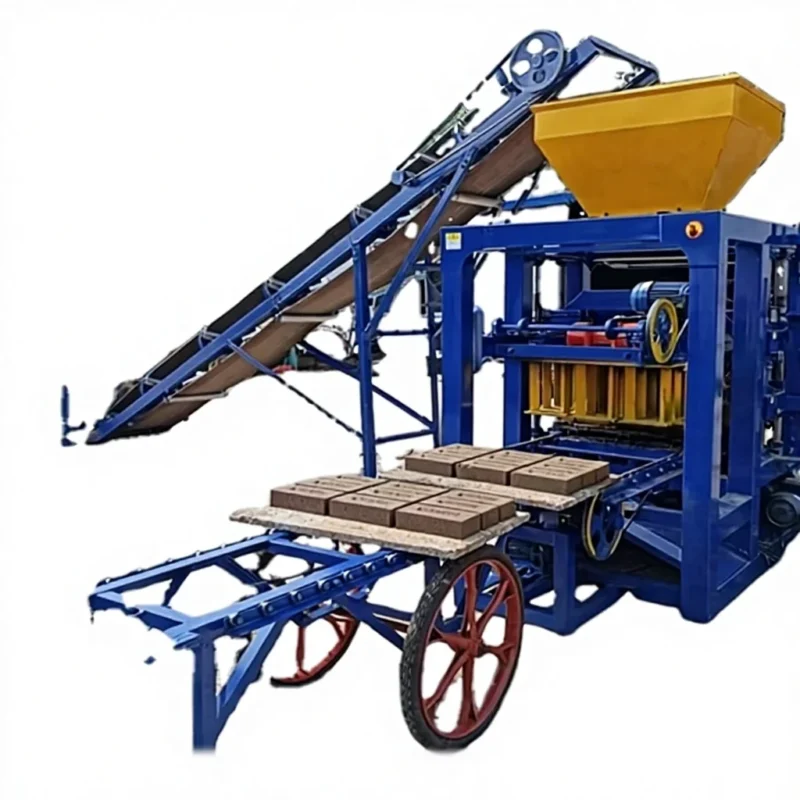
Matched Line Engineering — mixer, conveyor, press and pallet flow are sized together so the QTJ4-24 is never left waiting between stations.
Technical Specifications
| Parameter | Value |
|---|---|
| Model | QTJ4-24 |
| Product Type | Semi-Automatic Concrete Block Making Machine |
| Machine Frame | Dragon gate style, super steel with four wear-resisting vertical shafts |
| Molding Type | Platform Vibration |
| Lower Vibration | 2 × 3kW high-speed motors, vertical vibration box |
| Upper Vibration | 1.5kW attached vibration device |
| Elevating System | Cone-shape motor, JZQ250 speed reducer, V-belt drive |
| Delivery Device | Cycloidal pin wheel reducer, chain and belt, self-conveying frame |
| Overall Dimensions | 3600mm × 1700mm × 2560mm (working state) |
| Total Mass | 1750kgs |
| Overall Power | 14.25kW |
| Pallet Size | 850mm × 450mm |
| Mould Format | 390×190×190mm (4 pcs/mould) / 240×115×53mm (21 pcs/mould) |
| Cycle Time | 24 seconds per mould (basis to be confirmed against block format and mix) |
| Control System | Electronic controlling part (type and language to be confirmed) |
| Voltage & Frequency | Configurable to target market (to be confirmed before production) |
| Automation Level | Semi-automatic, mechanical and electronic combination |
| Material Storing | Material releasing hopper + storing hopper, bolt-fixed to frame |
| Supporting Equipment | JQ350 pan mixer, 6m belt conveyor |
| Optional Equipment | Auto stacker (3–6 layers), curing yard trolley |
Application Suitability
| Application | Material or Output |
|---|---|
| Hollow concrete block production | Crushed stone, sand, cement and fly ash blends for 390×190×190mm blocks |
| Solid brick manufacturing | Fine aggregate and cement mixes for 240×115×53mm bricks |
| Paving brick production | High-density aggregate blends for interlocking and rectangular pavers |
| On-site construction supply | Small-batch hollow blocks and solid bricks produced at the building site |
| First plant startup | Low-investment stationary line for entrepreneurs entering block production |
Why Pallet Handling Decides Your Actual Daily Output
A semi-automatic block making machine production line is only as fast as its slowest station downstream of the press.
When the QTJ4-24 completes a mould cycle every 24 seconds, a fresh pallet of wet blocks exits the press and must move to the curing yard before the next pallet arrives. If that movement relies on a single worker carrying pallets by hand, the press sits idle while the operator walks to the yard and back. Over a shift, those idle gaps accumulate into a noticeable gap between the rated cycle time and the blocks actually cured and sold. I have seen lines in Central America where the press was technically capable of much more, but the real bottleneck was a worker pushing a wheelbarrow across uneven ground. The pallet handling plan is the part of the quotation that most suppliers leave blank, and it is the part that most often causes the buyer to call six months later asking why output fell short. [NEED_CITE: pallet logistics as the leading cause of output shortfall in small block plants]
How the Line Stations Connect Around the Press
The JQ350 pan mixer feeds the 6m belt conveyor, which delivers mixed material into the QTJ4-24 hopper at a rate matched to the press cycle. The material storing hopper on the frame holds enough for several cycles, so the mixer does not need to run continuously — it batches, the conveyor carries, and the hopper buffers. This semi-automatic block making machine production line is designed so that material arrives slightly ahead of demand rather than slightly behind it, keeping the press from waiting on a half-empty hopper.
Where the Cycle Time Meets the Curing Yard
Once blocks leave the press, the optional auto stacker lifts 3 to 6 layers per pallet, and the curing yard trolley carries them to the drying area. The trolley route must be planned before the line is installed — a path that crosses a forklift lane or climbs a ramp will slow every trip, and those seconds compound across hundreds of cycles per shift. The 850×450mm pallet size must match the curing rack spacing and the forklift the buyer already owns. A pallet that is too wide for the rack means blocks sit on the ground; a pallet that does not fit the forklift tines means another manual lift. These details are not optional extras — they are part of the semi-automatic block making machine production line working as a single system. [NEED_CITE: curing rack compatibility with pallet dimensions in block production]
What the Numbers on the Frame Actually Mean for Your Blocks
The dual 3kW lower vibration motors drive a vertical vibration box beneath the platform, while the 1.5kW upper vibration device applies pressure from above. Together they compact the mix from both directions, which matters when the local aggregate has a different particle shape than the default test material. The dragon gate frame with four wear-resisting vertical shafts keeps the mould aligned through thousands of cycles — if the shafts wear unevenly, block dimensions drift and pallets jam at the exit. The JZQ250 speed reducer on the elevating system controls the rate at which the upper mould head descends, and that descent speed directly affects whether the mix settles evenly or traps air pockets in the corners of a hollow block. The overall power draw of 14.25kW across all stations means most small-plant electrical panels can support the line without a dedicated transformer upgrade, but the voltage and frequency must still be confirmed for the target market before the control panel is wired.
The Hidden Cost of Skipping the Line Layout Step
When a buyer purchases the press alone and sources the mixer, conveyor and pallet handling locally, the stations rarely align on cycle time. A mixer that batches too slowly starves the hopper; a conveyor that runs too fast floods it. A stacker that handles fewer layers than the press outputs means pallets pile up at the exit, and workers begin hand-stacking — reintroducing the very bottleneck the machine was meant to remove. I have visited plants where the curing trolley wheels were the wrong gauge for the yard track, so every tenth trip derailed, and the press sat idle while someone reset the wheels. These are not machine faults. They are line integration gaps that a matched quotation prevents. [NEED_CITE: integration mismatch as a source of unplanned downtime in block lines]
What a Matched Quotation Actually Covers
Block machinery is our single focus, so the QTJ4-24 is never quoted as a standalone press disconnected from the stations around it. The configuration is set against your actual mix design and local aggregate, not a catalogue default that assumes a specific sand source. Mould design covers the formats your market actually sells, including custom drawings if your buyers need a size outside the standard 390×190×190mm range. The automation level is selectable — you can start with manual pallet handling and add the auto stacker later without replacing the press. Installation support includes operator training on the specific control language and voltage your plant runs on, not a generic manual in a language your team does not read. Wear parts and mould replacement lists are provided at delivery so the first reorder happens before the first breakdown, not after.
Documentation & Verification
- Line layout drawing showing station spacing and pallet flow path for your site dimensions
- Capacity calculation stating the block format and mix assumed for each output figure
- Mould drawing with format list covering every block type included in the quotation
- Voltage and control language confirmation sheet signed before the control panel is wired
- Factory test record showing cycle time and block density with your target mould installed
- Pallet specification matched to your curing rack spacing and forklift tine width
Installation, Commissioning & Support
- Foundation plan accounting for the 3600×1700mm footprint and vibration isolation requirements
- Electrical circuit rated for 14.25kW total load with voltage confirmed for local grid supply
- Machine arrives with upper vibration device and hopper bolt-fixed for transport, field-assembled on site
- First production run supervised with mould alignment checked against the four vertical shafts
- Operator training covers mould change procedure and electronic control panel in confirmed language
- Wear parts list identifies vertical shaft sleeves and vibration motor bearings for first reorder cycle
What We Need to Configure Your Line
Before we build a quotation, we need to know the block formats your market buys and the daily volume you are targeting in each format. Tell us what raw materials are available locally — the aggregate type, cement grade and any industrial by-products like fly ash — so the mix design can be set before the vibration force is calibrated. Share your site dimensions, existing curing rack spacing and forklift specification so the pallet size and trolley route can be designed around what you already have, not the other way around.
Frequently Asked Questions
Q: How is daily output calculated for the QTJ4-24, and which block format does it assume?
A: The 24-second cycle time is measured with a specific mould installed and a specific mix consistency. Hollow blocks at 390×190×190mm produce 4 pieces per cycle, while solid bricks at 240×115×53mm produce 21 per cycle. Daily output depends on shift length, pallet handling speed and curing yard capacity — not just the press cycle. We provide a capacity table stating the format assumed for each output figure.
Q: What supporting equipment is included versus optional in the line quotation?
A: The JQ350 pan mixer and 6m belt conveyor are included as standard. The auto stacker and curing yard trolley are optional but strongly recommended — without them, pallet handling becomes manual and the press sits idle between cycles. We quote both configurations so you can see the difference in labour and output before deciding.
Q: How do the mixer and conveyor match the QTJ4-24 press cycle?
A: The JQ350 batches enough material for several press cycles, and the 6m belt conveyor delivers it into the frame-mounted storing hopper at a steady rate. The hopper buffers the flow so the press never waits on a half-empty batch. If you change block formats or mix density, the batch timing is adjusted during commissioning.
Q: What pallet size and material do I need, and will it fit my curing yard?
A: The QTJ4-24 uses 850×450mm pallets. Before production, we check this against your curing rack spacing and forklift tine width. If your existing racks are narrower, we adjust the pallet spec or recommend a rack modification — because a pallet that does not fit the rack means blocks sit on the ground and cure unevenly.
Q: What electrical details must be confirmed before shipment?
A: Voltage, frequency and the electronic control panel display language must be locked before the control panel is wired. A 380V/50Hz panel sent to a 440V/60Hz site will not commission without a transformer swap, and a display in the wrong language slows operator training. We confirm all three in writing before production begins.


