
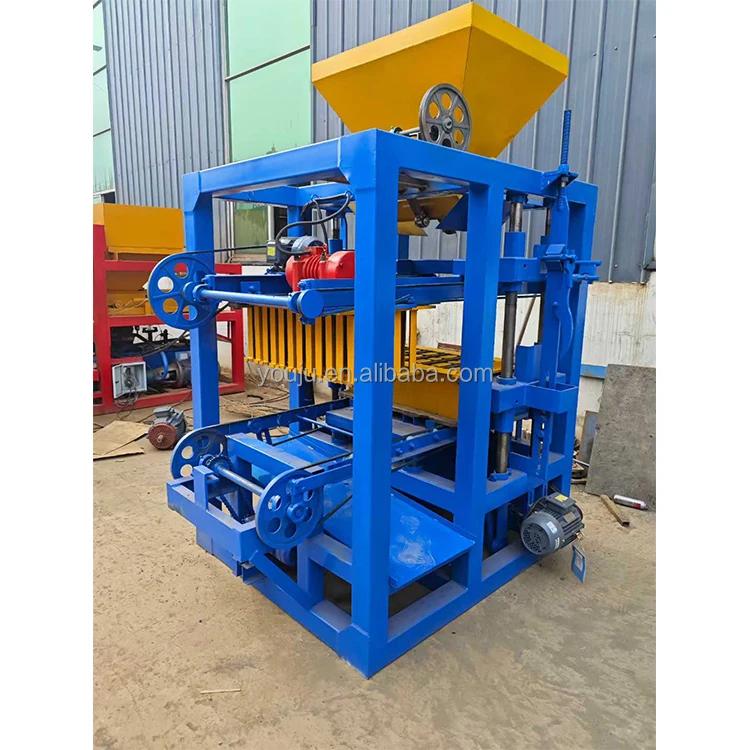
Integrated Line Matching — Every station from the JQ350 mixer through the 6m belt conveyor to the optional stacker is timed against the press cycle so the machine never waits for feed or pallets.
Technical Specifications
| Parameter | Value |
|---|---|
| Model | QTJ4-24 |
| Product Type | Semi-Automatic Concrete Block Making Machine |
| Machine Type | Stationary, Platform Vibration |
| Molding Type | Platform Vibration (lower and upper) |
| Overall Dimensions (L×W×H) | 3600mm × 1700mm × 2560mm (working state) |
| Total Mass | 1750 kgs |
| Pallet Size | 850mm × 450mm |
| Overall Power | 14.25 kW |
| Lower Vibration Motors | 2 × 3 kW (high speed motors) |
| Upper Vibration Power | 1.5 kW (attached vibration device) |
| Elevating System | Cone-shape motor with JZQ250 speed reducer, V-belt drive |
| Delivery Device | Cycloidal pin wheel speed reducer with chains and V-belt |
| Machine Frame | Dragon gate style, super steel, four vertical wear-resisting shafts |
| Mould Format Examples | 390×190×190mm (4 pcs/mould); 240×115×53mm (21 pcs/mould) |
| Output Capacity | basis not stated in source — confirm block format and mix |
| Cycle Time | basis not stated in source — confirm block format |
| Automation Level | Semi-automatic (mechanical and electronic combined operation) |
| Control System | Electronic controlling part (PLC or relay logic to be confirmed) |
| Voltage & Frequency | To be confirmed for destination market |
| PLC Display Language | To be confirmed |
| Stacking Method | Manual pallet handling; optional auto stacker (3–6 layers) |
| Hydraulic Pressure | Not applicable — mechanical vibration system |
| Line Configuration | JQ350 pan mixer, 6m belt conveyor (standard) |
| Optional Equipment | Auto stacker, block clamper, diesel generator, wheel loader, forklift |
| Assembly State | Fully assembled frame with bolt-fixed hoppers and components |
Application Suitability
| Application | Material or Output |
|---|---|
| Hollow block production for housing projects | Crushed stone, sand, cement with local aggregate blends |
| Solid brick manufacturing for masonry walls | River sand, stone dust, cement mixes |
| Small to medium block plant startup | Standard concrete mixes with locally sourced aggregate |
| On-site block production by contractors | Concrete mixes matched to site-available raw materials |
| Format diversification for existing plants | Multiple mould formats on a single pallet size (850×450mm) |
What "Semi-Automatic" Actually Means for Your Daily Output
The semi-automatic block machine production line only delivers its rated output when mixer feed rate, conveyor speed, and pallet handling are all matched to the press cycle.
Many quotations list a cycle number without naming the block format behind it, so a plant expecting thousands of hollow blocks per shift finds the real count far lower once the line is running. I have walked through commissioning where the mixer could not keep up with the press, leaving the operator standing idle between cycles while the conveyor belt sat empty. That gap between quoted and real throughput is almost always a line-balance problem, not a machine problem [NEED_CITE: line balance principles in concrete block manufacturing]. With the QTJ4-24 paired to a JQ350 pan mixer and 6m belt conveyor, the feed side is specified to match press demand — but daily output still depends on which mould you run, what your local aggregate looks like, and how quickly pallets move through curing.
Matching Every Station Around the Press
The QTJ4-24 press sits at the centre of this semi-automatic block machine production line, but it cannot run faster than the slowest station feeding or clearing it. The JQ350 pan mixer must deliver a consistent batch to the 6m belt conveyor at a rate that fills the press hopper before each cycle begins. If the mixer batch size or mixing time drifts, the press waits. That is why the mixer and conveyor are specified as standard line equipment rather than left to the buyer to source separately — the feed rate is already calculated against the press cycle.
Where Manual Handling Ends and Automation Begins
On a semi-automatic block machine production line, the operator still moves pallets between the press output and the curing area by hand unless an auto stacker is added. The optional stacker handles three to six layers depending on block height, removing the heaviest repetitive task from the shift. This matters because manual pallet handling speed directly caps how fast the press can cycle — if the operator cannot clear the finished pallet before the next press stroke, the entire line slows down [NEED_CITE: manual versus automated pallet handling in block plants].
Vibration Force, Frame Rigidity, and Block Density
The dual 3 kW lower vibration motors and the 1.5 kW upper vibration device work together to compact the concrete mix from both directions, which is what gives the block its green strength before curing. The dragon gate frame with four wear-resisting vertical shafts keeps the mould aligned through thousands of cycles — if the frame flexes, the upper vibration head does not seat evenly and density varies across the pallet. For the 850×450mm pallet size, that even compaction across the full mould area is what determines whether blocks at the edge of the pallet meet the same strength standard as blocks in the centre.
When the Pallet Size Does Not Fit Your Curing Area
I once set up a line where the buyer never checked the 850×450mm pallet against the curing racks already built on site. The pallets were too wide for the rack slots, so every pallet had to be re-stacked by hand before curing — doubling the labour the semi-automatic configuration was supposed to reduce. The same issue appears with forklifts: if the fork width does not match the pallet dimension, pallets tip during transport to the yard. Confirming pallet size against existing infrastructure is a five-minute check that prevents weeks of frustration after arrival [NEED_CITE: pallet sizing and curing rack compatibility in block production].
Why a Matched Line Is Quoted as One System
Sourcing the mixer, conveyor, and stacker from separate suppliers means no single party is responsible when cycle times do not align. This semi-automatic block machine production line is configured as one package so the press, mixer output, conveyor feed rate, and optional stacker speed are all specified against the same block format and mix design. If commissioning reveals a bottleneck, the adjustment happens within one line specification rather than across three purchase orders and three warranty boundaries.
Documentation & Verification
- Line layout drawing showing station spacing, conveyor length, and pallet flow direction
- Capacity calculation sheet stating which block format the output figure assumes
- Factory test record with mixer, conveyor, and press running together under load
- Voltage, frequency, and control language confirmation signed before dispatch
- Pallet specification sheet with dimensions and load rating matched to curing setup
- Wear parts and mould list with recommended replacement intervals
Installation, Commissioning & Support
- 3600×1700mm footprint requires level concrete pad with anchor bolt provision for the 1750 kg frame
- 14.25 kW total power draw needs dedicated circuit with correct voltage and frequency confirmed pre-shipment
- Frame ships fully assembled; hoppers and bolt-fixed components re-secured on site
- JQ350 mixer and 6m belt conveyor aligned and tensioned during first-run commissioning
- Operator training covers mould change procedure, vibration timing, and pallet feed rhythm
- Wear parts list provided with first replacement order recommendations
What to Include in Your Inquiry
Send the block format you intend to produce, the daily volume your market absorbs, and a sample or description of the aggregate available locally so the mix can be tested before the line is locked in. Confirm the voltage, frequency, and control display language for your site, and state whether an auto stacker is needed or if pallets will be handled manually. If you already have curing racks or forklifts on site, include their dimensions so the 850×450mm pallet is checked against them before production begins.
Frequently Asked Questions
Q: How is the daily output calculated, and which block format does it assume?
A: The QTJ4-24 capacity depends entirely on the mould format running — a 390×190×190mm hollow block yields four pieces per cycle while a 240×115×53mm solid brick yields twenty-one. We state the assumed format, cycle time, and shift length in every capacity calculation so the daily figure matches what your plant will actually produce.
Q: Does the JQ350 mixer output match the press cycle to avoid idle time?
A: Yes. The JQ350 pan mixer and 6m belt conveyor are specified as standard line equipment with batch size and feed rate calculated against the press demand. If your mix design requires longer blending, we adjust the mixer timing before the line is dispatched rather than discovering the mismatch on site.
Q: Will the 850×450mm pallet fit my existing curing racks and forklift?
A: That depends on your current setup. We ask for your curing rack slot dimensions and forklift fork width during the inquiry stage so the pallet specification is cross-checked before production. A mismatch here is one of the most common reasons a new line underperforms in the first month.
Q: Which stations are included in the quotation — is stacking covered?
A: The standard line includes the press, JQ350 mixer, 6m belt conveyor, and a trolley. Pallet stacking downstream of the press is manual unless you add the optional auto stacker, which handles three to six layers. Curing rack handling and cubing are separate scope items and quoted only if requested.


