
Matched Line Rhythm — the QTJ4-24 press cycle, spiral feeder, and 850×450mm pallet are specified as one timed system so upstream mixing and downstream stacking never force the press to idle.
Technical Specifications
| Parameter | Value |
|---|---|
| Product Type | Automatic Concrete Block Making Machine |
| Model | QTJ4-24 |
| Overall Dimensions (L×W×H) | 3600×1700×2560mm |
| Pallet Size | 850×450mm |
| Molding Cycle | 24-26s |
| Overall Power | 11.95kW |
| Vibration Force | 45kN (2×3kW lower + 2×1.5kW upper vibrators) |
| Total Mass | 2T |
| Molding Method | Mechanical |
| Material Distribution | Full-automatic spiral |
| Reducer for Mold Lifting | 350-type |
| Materials | Cement, sand, stone |
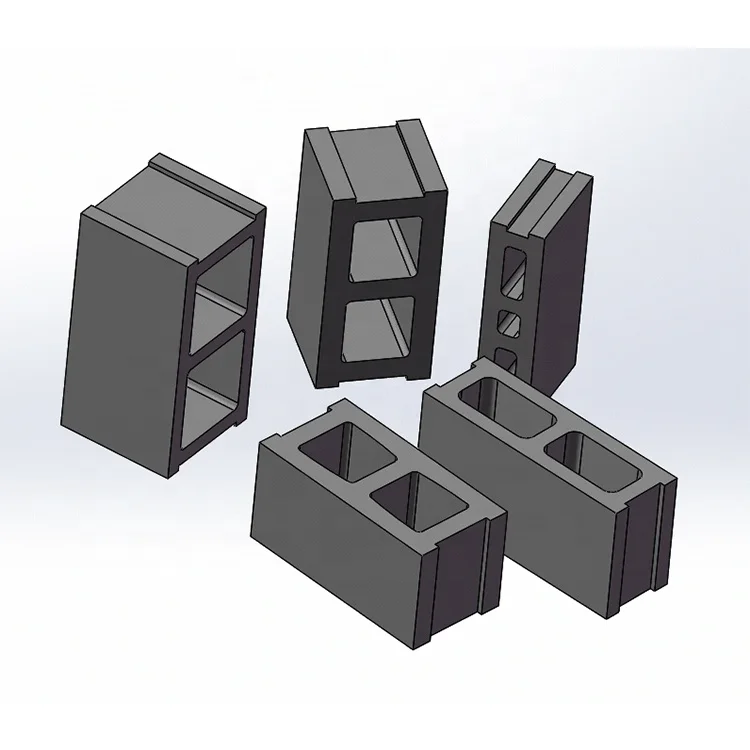
| Mould Format | Hollow bricks, interlocking bricks, paving bricks, solid bricks |
| Output Capacity | (basis not stated in source — confirm block format / material / thickness) |
| Automation Level | Semi-automatic (mechanical molding, spiral feeding) |
| Warranty | 1 year for whole machine (excluding spare parts) |
Application Suitability
| Application | Material or Output |
|---|---|
| Hollow block production for building walls | Cement, sand, crushed stone aggregate |
| Solid brick manufacturing for load-bearing structures | Cement, sand, stone mix |
| Interlocking brick production for retaining walls | Cement, sand, graded stone |
| Paving brick production for walkways and yards | Cement, sand, fine aggregate |
| Small-to-medium block plant operations | Semi-automatic line with manual pallet handling |
| On-site construction block production | Portable setup with local material sourcing |
What the Molding Cycle Number Actually Means for Your Line
A 24-26 second cycle only holds if every station upstream and downstream keeps the same rhythm.
I have walked into plants where the press sat idle for seconds between cycles because the mixer discharged too slowly or the pallet return conveyor lagged behind. The concrete block production line QTJ4-24 is rated at one cycle every 24-26 seconds, but that number assumes the spiral feeder has material ready, the pallet is positioned, and the finished block has been cleared. When any of those conditions slip, the real output drops well below what the spec sheet suggests [NEED_CITE: actual versus rated output in block production lines]. The block making machine supporting equipment must be sized and timed to match, not selected independently from a catalogue.
Feeding Station Synchronization with the Press
The full-automatic spiral material distribution on the QTJ4-24 is designed to charge the mold cavity uniformly within the 24-26 second window. If the mixer upstream cannot deliver a fresh batch to the hopper before the spiral starts its next feed, the press waits. A mixer with insufficient discharge capacity creates a bottleneck that no amount of press speed can overcome. The concrete block production line QTJ4-24 performs only as fast as its slowest station allows.
Pallet Circulation and Downstream Clearance
The 850×450mm pallet carries the freshly pressed block to the curing area. If pallets are not returning fast enough — because stacking is done by hand or the curing racks are full — the press has no surface to mold onto. Every pallet in circulation must complete its loop within the cycle window. This is where most block making machine supporting equipment layouts fail: the press is capable, but the pallet loop is not [NEED_CITE: pallet circulation requirements in semi-automatic block plants]. Planning pallet quantity, rack capacity, and forklift routes before the line ships prevents idle time from the first day of operation.
Vibration and Pressure Balance Across Formats
The QTJ4-24 uses a dual-level vibration system producing 45kN total force — two 3kW lower vibrators and two 1.5kW upper vibrators — combined with mechanical press pressure. This combination determines block density and surface finish. Different block formats demand different vibration profiles: a hollow block with thin walls needs sustained vibration to fill narrow mold cavities, while a solid paving brick requires higher pressure for compaction. The 350-type reducer controlling mold lifting must operate reliably across thousands of cycles per shift, because any hesitation in the lift mechanism disrupts the rhythm and risks damaging the freshly formed block. Matching vibration force to the buyer’s specific mix design and local aggregate is essential; a configuration tuned for one material may produce weak or cracked blocks with another.
When Supporting Stations Are Left Out of the Quotation
I have seen plants invest in a press and then discover that pallet handling, stacking, and curing rack systems were not part of the delivered scope. The result is workers carrying heavy pallets by hand, curing areas overflowing with blocks stacked on the floor, and the press waiting for someone to clear the output station. This is not a failure of the machine — it is a failure of line planning [NEED_CITE: hidden costs of incomplete block production line quotations]. When block making machine supporting equipment is specified separately or omitted entirely, the press capacity printed on the nameplate becomes irrelevant to actual daily output.
Why Line-Level Specification Matters Here
Every configuration starts with the buyer’s target block format, local raw material, and site conditions — not a default catalogue entry. The QTJ4-24 is specified alongside its pallet size, feeder type, and automation level as a timed system. Pallet dimensions are cross-checked against the buyer’s existing curing racks and forklift capacity before production begins. Mould options cover the formats the buyer’s market actually sells, including custom drawings where standard moulds do not fit. Voltage, frequency, and control language are confirmed before the line enters assembly, avoiding commissioning delays at the destination. Installation support includes operator training on the full line, not just the press station.
Documentation & Verification
- Line layout drawing showing station cycle times and buffer points for the QTJ4-24
- Pallet specification sheet matched to curing rack dimensions and forklift load rating
- Capacity calculation stating block format, mix design, and aggregate assumptions
- Voltage, frequency, and PLC display language confirmation record before assembly
- Factory test record on the buyer’s target block format before dispatch
- Operation and maintenance manual covering press and all supporting stations
Installation, Commissioning & Support
- Foundation plan based on 3600×1700mm footprint and 2T operating mass of the QTJ4-24
- Electrical connection verified against confirmed voltage and frequency before wiring
- Machine shipped in dismantled state with reassembly supervised on site
- First-run parameter setting for mold cycle, vibration intensity, and spiral feed timing
- Operator training on full line including pallet handling and stacking procedures
- Wear parts list with hydraulic seals and vibration motor bearings identified for first replacement
Before You Request a Quote
To size the concrete block production line QTJ4-24 correctly, share the block format you sell most, the daily output you need for that specific format, and the cement-sand-stone mix available locally. Include your existing curing area dimensions, forklift capacity, and the voltage and frequency standard at your site. If you already operate upstream or downstream equipment, provide those specifications so the line rhythm can be matched end to end.
Frequently Asked Questions
Q: How do I verify real daily output when the QTJ4-24 is connected to the full line?
A: Request a line layout drawing that shows each station’s cycle time and buffer capacity. The 24-26 second molding cycle only translates to actual output when the mixer discharge rate, pallet return speed, and stacking method all keep pace. Ask for a capacity calculation that states which block format and mix design the number is based on.
Q: What mixer capacity and feeding rhythm prevent the press from waiting?
A: The spiral feeder on the QTJ4-24 draws material from the hopper each cycle. Your mixer must discharge a full batch into that hopper before the next feed cycle begins. Provide your mixer model and discharge rate so the feeding rhythm can be verified against the 24-26 second press cycle before the line is finalized.
Q: Does the 850×450mm pallet size match my existing curing racks and forklift?
A: The pallet dimensions must fit your curing rack slots and your forklift tine spacing. If your racks were built for a different pallet size, either the racks or the pallets need adjustment. Share your rack dimensions and forklift model so the pallet specification can be confirmed before production.
Q: Which supporting stations are included in the quotation and which are separate?
A: Confirm whether raw material feeding, pallet return, stacking, and curing rack handling are part of the delivered scope. The QTJ4-24 quotation should list every station from mixer discharge to cured block output. Any station marked as buyer-supplied needs its cycle time verified against the press rhythm.
Q: What electrical and control details must be confirmed before the line ships?
A: Voltage, frequency, and PLC display language should all be documented before assembly begins. The QTJ4-24 electrical system is built to the confirmed specification, and changing it after arrival causes commissioning delays. Provide your site voltage standard and preferred operator language at the inquiry stage.


