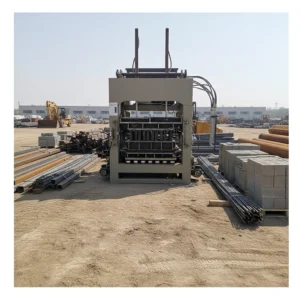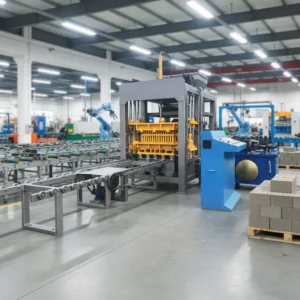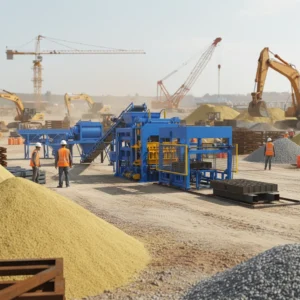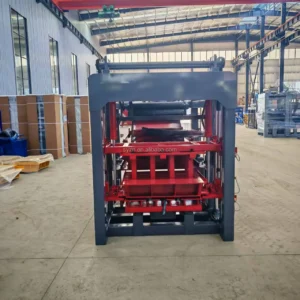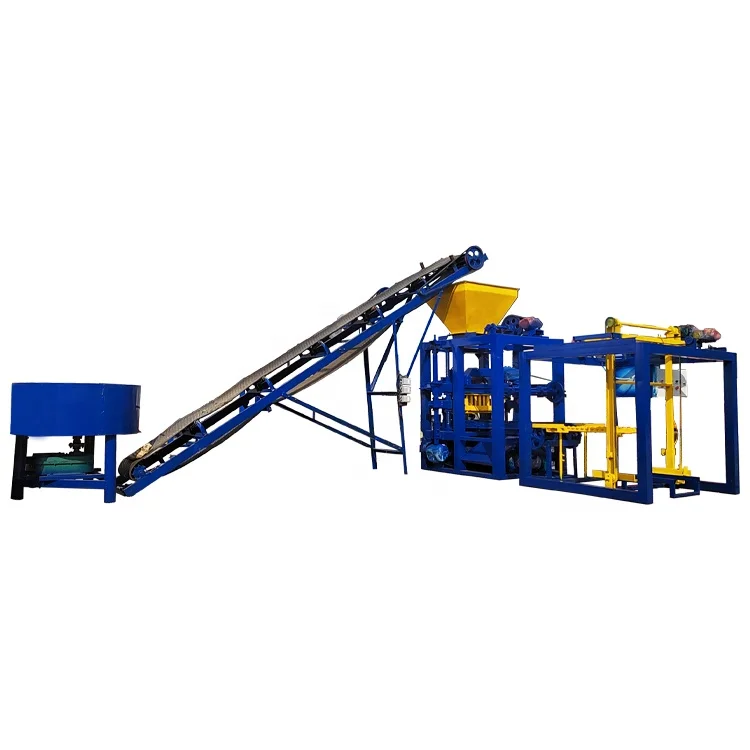
Line cycle matched upstream and down — the QTJ4-24 press is specified alongside the mixer, pallet feeder, and stacking stations so no node waits on another, based on the buyer’s actual block format rather than a catalogue default.
Technical Specifications
| Parameter | Value |
|---|---|
| Model | QTJ4-24 |
| Product Type | Concrete Block Making Machine |
| Overall Dimensions (L×W×H) | 2060×1700×2650 mm |
| Total Mass | 2000 kg |
| Rated Vibration Force | 35.5 kN |
| Main Vibration Form | Platform Vibration |
| Vibration Frequency | 4200 r/min |
| Pallet Size | 900×450 mm |
| Molding Cycle | 24 s (basis not stated in source — confirm block format / material / thickness) |
| Overall Power | 11.95 kW |
| Demolding Method | Vibration |
| Factory Area Required | 260 m² |
| Raw Materials | Crushed stone, sand, cement, fly ash, gravel, slag, dust |
| Control System | Not specified in source |
| Voltage & Frequency | Not specified in source |
Application Suitability
| Application | Material or Output |
|---|---|
| Hollow block production | Crushed stone, sand, cement blends |
| Solid block production | Fly ash, gravel, cement mixes |
| Paver and colored paver runs | Fine aggregate with cement and pigment |
| Interlocking block production | Sand, slag, cement combinations |
| Kerbstone and curb production | Coarse aggregate with cement binder |
| On-site contractor block making | Locally sourced aggregate and cement |
What a "24-Second Cycle" Actually Means for Your Line Layout
A molding cycle number without the block format attached is not a capacity figure — it is a starting point for line design.
I have stood on production floors in Nairobi and Dhaka where the press was cycling fine but the mixer could not feed fast enough, or the pallet return conveyor was bottlenecked by a stacker that was never quoted. The QTJ4-24 concrete block making machine production line only reaches its intended throughput when every station upstream and downstream is timed to the same cycle. That means the mixer discharge rate, the pallet feeder interval, and the stacking station speed all have to be calculated against the specific block format you are running — hollow, solid, or paver — because each format changes the demolding time and the handling load. [NEED_CITE: line synchronization standards for block production plants]
Matching the Mixer to the Press Interval
The QTJ4-24 draws 11.95 kW across its full operation, which sets the electrical provisioning baseline for the entire concrete block making machine production line. The mixer must deliver a batch volume that fills the mould box within the press cycle window, accounting for moisture content and aggregate gradation at your site. If the mixer is undersized, the press sits idle between cycles and daily output drops regardless of the rated vibration force. The raw material feeding station must also keep pace — a gravity-fed hopper behaves differently from a belt-fed system when handling high-slag mixes common in South Asian plants.
Pallet Flow Determines Real Daily Throughput
The 900×450 mm pallet size defines how many blocks leave the press per cycle, but it also determines the curing rack geometry and the forklift aisle width on your production floor. A pallet feeder that is not timed to the 24-second cycle (basis to be confirmed per format) will either pile pallets at the press exit or starve the press of empty pallets. Downstream, if the stacking station is omitted from the quotation, operators handle wet blocks manually — which introduces breakage and caps daily throughput well below the calculation on paper. [NEED_CITE: pallet handling impact on block plant throughput]
Reading the Vibration and Force Numbers Together
Platform vibration at 35.5 kN and 4200 r/min is the consolidation mechanism that determines block density and green strength at demolding. These two values must be evaluated against your local aggregate particle size and cement ratio — a coarse crushed-stone mix responds differently from a fine fly-ash blend. The vibration frequency sets the compaction speed while the force sets the consolidation pressure; if either is mismatched to the mix, blocks crack at demolding or fail compressive strength tests after curing. This is why the machine configuration should be set against a sample of your actual raw material, not a generic test mix. The 2060×1700 mm footprint of the QTJ4-24 also means the vibration isolation foundation must be sized to prevent resonance transfer to adjacent line stations.
The Cost of Quoting the Press Alone
When a quotation covers only the press and omits pallet handling, stacking, and curing rack systems, the buyer discovers on commissioning day that blocks are stacking by hand and output is limited by labour speed rather than machine speed. I have seen plants where the pallet return took two workers full-time, and curing rack handling added another two — labour that was never in the business plan. [NEED_CITE: common omissions in block machine quotations] A mismatched pallet size also forces a buyer to reconfigure the curing yard or purchase a different forklift, costs that appear months after the machine arrives. These gaps are not equipment failures; they are line-design failures that originated at the quotation stage.
Why Source the Full Line from One Specification Point
Block machinery is our single focus, which means the QTJ4-24 press, its moulds, pallets, and the surrounding handling equipment are specified as one matched system rather than assembled from separate suppliers. The line configuration is set against your actual mix design, local aggregate availability, and target block format — not a catalogue default. Mould design covers the formats your market actually sells, and custom mould drawings are available when your product range includes non-standard dimensions. Automation level is selectable, so a buyer can start with semi-automatic pallet handling and add automatic stacking later without replacing the press. Installation support includes operator training at your site, and the mould and wear-parts list ensures the first replacement cycle does not become a sourcing crisis.
Documentation & Verification
- Line layout drawing showing station spacing matched to the QTJ4-24 cycle interval
- Capacity calculation sheet stating the block format assumed for each output figure
- Pallet specification confirmed against your curing rack dimensions and forklift capacity
- Hydraulic and electrical schematic for integration with upstream batching and downstream stacking
- Voltage, frequency, and control language confirmation document before production release
- Factory test record run on your specified block format before dispatch
Installation, Commissioning & Support
- Foundation plan sized for the 2060×1700 mm footprint and 2000 kg mass with vibration isolation
- Electrical provisioning for 11.95 kW total draw with dedicated circuit and correct voltage confirmation
- Machine arrives partially dismantled for container loading — reassembly sequence provided on site
- First-run commissioning with parameter setting against your local aggregate and mix design
- Operator training covering mould change procedure, pallet loading, and daily maintenance checks
- Wear parts and mould list supplied with recommended replacement intervals by component
What to Include in Your Inquiry
To design the QTJ4-24 concrete block making machine production line around your actual site conditions, provide the block formats you intend to produce with target daily output per format, your local raw material types and gradation, and the available factory area and ceiling height. Confirm your site voltage and frequency along with the preferred control display language. If you have existing mixers, conveyors, or forklifts on site, share their specifications so the line can be built around them rather than replacing them.
Frequently Asked Questions
Q: How are cycle times matched between the QTJ4-24 press and upstream mixing and downstream pallet feeding stations?
A: Each station is timed against the press cycle for your specific block format. The mixer discharge rate, pallet feeder interval, and stacking station speed are calculated so no node waits on another. This prevents idle press time and ensures daily throughput matches the line layout calculation provided before order confirmation.
Q: What block format is the 24-second cycle based on, and how does output change across formats?
A: The 24-second cycle is listed without a stated block format basis, so it must be confirmed per product. Hollow blocks, solid blocks, and pavers each have different mould fill volumes and demolding requirements, which change the actual cycle time. A capacity calculation per format is provided during the configuration stage before line design is finalized.
Q: How does the 900×450 mm pallet size affect curing rack layout and forklift requirements?
A: Pallet dimensions define the curing rack slot width, rack height, and forklift tine spacing on your production floor. If your existing curing area or forklift does not match this pallet size, the line layout must account for reconfigured racks or different handling equipment. This confirmation happens during the proposal stage, not after delivery.
Q: Which supporting equipment must be included in the quotation to avoid manual handling gaps?
A: Raw material feeding, mixing, pallet feeding, stacking, and curing rack handling are the stations that surround the press. Omitting any of them shifts that function to manual labour, which caps throughput and introduces breakage. The quotation should list every station from material intake to stacked output so the line operates as a continuous system.
Q: What voltage and control language confirmation is required before shipment?
A: Site voltage, frequency, and PLC display language must be confirmed before production begins. Incorrect voltage delays commissioning while transformers are sourced locally, and an unfamiliar control language slows operator training. A written confirmation document covering all three parameters is part of the pre-production checklist.