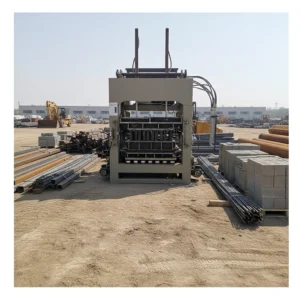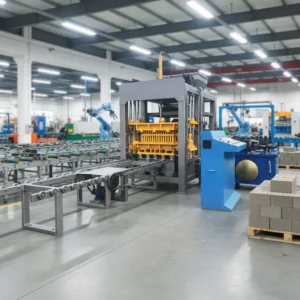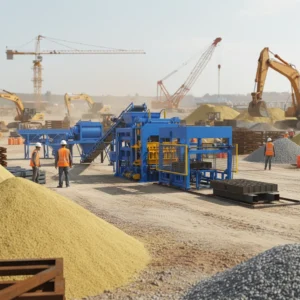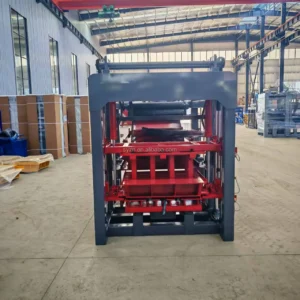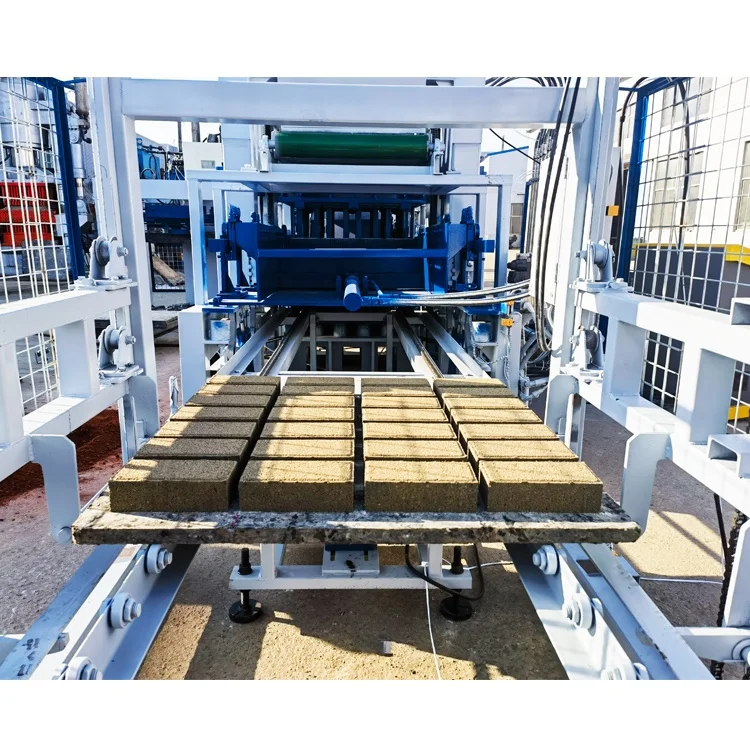
Station Timing Alignment — A complete QT8-15 block line where mixer, pallet feeder, press, conveyor and sweeper are specified as one matched system, so cycle times align and the press is not left idle between stations.
Technical Specifications
| Parameter | Value |
|---|---|
| Model | QT8-15 |
| Product Type | Automatic Hydraulic Concrete Block Making Machine |
| Overall Dimensions (L×W×H) | 8300×1860×3000 mm |
| Molding Cycle | 15–20s (basis not stated in source — confirm block format / material / thickness) |
| Vibration Force | 55 kN |
| Rated Power | 37.2 kW (rated or peak not specified in source) |
| Mixer | JS750 |
| Pallet Size | 1020×900 mm |
| Total Weight | 8 T |
| Control System | PLC Control System |
| Hydraulic Station | Included (pressure rating to be verified against catalog) |
| Applied Products | Paver, solid block, hollow block, curbstone (via mould change) |
| Raw Materials | Crushed stones, sand, cement, dust, fly ash |
| Included Stations | Block making machine, hydraulic station, PLC control, pallet feeder, block conveyor, sweeper, material feeder, mould, spare parts |
| Automation Level | Automatic (with pallet feeder and block conveyor) |
| Voltage & Frequency | To be confirmed before commissioning |
Application Suitability
| Application | Material or Output |
|---|---|
| Building material plant | Solid and hollow blocks from crushed stone, sand, and cement |
| Paving contractor | Concrete pavers and interlocking formats from fine aggregate and cement |
| Infrastructure project | Kerbstones and curb formats using dense mix designs |
| Existing block producer | Format switching via mould change across hollow, solid, and paver ranges |
What the Quoted Cycle Time Often Leaves Out in a QT8-15 Block Making Machine Production Line
The press is only as fast as the slowest station around it.
Buyers regularly see a cycle time on a spec sheet and calculate daily output by multiplying it across two shifts. In the field, pallet handling gaps, mixer supply delays, and manual conveyor clearing stretch that cycle well beyond the quoted number. On one West African site I worked, a line configured for high output lost nearly a third of its shift because the pallet return loop could not keep pace with the press [NEED_CITE: common pallet loop bottleneck causes in block lines]. The turnkey concrete block line only delivers its rated throughput when every station — feeding, pressing, conveying — is timed as a single system.
How the JS750 Mixer Keeps Pace with the Press
The QT8-15 press cycles every 15 to 20 seconds depending on the block format, and the JS750 mixer is sized so that a fresh batch arrives at the material feeder before the hopper runs low. Undersized mixers are a frequent cause of press idle time — the vibration table waits while the operator signals for more material. This pairing keeps the supply loop continuous through a standard shift.
Pallet Feeder and Conveyor as Part of the Cycle
The pallet feeder returns cured pallets to the press table on a timed loop that matches the molding cycle. Downstream, the block conveyor and sweeper clear finished product without requiring the operator to manually pull pallets or brush debris. This removes two common manual bottlenecks where cycle time stretches unpredictably.
Reading the Specs That Shape Line Balance
The 55 kN vibration force, combined with hydraulic pressure, determines the compaction density of each block. Higher vibration force produces denser blocks but requires the right mix consistency — too dry and the mix crumbles, too wet and it sticks to the mould [NEED_CITE: vibration force and mix moisture relationship in block compaction]. The 1020×900 mm pallet size dictates the curing area layout and forklift capacity a plant must have on site. The 37.2 kW rated power across the line requires a dedicated circuit that must be confirmed against local voltage and frequency standards before the machine ships.
The Hidden Cost of Stations That Do Not Match
When a block line is assembled from separate suppliers, the pallet feeder cycle, mixer discharge rate, and conveyor speed are rarely coordinated before installation. I have seen plants where the press was fully capable but sat idle for seconds between cycles because the pallet feeder was slower than the press, or the conveyor backed up because the sweeper station was omitted entirely. These gaps do not appear on any quotation but they show up in the daily output count [NEED_CITE: production losses from uncoordinated line station timing].
Why Sourcing the Full Line from One Supplier Matters
Every station on this line — the JS750 mixer, material feeder, pallet feeder, press, conveyor, and sweeper — is specified together so that timing relationships are confirmed at the factory before shipment. The PLC control coordinates station sequences rather than leaving each station on its own timer. Configuration is set against the buyer’s local aggregate and target block format, not a default catalog setting. Moulds are matched to the pallet size and hydraulic force, so format changes do not require mechanical adjustment of the press frame. Documentation covers the full line, not just the press alone.
Documentation & Verification
- Line layout with capacity calculation stating which block format the cycle time assumes
- Station-by-station timing chart covering mixer discharge, pallet feed, press cycle, and conveyor handoff
- Hydraulic and electrical schematic spanning all line stations, not the press alone
- Voltage, frequency, and PLC display language confirmed in writing before production
- Factory test record on buyer’s target block format before dispatch
- Packing photographs and customs documentation support
Installation, Commissioning & Support
- Foundation plan sized to the 8300×1860 mm footprint and 8 T operating weight
- Dedicated power circuit confirmed for 37.2 kW at buyer’s local voltage and frequency
- PLC display language set before shipment to match site operators
- Commissioning includes station timing calibration across mixer, feeder, press, and conveyor
- Operator training on mould change procedure and daily maintenance schedule
- Wear parts and hydraulic seal list provided for first-year planning
What to Include in Your Inquiry
To size the line correctly, share the block formats your market sells, the daily output target per format, and the local aggregate available — particularly sand gradation and moisture content. Confirm your site voltage and frequency, the PLC language your operators read, and whether you need stacking or curing rack handling added to the line.
Frequently Asked Questions
Q: How is the daily output of the QT8-15 line calculated and which block format is assumed?
A: Output depends on the block format, mix design, and pallet size. The 15–20 second cycle is a range that varies by product thickness and material. A capacity calculation is provided with each proposal stating the exact block format and mix assumed, so the buyer can verify the figure against their own product range.
Q: How do the mixer, pallet feeder, and conveyor cycle times align with the press?
A: The JS750 mixer batch size and discharge rate are matched to the press hopper consumption rate. The pallet feeder return loop is timed to the molding cycle so the press table never waits. The conveyor and sweeper clear finished blocks at the same cadence, preventing downstream backup.
Q: What pallet size and material are matched to the curing area?
A: The standard 1020×900 mm pallet is specified to fit the press table. Pallet material — steel, bamboo, or composite — is selected based on the buyer’s curing method, forklift capacity, and local climate. This is confirmed during the proposal stage so the pallet matches existing site equipment.
Q: How is voltage, frequency, and PLC language confirmed before shipment?
A: The buyer provides local power supply details and operator language preference in writing before production begins. The electrical system and PLC display are configured accordingly, avoiding commissioning delays that occur when these details are left to the installation stage.
Q: Which line stations are included and which are optional?
A: The quotation covers the press, hydraulic station, PLC system, JS750 mixer, material feeder, pallet feeder, block conveyor, sweeper, and mould. Automatic stacking, curing rack handling, and cubing systems are available as additions and are specified separately based on the buyer’s automation level and plant layout.