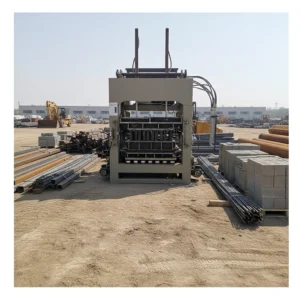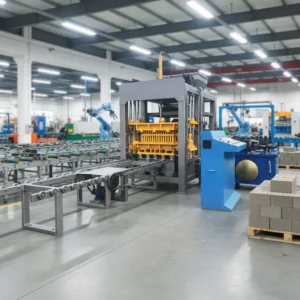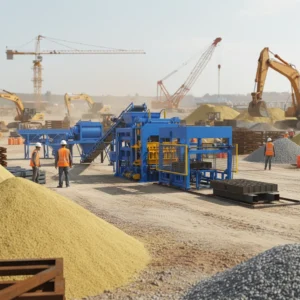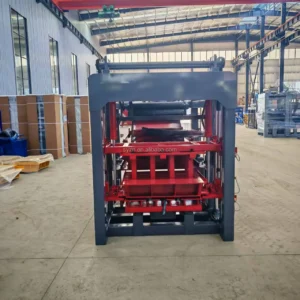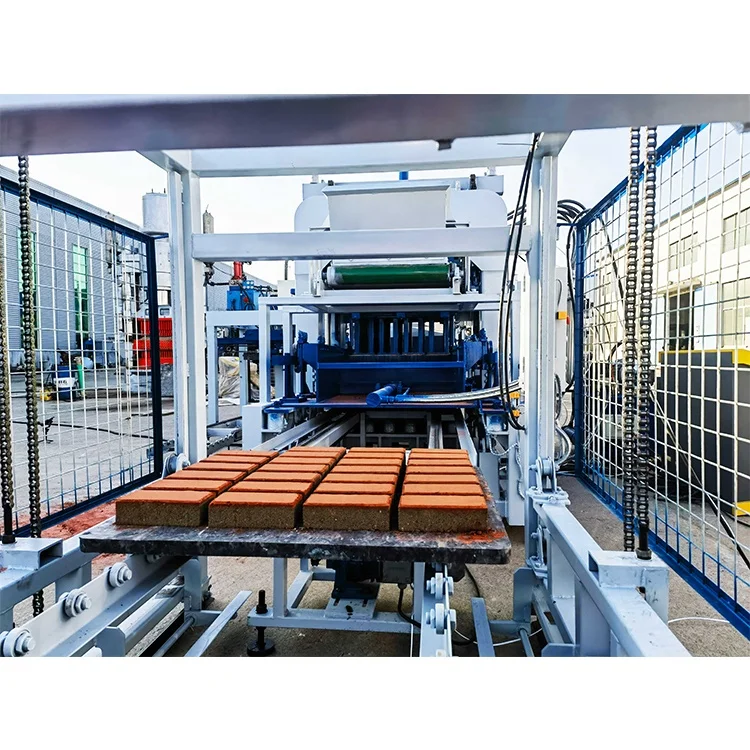
Matched Line Engineering — Every station from raw material feeding to curing rack handling is timed against the 15–20 s QT8-15 molding cycle, so the press never waits for a pallet or mixer discharge.
Technical Specifications
| Parameter | Value |
|---|---|
| Product Type | Hydraulic Concrete Block Making Machine |
| Model | QT8-15 |
| Overall Dimensions (L×W×H) | 8300 × 1860 × 3000 mm |
| Rated Pressure | 21 MPa |
| Main Vibration Form | Platform Vibration |
| Vibration Frequency | 2800–4500 r/min |
| Vibration Force | 45 kN |
| Pallet Size | 950 × 900 mm |
| Molding Cycle | 15–20 s |
| Overall Power | 55.5 kW |
| Demolding Method | Hydraulic |
| Total Mass | 8 T |
| Factory Area (press only) | 300 m² |
| Applied Products | Concrete blocks, hollow/solid blocks, pavers, interlocking blocks, curbstone, colored pavers |
| Raw Material | Crushed stone, sand, cement, dust, fly ash, gravel, slag |
| Output Capacity | basis to be confirmed per block format and mix design |
Application Suitability
| Application | Material or Output |
|---|---|
| Block and paver production plants | Hollow and solid concrete blocks from crushed stone, sand, and cement |
| Construction contractors producing on-site | Interlocking blocks and curbstones using locally sourced gravel and fly ash |
| Concrete product manufacturers adding formats | Colored pavers and porous bricks with pigment-integrated mix designs |
| Housing project contractors setting up local plants | Load-bearing hollow blocks from slag and cement blends |
| Building material distributors | Multiple block formats on a single line with format changeovers |
Why "Cycles per Hour" Tells Only Half the Story
A press that cycles every 15–20 seconds can only run at full tempo if every upstream and downstream station keeps pace.
I have walked onto sites where the concrete block making machine production line was quoted at a specific cycle rate, yet the daily pallet count told a different story. The mixer discharged slower than the press consumed, or the pallet return loop bottlenecked at the stacking station. Within a week, operators were manually ferrying pallets to the curing area because the handling system was never part of the original scope [NEED_CITE: common block line throughput shortfalls due to uncoordinated auxiliary stations].
The QT8-15 is specified as one node within a coordinated line. Raw material feeding, mixing, pallet circulation, stacking, and curing rack handling are configured together so that no single station forces the press into idle time.
How Each Station Links to the 15–20 Second Press Cycle
The molding cycle sets the heartbeat of the entire concrete block making machine production line. If the mixer batch is not ready when the hopper calls for material, the press pauses. If the pallet feeder cannot deliver a clean pallet within the cycle window, the press waits again. Each auxiliary station is therefore sized and timed against the 15–20 second window, including buffer capacity in the hopper and overlap logic in the PLC so that a brief upstream delay does not cascade into a full stop.
Where Line Integration Prevents the Most Common Bottlenecks
The gap between quoted capacity and real daily output almost always lives in the transitions — mixer discharge to hopper, press ejection to pallet conveyor, conveyor to stacking robot. On the QT8-15 line, pallet size is confirmed against the buyer’s existing curing rack spacing and forklift fork width before the order is placed, so fresh blocks move from press to rack without a manual hand-off [NEED_CITE: pallet-to-rack compatibility issues in block production]. The stacking station is programmed for the same cycle rhythm, placing loaded pallets onto curing racks at a rate the press can sustain over a full shift.
Reading the Numbers That Actually Matter on Site
The 21 MPa rated pressure and 45 kN vibration force work together: hydraulic pressure compacts the mix from above while platform vibration at 2800–4500 r/min settles aggregate from below. Block density depends on both forces being matched to the specific mix design — a fly-ash-heavy blend reacts differently than a crushed-stone blend. The 950 × 900 mm pallet size determines how many blocks press per cycle and how those blocks fit onto standard curing racks. The 55.5 kW total power rating defines the electrical supply contract the buyer must arrange before the line arrives, and the 8 T total mass dictates the foundation slab thickness needed to absorb vibration without resonance transfer to adjacent structures.
What Happens When Supporting Equipment Is Left Off the Quote
When pallet handling, stacking, and curing rack systems are excluded from the line quotation, the buyer inherits manual material movement that was never factored into the cycle calculation. Fresh blocks sit on pallets beside the press while workers carry them to the curing area one at a time. Output drops, block edges chip during hand-carry, and the labor cost erases any savings from a lower equipment invoice [NEED_CITE: labor cost impact of manual pallet handling in block plants]. The QT8-15 line quotation includes every station from raw material infeed to stacked curing rack, so the throughput calculation holds once the line is running.
Why Buyers Source the Full Line Here
Block machinery is the single focus of this operation, which means the QT8-15 press, its moulds, pallets, and every handling station are specified as one matched system rather than assembled from separate vendors. The line configuration is set against the buyer’s actual mix design, local aggregate availability, and target block format instead of a catalogue default. Mould design covers the formats the buyer’s market sells, with custom drawings available for non-standard profiles. Automation level is selectable, so a plant can start with semi-automatic pallet handling and add full stacking and cubing later. Factory testing covers the complete line, not the press alone, before any crate leaves the floor.
Documentation & Verification
- Line layout showing QT8-15 station spacing and pallet flow direction matched to buyer’s building footprint
- Capacity calculation per block format with molding cycle stated for each
- Pallet specification confirming 950 × 900 mm dimensions and material grade
- Voltage, frequency, and PLC display language written confirmation before production
- Factory test record covering full line run with buyer’s chosen mould installed
- Hydraulic and electrical schematic for QT8-15 press and all auxiliary stations
Installation, Commissioning & Support
- Foundation slab poured to bear the 8 T QT8-15 mass and absorb platform vibration loads
- Dedicated 55.5 kW electrical circuit with voltage and frequency confirmed at order stage
- Machine arrives dismantled for container loading; reassembly supervised on site
- First run covers mould change procedure and cycle timing verification across all stations
- Operator training includes PLC navigation in confirmed display language
- Wear parts list covers hydraulic seals, vibration springs, and mould liners specific to QT8-15
Before You Request a Quote
Provide the block format or formats you plan to produce, along with daily output targets and the raw materials available locally. Share your site dimensions, curing area layout, and existing forklift specifications so pallet and rack handling can be matched. Confirm the local voltage, frequency, and preferred PLC language to avoid commissioning delays.
Frequently Asked Questions
Q: How are cycle times matched across mixing, pallet feeding, pressing, and stacking so the press is never idle?
A: Each station is timed against the 15–20 second QT8-15 molding cycle. The mixer discharge rate, pallet feeder speed, and stacking robot placement interval are all set with a small buffer overlap in the PLC, so a brief upstream delay does not force the press into a full stop.
Q: What supporting equipment is included in the line quotation versus what must be sourced separately?
A: The quotation covers raw material feeding, mixing, pallet feeding, stacking, and curing rack handling as part of the QT8-15 line. The buyer typically provides the curing yard structure, water supply, and electrical connection to the main panel.
Q: How is pallet size chosen to fit the buyer’s existing curing area and forklift?
A: The 950 × 900 mm pallet dimension is checked against the buyer’s curing rack spacing and forklift fork width before the order is finalized. If the existing infrastructure requires a different size, pallet and rack specifications are adjusted together.
Q: What is the factory area requirement for the complete line, not just the press?
A: The QT8-15 press alone references a 300 m² footprint, but the full line including mixer, pallet return loop, and stacking area requires additional space. A line layout drawing is provided showing total length, width, and height clearance for the buyer’s building.
Q: How is raw material feed configured to match the buyer’s local aggregate and mix design?
A: The batching and mixing station is set up for the specific aggregate gradation, cement type, and moisture content available at the buyer’s location. Mix proportions are confirmed during line configuration so the 21 MPa hydraulic pressure and vibration settings produce consistent block density.