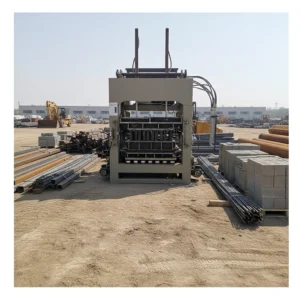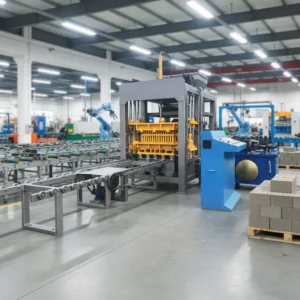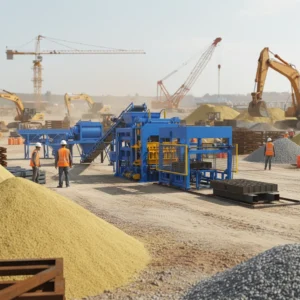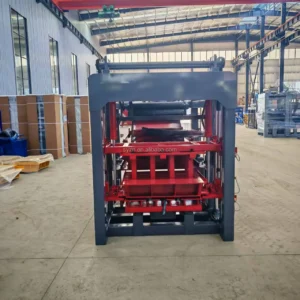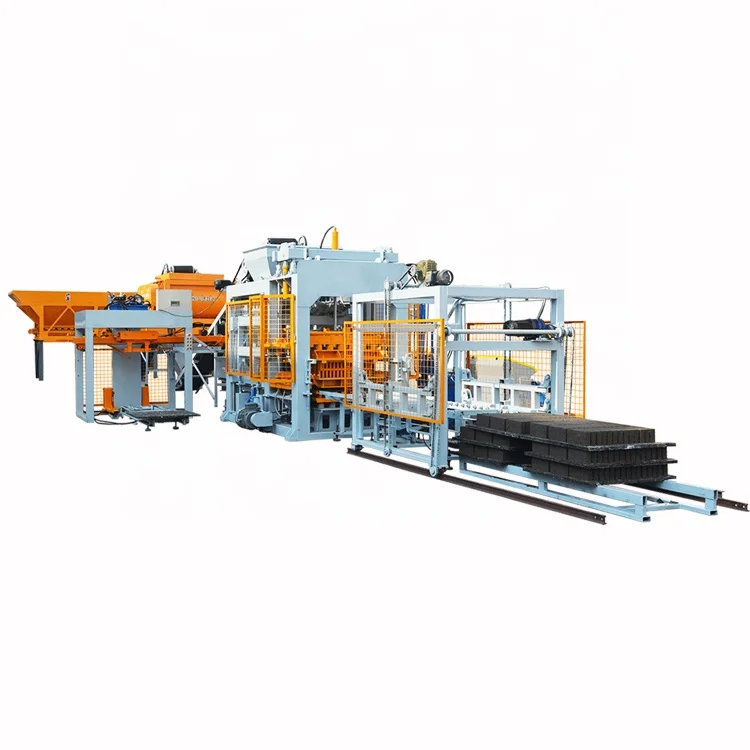
Matched System Engineering — Every station from raw material feeding to automatic stacking is specified against the QT8-15 cycle tempo so the press never waits on upstream or downstream equipment.
Technical Specifications
| Parameter | Value |
|---|---|
| Model | QT8-15 |
| Product Type | Hydraulic Full Automatic Concrete Block Making Machine with Stacker |
| Overall Dimensions (L×W×H) | 8300×1860×3000 mm |
| Rated Pressure | 21 MPa |
| Main Vibration Form | Platform Vibration |
| Vibration Frequency | 2800–4500 r/min |
| Vibration Force | 45 kN |
| Pallet Size | 950×900 mm |
| Molding Cycle | 15–20 s (basis to be confirmed) |
| Overall Power | 55.5 kW |
| Total Mass | 8 T |
| Demolding Method | Hydraulic |
| Automation Level | Full Automatic with Stacker |
| Raw Material | Crushed stone, sand, cement, fly ash, gravel, slag |
| Applied Products | Hollow/solid blocks, pavers, interlocking blocks, curbstone |
Application Suitability
| Application | Material or Output |
|---|---|
| Hollow block production plants | Crushed stone, sand, cement, fly ash blends |
| Paver and interlocking brick lines | Colored concrete mixes with fine aggregate |
| Curbstone and solid block manufacturing | Coarse gravel, slag, cement compositions |
| On-site contractor block production | Locally sourced aggregate and sand |
| Building material distributor lines | Multi-format output across block and paver ranges |
Why the Mixer and Stacker Matter More Than the Press Alone
A block machine only runs as fast as its slowest supporting station allows.
When I first started setting up block lines here in Linyi, buyers would focus entirely on the press tonnage and vibration force. They signed contracts for a high-output host machine, only to discover on commissioning day that the mixer could not feed fast enough, or the pallet return system jammed every third cycle. The QT8-15 block machine production line addresses this by treating every station — batcher, mixer, pallet feeder, press, stacker, curing rack handler — as one synchronized system rather than a collection of independent purchases [NEED_CITE: block production line synchronization principles].
The gap between quoted press capacity and actual daily output almost always lives in the supporting equipment. A 15–20 second molding cycle means the upstream mixer must deliver a fresh batch within that same window, and the downstream stacker must clear and return pallets without delay. Miss any one of those handoffs, and the press sits idle while operators scramble.
How Each Station Keeps Pace With the Press Cycle
The QT8-15 block machine production line sets its rhythm at a 15–20 second molding cycle, and every supporting station must match that tempo. The raw material batcher and mixer are sized so that a complete mix is ready before the press finishes its current mold. The pallet feeder loads fresh pallets onto the conveyor in the same window the press completes a compaction stroke. When any station falls behind, the press pauses — and those pauses accumulate across a shift into meaningful lost output.
Pallet Handling and Stacker Integration on the Line
The full automatic stacker removes what used to be the most labor-intensive bottleneck on a block line: pulling wet pallets off the conveyor and stacking them onto curing racks by hand. On this line, the stacker receives pallets directly from the press outfeed, aligns them, and places them into curing rack positions. The 950×900 mm pallet size is selected to match standard curing rack dimensions and the forklift capacity already present at most block plants [NEED_CITE: pallet sizing standards for concrete block curing racks]. The pallet return conveyor then feeds clean, empty pallets back to the press infeed, closing the loop without manual intervention.
Reading the Specs That Actually Shape Your Line Layout
The rated pressure of 21 MPa combined with platform vibration at 2800–4500 r/min and 45 kN vibration force determines the density and strength of the finished block. Hydraulic pressure compresses the mix while vibration settles fine particles into voids — if either value is mismatched to your local aggregate gradation, block strength will vary batch to batch. The 55.5 kW overall power draw tells you the electrical supply and dedicated circuit requirements for the entire press station. The 8 T total mass and 8300×1860×3000 mm footprint define the foundation pad and workshop clearance needed before the machine arrives. Factory area of 300 m² covers the press zone plus immediate pallet circulation, but the full line including mixer, curing racks, and cubing station will require additional space that should be confirmed in the layout drawing.
What Happens When Line Stations Are Not Specified Together
I have watched plants where the buyer sourced the press from one supplier and the mixer from another, only to find the mixer discharge height did not match the press hopper inlet. Pallets ordered separately arrived in a size that did not fit the curing racks already built on site. The stacker was added later and could not communicate with the press PLC, so operators ran it manually — defeating the purpose of buying full automation [NEED_CITE: PLC communication protocols between block machine stations]. These mismatches cost weeks of commissioning time and force temporary manual workarounds that persist long after the line is supposed to be running automatically.
What Sets This Line Configuration Apart
Block machinery as a single focus means the QT8-15 press, moulds, pallets, stacker, and curing handlers are specified as one matched system — not assembled from separate suppliers who have never spoken to each other. Configuration is set against your actual mix design, local aggregate, and target block format rather than a catalogue default that assumes materials you cannot source locally. The automation level is selectable, so a buyer can begin with semi-automatic pallet handling and upgrade to full automatic stacking and cubing as production volume grows. Mould design covers the specific formats your market demands, including custom drawings for non-standard block shapes. Installation and commissioning support includes operator training at your site, so the crew knows how to read PLC diagnostics and perform mould changes before the engineering team leaves.
Documentation & Verification
- Line layout showing capacity calculation per block format at each station
- Hydraulic and electrical schematics covering station-to-station connections
- Pallet specification matched to curing rack and forklift dimensions
- Voltage, frequency, and PLC display language confirmed before dispatch
- Factory test record run on your specified block format and mix design
- Wear parts and mould list with part numbers for reordering
Installation, Commissioning & Support
- Foundation pad poured to support the 8 T machine mass and vibration loads
- Dedicated electrical circuit sized for 55.5 kW total power draw at confirmed voltage
- Machine arrives dismantled for container loading with reassembly on site
- PLC parameters set to your block format and molding cycle during commissioning
- Operator training covers mould change procedure and stacker synchronization
- Hydraulic and electrical schematics provided for local maintenance teams
- Wear parts inventory recommended based on your production schedule
Before You Request a Quote
To size the QT8-15 block machine production line correctly, we need to know the block formats your market sells and the daily volume you plan to run. Share your local aggregate type and any available mix design data so the vibration and pressure settings can be matched before the machine ships. Confirm your workshop dimensions, existing curing rack layout, and forklift capacity so the pallet size and stacker configuration align with what you already have on site. Let us know your local voltage and frequency standard, plus the preferred PLC display language, so commissioning starts without electrical delays.
Frequently Asked Questions
Q: How is each station’s cycle time matched so the QT8-15 press is never left waiting?
A: The mixer discharge, pallet feeder, and stacker are each timed against the 15–20 second molding cycle. The batcher delivers a fresh mix within one press cycle, the pallet feeder loads before the press completes its stroke, and the stacker clears finished pallets in the same window. The line layout document shows throughput at every station for your specific block format.
Q: What supporting equipment is included in the line quotation?
A: The quotation covers the raw material batcher, mixer, pallet feeder, the QT8-15 press, full automatic stacker, curing rack handler, and pallet return conveyor. Each item is listed with its own specification sheet. Hydraulic and electrical connection points between stations are detailed in the schematics so your installation team knows exactly how stations link together.
Q: How is pallet size chosen to match the curing area and forklift already on site?
A: The 950×900 mm pallet dimension is verified against your curing rack spacing and forklift tine width before production begins. If your existing racks use a different size, the pallet specification is adjusted and the press pallet feeder is reconfigured accordingly. This confirmation happens during the proposal stage, not after the machine arrives.
Q: What voltage, frequency, and control language must be confirmed before the line ships?
A: Your local supply voltage and frequency are confirmed during the proposal stage and written into the production order. The PLC display language is set to your operator’s preference before factory testing. These details are documented in the electrical schematic so your electrician can verify connections on arrival without guessing at wiring configuration.