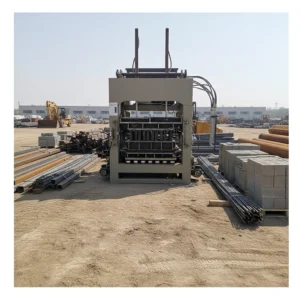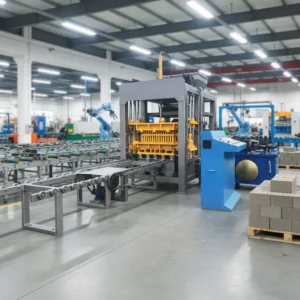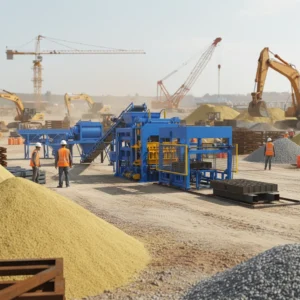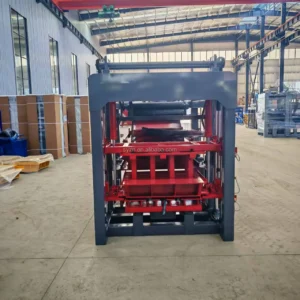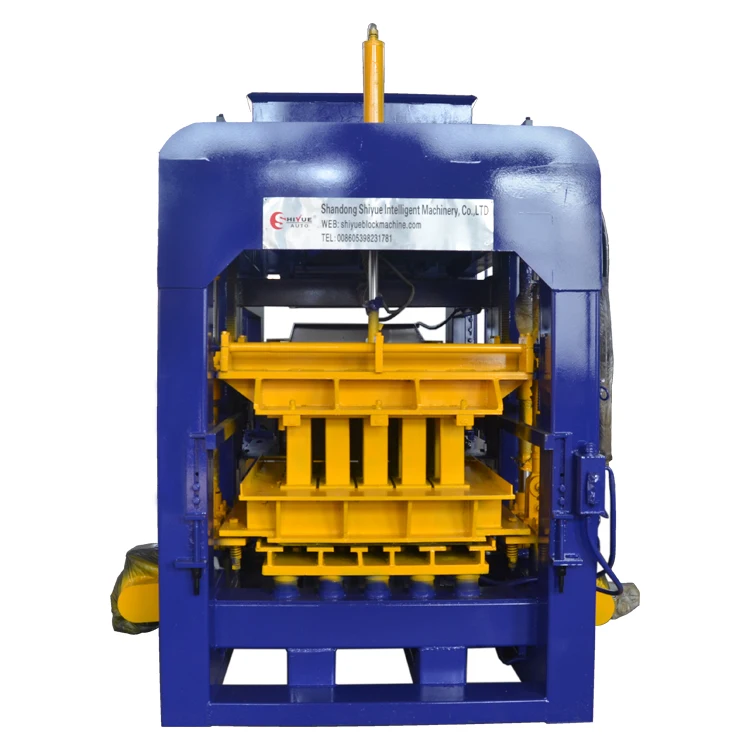
Integrated Line Design — every upstream feeder, mixer and downstream pallet handler is sized against the QT8-15 cycle so the press never sits idle waiting for material or boards.
Technical Specifications
| Parameter | Value |
|---|---|
| Model | QT8-15 |
| Product Type | Automatic Concrete Block Making Machine |
| Overall Dimensions (L×W×H) | 8300 × 1860 × 3000 mm |
| Rated Pressure | 21 MPa |
| Main Vibration Form | Platform Vibration |
| Vibration Frequency | 2800–4500 r/min |
| Vibration Force | 45 kN |
| Pallet Size | 950 × 900 mm |
| Molding Cycle | 15–20 s (basis to be confirmed by block format) |
| Overall Power | 55.5 kW |
| Total Mass | 8 T |
| Demolding Method | Hydraulic |
| Factory Area | 300 m² |
| Warranty | 1 year (whole machine, excluding spare parts) |
Application Suitability
| Application | Material or Output |
|---|---|
| Hollow block production | Crushed stone, sand, cement, fly ash |
| Solid block production | Gravel, sand, cement, slag |
| Paving block and colored paver production | Fine aggregate, cement, pigment |
| Interlocking block and curbstone production | Coarse aggregate, cement, dust |
What a "15-Second Cycle" Actually Means on the Floor
A cycle time printed on a nameplate tells you nothing until every station around the press can match it.
I spent weeks troubleshooting a block plant in Colombia where the buyer purchased a QT8-15 automatic concrete block making machine production line as a standalone press. The mixer batch size fed one mould every thirty seconds, but the press cycled in fifteen. The result was a press standing idle half the day, and the daily output landed far below the quoted figure [NEED_CITE: cycle time and upstream matching in concrete block plants]. The bottleneck was never the press itself — it was the gap between the mixer discharge and the next pallet arriving at the feed station.
Matching Every Station to the Press Rhythm
The QT8-15 molding cycle of 15–20 seconds sets the tempo that every other station must follow. A mixer that discharges every forty seconds forces the press to skip cycles, so the batching station must be specified to deliver a full charge within the press window. The pallet feeder must place a clean board, receive the vibrated mould, and clear the press table inside that same window, otherwise the hydraulic head is holding position and the vibration motors are burning power without producing a single block.
Where the Line Breaks Down Without Coordination
Downstream, the wet blocks on their pallets need to move to the curing rack before the next pallet leaves the press. If the stacking or transfer station runs slower than the press cycle, pallets queue up on the conveyor, blocking the press exit [NEED_CITE: pallet handling bottlenecks in block production]. This is why the automatic concrete block making machine production line must be quoted as connected stations with matched cycle budgets, not as a press with optional extras bolted on afterward.
Reading the Numbers That Matter
The 21 MPa rated pressure and 45 kN vibration force work together to compact the mix into a dense block before demoulding. If vibration force is high but hydraulic pressure is low, the block holds shape but lacks compressive strength; reverse the imbalance and the mix cannot flow into the mould corners. The 2800–4500 r/min frequency range lets the operator tune vibration to the aggregate size — coarser gravel needs lower frequency with longer dwell, while fine sand and fly ash respond to higher frequency with shorter cycles. The 950 × 900 mm pallet size then dictates the curing rack slot width, the forklift tine spacing, and the stacking pattern in the yard.
The Hidden Cost of Buying the Press Alone
When a buyer sources the press from one supplier, the mixer from another, and the pallet system from a third, no single party is responsible for the line running at its designed rhythm. The press vendor blames the mixer for slow feed; the mixer vendor blames the pallet handler for blocking the exit. The buyer ends up paying for engineering time to make three independent machines talk to each other [NEED_CITE: single-source versus multi-source line responsibility]. A 55.5 kW overall power envelope also means the electrical distribution board must be sized for the full line draw, not just the press motors — undersizing the main breaker causes nuisance trips that halt the entire automatic concrete block making machine production line mid-shift.
Why the Line Approach Changes the Outcome
Every station — raw material feeding, mixing, pallet circulation, stacking, and curing rack handling — is specified against the QT8-15 cycle budget rather than pulled from a standard catalogue. The pallet specification locks the 950 × 900 mm size, material, and thickness to the buyer’s existing curing rack and forklift, not to a default that arrives and does not fit. Voltage, frequency, and PLC display language are confirmed before production begins, so commissioning is not delayed by a control panel the operator cannot read. The 300 m² factory area is laid out to show exactly where the press sits relative to the mixer, the pallet return conveyor, and the curing zone, preventing the common mistake of leaving too little room for wet block circulation [NEED_CITE: block plant layout and curing zone spacing]. Mould design covers the formats the buyer’s local market actually sells, and custom mould drawings are reviewed before the press ships.
Documentation & Verification
- Line layout showing QT8-15 position relative to mixer, pallet return, and curing rack
- Capacity calculation stating the block format assumed for the 15–20 s cycle
- Pallet specification confirming 950 × 900 mm size, material, and load rating
- Hydraulic and electrical schematic matching the 55.5 kW supply requirement
- Voltage, frequency, and PLC language confirmation record before dispatch
- Factory test record on the buyer’s specified block format
Installation, Commissioning & Support
- 300 m² foundation plan covering press pit, mixer pad, and pallet return trench
- Electrical supply sizing for 55.5 kW total draw with dedicated breaker per station
- Press and pallet feeder alignment verification during on-site assembly
- First-run parameter tuning of vibration frequency and hydraulic pressure to buyer’s mix
- Operator training on mould change procedure and daily pallet inspection routine
- Wear parts list covering hydraulic seals, vibration motor bearings, and mould liners
Before You Request a Quote
To size the automatic concrete block making machine production line correctly, share the block formats your market sells, the daily volume you need, and the raw materials available locally. Confirm your site voltage and frequency, the pallet size your existing curing racks accept, and whether your current mixer and forklift will stay in the line or be replaced. With those details, every station can be matched to the QT8-15 cycle before the quotation is issued.
Frequently Asked Questions
Q: How is the QT8-15 cycle time matched with mixer batch size and pallet feeder speed?
A: The mixer is sized to discharge a full charge within the 15–20 second press window, and the pallet feeder is timed to place a board and clear the table in the same window. If either station runs slower, the press holds position and daily output drops below the quoted figure.
Q: What pallet material and thickness suit the 950 × 900 mm size for my curing method?
A: Bamboo, PVC, and steel pallets are available, each with different load ratings and moisture resistance. The recommendation depends on whether you use open-air curing, steam curing, or rack-based curing, and on the forklift tine spacing already in your yard.
Q: Which upstream and downstream stations are included in the line quotation?
A: Raw material feeding, mixing, pallet feeding, stacking, and curing rack handling can all be included. Any station you prefer to supply yourself is excluded from the quotation and marked on the line layout so interface responsibilities are clear.
Q: How does the 300 m² factory area break down across stations?
A: The layout allocates space for the press zone, pallet circulation loop, curing rack rows, and stacking area. The exact breakdown depends on your chosen automation level and the curing time your block format requires before pallets can be stripped.
Q: What electrical supply does the 55.5 kW total require, and is the control language configurable?
A: The line needs a three-phase supply at the voltage and frequency confirmed before production. The PLC display language is set to the operator’s language so commissioning is not delayed by an unreadable control panel on arrival.