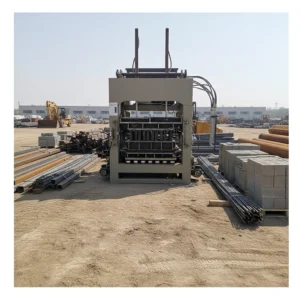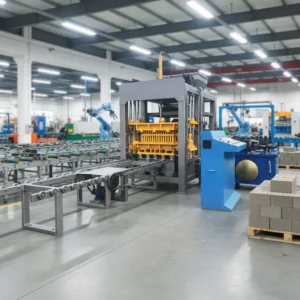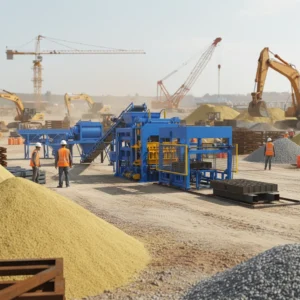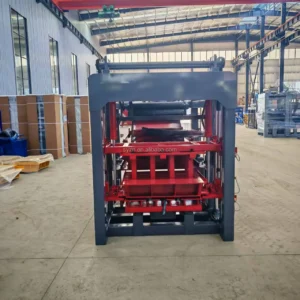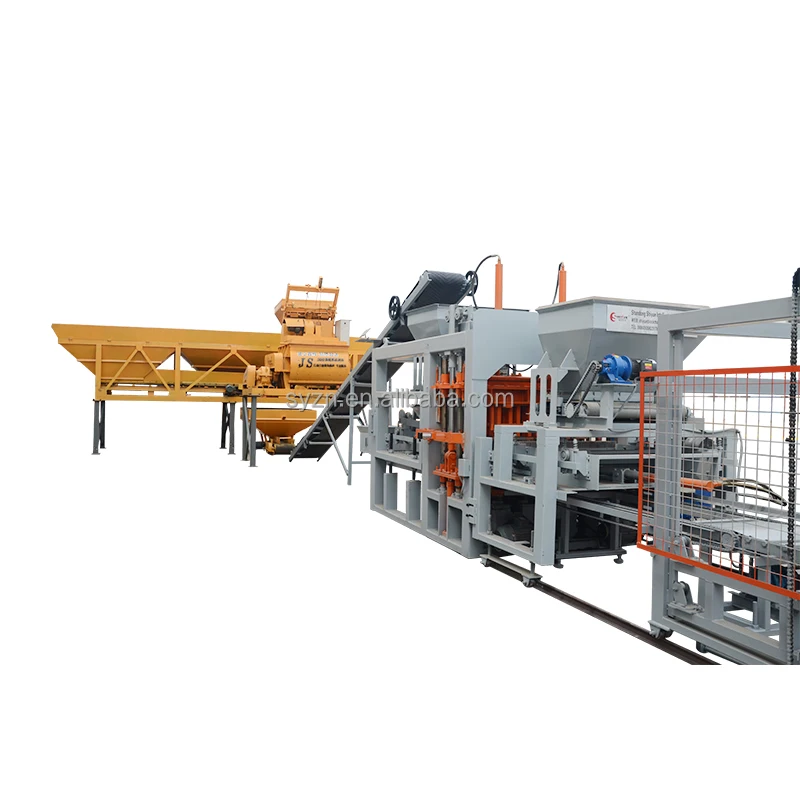
Matched Line Synchronization — Every station from the storage hopper to the pallet feed machine is timed against the QT7-15 press cycle so the Hydraulic Block Making Machine production line never starves for material or pallets.
Technical Specifications
| Parameter | Value |
|---|---|
| Product Type | Hydraulic Block Making Machine |
| Model | QT7-15 |
| Pallet Size | 1150 × 700 mm |
| Molding Cycle | 15–20 s |
| Overall Power | 45 kW |
| Vibration Force | 100 kN |
| Vibration Frequency | 0–60 Hz |
| Vibration Form | Platform Vibration |
| Demolding Method | Hydraulic |
| Control System | PLC with touch screen interface, remote fault diagnosis |
| Total Mass | 8 T |
| Output Capacity (400×200×200 mm hollow block) | 1,260–1,680 pcs/hour (basis: 7 pcs/mould, 15–20 s cycle) |
| Output Capacity (400×150×200 mm hollow block) | 1,440–1,920 pcs/hour (basis: 8 pcs/mould, 15–20 s cycle) |
| Output Capacity (200×100×60 mm rectangular brick) | 3,888–4,860 pcs/hour (basis: 27 pcs/mould, 20–25 s cycle) |
| Line Components | Pallet feed machine, block making machine, storage hopper, conveyor, hydraulic unit, PLC control cabinet |
| Automation Level | Automatic with PLC intelligent control |
Application Suitability
| Application | Material or Output |
|---|---|
| Hollow block production (400×200×200 mm) | Crushed stone, cement, sand, fly ash blends |
| Hollow block production (400×150×200 mm) | Lightweight aggregate and standard concrete mixes |
| Rectangular paving brick (200×100×60 mm) | Fine aggregate with cement binder for interlock pavers |
| Multi-cellular and standard bricks | Local aggregate with cementitious binder |
| On-site contractor production | Portable raw material feed for project-local casting |
What "1,680 Blocks per Hour" Means When the Rest of the Line Lags Behind
A press rated at 1,680 pieces per hour based on a 400×200×200mm hollow block is only as fast as its slowest upstream station.
I have watched a QT7-15 Hydraulic Block Making Machine production line sit idle for seconds per cycle because the pallet feed machine could not keep pace with the press demand. The operator stood at the control cabinet watching the PLC flag a pallet-missing alarm while perfectly mixed concrete sat in the storage hopper losing workability. The quoted output number assumed every station was synchronized; the installed line did not [NEED_CITE: line synchronization standards for concrete block plants]. Buyers who focus solely on the press specification end up with a bottleneck they did not plan for.
How the Stations Connect and Where Timing Breaks Down
The raw material conveyor feeds the storage hopper, which gravity-drops into the press mould cavity. The pallet feed machine slides a fresh pallet under the mould before each press cycle begins. If the pallet feed takes 3 seconds longer than the mould fill, the press waits. On a Hydraulic Block Making Machine production line configured with the QT7-15, the 15–20 second molding cycle sets the pace, and every surrounding station must complete its task within that window or the entire line decelerates.
Where the Hydraulic Unit and PLC Coordinate the Sequence
The hydraulic unit controls both the press compression and the demolding stroke. The PLC with touch screen interface sequences the pallet feed, vibration start, hydraulic pressure application, and demolding in a fixed order. Remote fault diagnosis capability lets the control system flag which station fell out of sync, so the operator can trace the delay rather than guessing. This level of integration matters because a mismatch in any single station cascades through the whole cycle [NEED_CITE: PLC sequencing in automated concrete block lines].
Reading the Specs That Actually Shape Your Output
The 100 kN vibration force combined with hydraulic demolding determines the green strength of the block as it leaves the mould. If the vibration force is too low for the buyer’s aggregate gradation, blocks crack during pallet transfer. The 0–60 Hz adjustable vibration frequency allows tuning to different mix designs; a coarse aggregate blend needs a lower frequency with higher amplitude, while fine sand mixes respond better to higher frequency. The 1150 × 700 mm pallet size dictates how many blocks fit per cycle and must match the curing rack dimensions and the forklift the buyer already operates. The 45 kW overall power requirement means the electrical supply must be sized for continuous draw across the press, conveyor, and pallet feed simultaneously, not just the press alone.
The Cost of Skipping Line-Level Configuration
A buyer who purchases the press without specifying the pallet feed speed, conveyor throughput, and storage hopper volume ends up improvising on site. Hand-stacking blocks because no automatic handling was quoted adds labour and introduces breakage. Choosing a pallet material that warps under local humidity causes uneven block faces and increases rejection rates. Voltage and frequency confirmed only after the machine ships delays commissioning while transformers are sourced locally [NEED_CITE: voltage and frequency standards by export market].
Why Buyers Source the Full Line Here
Block machinery is our single focus, so the QT7-15 press, mould, pallet, and handling equipment are specified as one matched system rather than assembled from separate suppliers. We configure the line against the buyer’s actual mix design and local aggregate, not a catalogue default. Mould design covers the formats the buyer’s market sells, with custom drawings available. Automation level is selectable, so a buyer can start with semi-automatic pallet handling and add automatic stacking later. Installation support includes operator training on the PLC touch screen interface and maintenance scheduling for hydraulic wear parts.
Documentation & Verification
- Line layout drawing showing station spacing and cycle time allocation per format
- Capacity calculation sheet stating the block format and mould cavity count assumed
- Pallet specification matched to curing rack dimensions and forklift capacity
- Hydraulic and electrical schematic with voltage and frequency confirmed pre-production
- Factory test record on the buyer’s target block format before dispatch
- CE declaration documentation where applicable to destination market
Installation, Commissioning & Support
- Foundation plan specifying load points for the 8 T total mass of press and hydraulic unit
- Dedicated electrical circuit sized for 45 kW continuous draw across all line stations
- Machine dismantled into container-load sections with reassembly sequence documented
- PLC touch screen language and parameters set to buyer’s market before commissioning
- Operator training on mould change procedure, vibration frequency adjustment, and fault diagnosis
- Wear parts list covering hydraulic seals and vibration platform components with replacement intervals
Before You Request a Quote
Send us your target block format and dimensions, the daily output you need, and your local raw material source. Confirm your site voltage, frequency, and preferred PLC display language. Let us know the curing area layout and the pallet handling equipment you already have so we can size the pallet feed and conveyor to match.
Frequently Asked Questions
Q: How are the line stations connected and where must cycle times match?
A: The conveyor fills the storage hopper, which feeds the mould while the pallet feed positions a pallet beneath it. On the QT7-15, the 15–20 second molding cycle sets the tempo. Every station must complete its task within that window, or the PLC pauses the press and flags the delayed station on the touch screen.
Q: What block format is assumed in the capacity calculation?
A: Each output figure is tied to a specific format. The 1,260–1,680 pcs/hour figure assumes a 400×200×200 mm hollow block with 7 cavities per mould and a 15–20 second cycle. Realistic daily output depends on your shift length, pallet circulation speed, and curing rack capacity.
Q: Is pallet feeding and handling included in the line?
A: The standard configuration includes the pallet feed machine as a synchronized station. Stacking and curing rack handling are configurable additions. We specify these against your curing area layout so wet blocks move from press to rack without hand-stacking.
Q: What voltage and PLC language options are available?
A: Voltage and frequency are confirmed with the buyer before production to match the destination market. The PLC touch screen display language is set during configuration so operators can read alarms and cycle parameters in their working language upon commissioning.
Q: How is vibration matched to local aggregate?
A: The platform vibration system offers 0–60 Hz frequency adjustment and 100 kN force. We tune these against the buyer’s mix design and aggregate gradation so block density and green strength meet the target specification without cracking during demolding or pallet transfer.