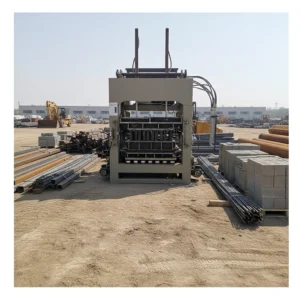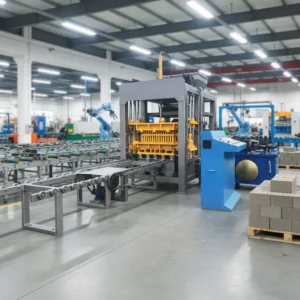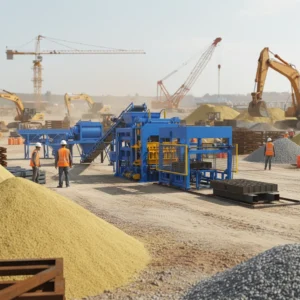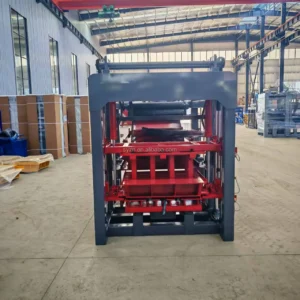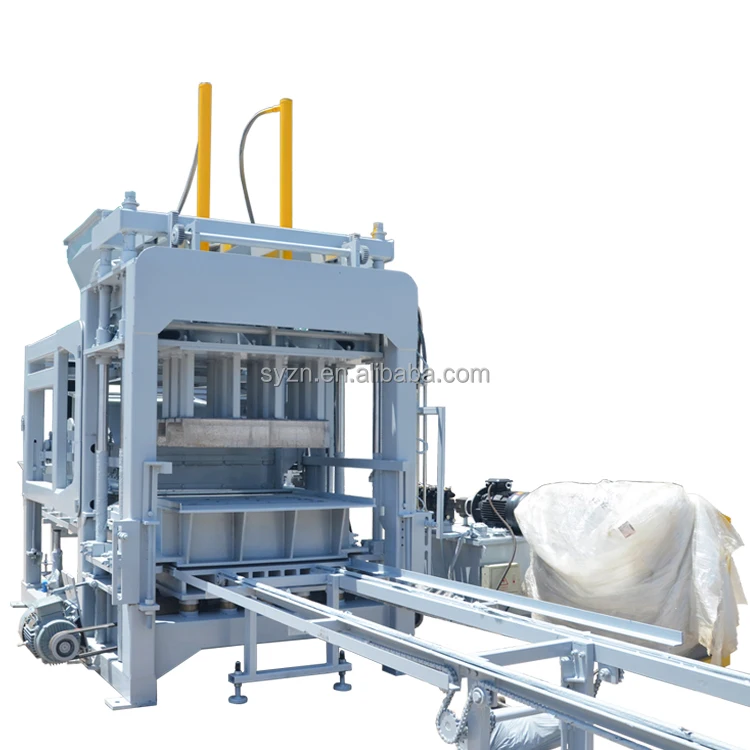
Complete Line Synchronization — The QT7-15 press is specified with pallet feeding, conveyor, and stacking stations timed to its 15-20 second cycle so no station waits on another.
Technical Specifications
| Parameter | Value |
|---|---|
| Model | QT7-15 |
| Product Type | Hydraulic Block Making Machine |
| Pallet Size | 1150 × 700 mm |
| Molding Cycle | 15–20 s |
| Overall Power | 45 kW |
| Vibration Force | 100 kN |
| Vibration Frequency | 0–60 Hz |
| Vibration Form | Platform Vibration |
| Demolding Method | Hydraulic |
| Total Mass | 8 T |
| Control System | PLC with touch screen interface |
| Fault Diagnosis | Remote control and fault diagnosis system |
| Output Capacity (400×200×200 mm hollow block) | 1,260–1,680 pcs/hour; 10,080–13,440 pcs/8 hr |
| Output Capacity (400×150×200 mm hollow block) | 1,440–1,920 pcs/hour; 11,520–15,360 pcs/8 hr |
| Output Capacity (200×100×60 mm rectangular brick) | 3,888–4,860 pcs/hour; 31,104–38,880 pcs/8 hr |
| Mould Change | Simple replacement for multi-format production |
| Assembly State | Complete line: pallet feed machine, block making machine, storage hopper, conveyor, hydraulic unit, PLC control cabinet |
| Standards | CE |
Application Suitability
| Application | Material or Output |
|---|---|
| Hollow block production | 400×200×200 mm and 400×150×200 mm formats from crushed stone, sand, and cement |
| Rectangular paving brick | 200×100×60 mm format from fine aggregate and cement |
| Multi-cellular brick | Lightweight aggregate or aerated concrete mixes |
| Standard solid brick | Local sand, crusher dust, and cement blends |
| On-site construction blocks | Project-specific formats using locally sourced aggregate |
Why Synchronization Across Stations Matters More Than Press Speed
A press rated for 1,680 hollow blocks per hour produces nothing while it waits for the next pallet.
I once watched a QT-class line where the mixer discharged every 45 seconds but the press cycled in 18. The press sat idle nearly half the time, and hourly output dropped to barely over half the quoted figure. The block production line equipment only delivers its rated throughput when every upstream and downstream station — raw material feeding, mixing, pallet feeding, stacking, and curing rack handling — is timed to the same beat. [NEED_CITE: line synchronization principles in concrete block manufacturing]
Matching the Mixer Discharge to the Press Cycle
The QT7-15 completes a moulding cycle in 15 to 20 seconds depending on block format. That means the mixer must deliver a fresh batch to the storage hopper at least every two cycles, or the hopper runs dry and the press pauses. When configuring the block production line equipment, we calculate the mixer batch volume against the press consumption rate per cycle for each target format, then select a conveyor speed that keeps material flowing without overflow at the hopper.
Pallet Circulation as the Real Bottleneck
The 1150 × 700 mm pallets travel from the press to the curing area, then return empty to the pallet feed machine. If the curing rack capacity or forklift turnaround cannot keep up, empty pallets do not arrive in time and the press halts. Line layout must account for the total pallet count in circulation, the curing rack dimensions, and the return path speed so that pallet supply never constrains the QT7-15 output.
Reading the Specs Beyond the Press Alone
The 100 kN vibration force and 0–60 Hz frequency range on the QT7-15 determine block density and surface finish, but those values only matter if the pallet underneath is rigid enough to transmit vibration without absorbing it. Platform vibration at this force level requires pallets with consistent thickness and flatness; warped pallets produce uneven compaction and weak corners. The hydraulic demolding system lifts the mould cleanly at cycle end, and the conveyor must accept the loaded pallet at a matching speed to avoid jolting freshly formed blocks. Total connected load across the full block production line equipment reaches approximately 45 kW at the press alone, so the electrical supply and distribution panel must account for the mixer, conveyor motors, and stacking system running simultaneously. [NEED_CITE: electrical load planning for concrete block plants]
What Happens When Line Stations Are Specified Separately
When a buyer sources the press from one supplier, the pallet feeder from another, and the stacking system from a third, no single party owns the cycle-time match. The pallet feeder may arrive with a 30-second indexing speed while the press cycles in 18 seconds. The stacking station may be rated for a different pallet size. Gaps like these surface only during commissioning, when rework costs and project delays have already accumulated. [NEED_CITE: integration risks in multi-supplier block plant setups]
Why Procurement From a Single Line Source Changes the Outcome
Every station on the QT7-15 line — storage hopper, conveyor, pallet feed machine, hydraulic unit, and PLC control cabinet — is specified against the same cycle-time calculation. The pallet size 1150 × 700 mm is confirmed against the buyer’s curing rack dimensions and forklift reach before production begins. Voltage, frequency, and PLC display language are locked in at order stage, not discovered at unpacking. Mould formats are selected for the blocks the buyer’s market actually sells, and the capacity calculation states the output per format rather than quoting a single peak figure. Factory testing runs the full assembled line, not just the press, so cycle synchronization is verified before shipment.
Documentation & Verification
- Line layout drawing showing station spacing and pallet return path for the QT7-15 configuration
- Capacity calculation sheet stating output per block format with cycle time assumptions
- Pallet specification confirming 1150 × 700 mm dimensions, material grade, and load rating
- Hydraulic and electrical schematic mapping the press to conveyor, pallet feeder, and stacking connections
- Voltage, frequency, and PLC language confirmation record signed before production
- Factory test record documenting full-line run with target block format and measured cycle times
Installation, Commissioning & Support
- Foundation plan sized for 8 T total mass and vibration isolation at 100 kN force
- Dedicated 45 kW circuit with correct voltage and frequency confirmed before wiring the PLC cabinet
- Pallet feed machine aligned to conveyor height and indexed to the 15–20 s moulding cycle
- Remote fault diagnosis system tested with local network during commissioning
- Operator training on mould change procedure and PLC touch screen navigation for all configured formats
- Wear parts list covering hydraulic seals, vibration springs, and mould liners with reorder intervals
What to Share With Your Inquiry
Tell us the block formats your market requires, the daily volume you plan to run, and the raw materials available locally. Share your workshop dimensions and curing area layout so we can match pallet circulation to your space. Confirm the voltage and frequency at your site, the language you need on the PLC display, and whether you have an existing mixer or forklift the line must integrate with.
Frequently Asked Questions
Q: How do cycle times at the press synchronize with pallet feeding and stacking station speeds?
A: The QT7-15 moulding cycle runs at 15 to 20 seconds depending on block format. The pallet feed machine indexes a fresh pallet into position within that same window, and the conveyor accepts the loaded pallet at a matching rate. Each station motor speed and indexing interval is set during line configuration so no station waits on another.
Q: What supporting equipment must be included so the QT7-15 is not left waiting between cycles?
A: At minimum the line needs a storage hopper with continuous mixer discharge, a pallet feed machine holding enough empty pallets for uninterrupted cycling, a conveyor timed to the press output rate, and a stacking or curing rack system that clears loaded pallets before the next batch exits. Missing any of these stations creates idle time at the press.
Q: How is the pallet size 1150 × 700 mm selected against curing area capacity and forklift reach?
A: The pallet dimensions must match the curing rack slot width and the forklift tine spacing already on site. If the curing racks were built for a different pallet size, blocks would have to be re-stacked by hand after demolding. We confirm rack dimensions and forklift specifications before finalizing pallet size and ordering the pallet feed machine.
Q: How does the line layout calculation account for different block formats and their respective cycle times?
A: Each block format — hollow, paving, solid — has a distinct moulding cycle within the 15 to 20 second range and a different number of pieces per cycle. The capacity calculation states the hourly and eight-hour output for every format the buyer plans to produce, and the mixer batch size and conveyor speed are set to match the fastest format in the mix.
Q: What automation level connects the press to automatic stacking and cubing versus manual pallet handling?
A: The QT7-15 ships as a complete block production line equipment set including pallet feed and conveyor. From there, buyers can choose manual pallet removal at the line end, semi-automatic stacking with a finger car, or fully automatic cubing that stacks and straps output for forklift transfer. The automation level is selectable and upgradeable after initial installation.