
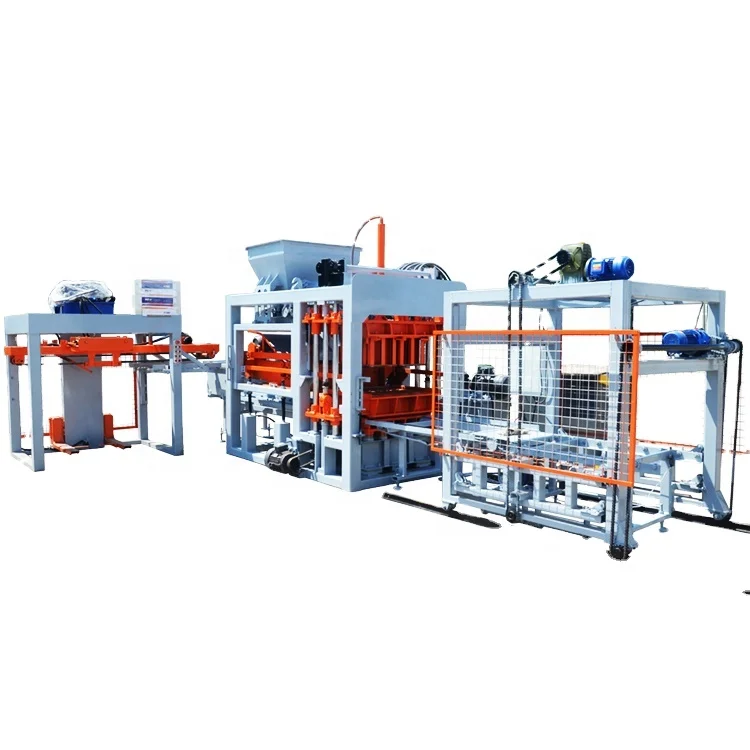
Matched System Integration — The QT6-15 is configured as a complete block production line where raw material feeding, mixing, pallet handling, and stacking are matched to the press cycle time so the machine is never left waiting between stations.
Technical Specifications
| Parameter | Value |
|---|---|
| Product Type | Interlocking Block Making Machinery |
| Model | QT6-15 |
| Overall Dimension | 820017002950mm |
| Vibration Frequency | 0-60HZ |
| Vibration Form | Platform Vibration |
| Moulding Mode | Load automatically, vibration moulding |
| Pallet Size | 880*850mm |
| Molding Cycle | 15-20s (basis: hollow/solid block), 20-25s (basis: pavers) |
| Overall Power | 37KW |
| Vibration Force | 45KN |
| Total Mass | 7T |
| Demolding Method | Hydraulic |
| Control System | PLC (Programmable Controller) with touch screen |
| Hydraulic System | Independent integrated type hydraulic station |
| Block Compressive Strength | More than 15 MPa |
| Factory Area | 1200m2 |
Application Suitability
| Application | Material or Output |
|---|---|
| Hollow Block Production | Crushed stone, cement, and sand (400x200x200mm, 400x150x200mm) |
| Solid Brick Production | Standard concrete mix and local aggregates (240x115x53mm) |
| Paving Brick Production | Interlocking and rectangular pavers (200x100x60mm, 225×112.5x60mm) |
| Waste Utilization | Fly ash, slag, and various industrial waste aggregates |
Why the Quoted Cycle Time is Only Half the Story
The block production line equipment must be synchronized so the press is never starved of pallets or wet mix.
I have seen QT6-15 units sit idle because the upstream mixer could not feed the hopper fast enough, or the downstream stacker was jammed by a mismatched pallet size. When the 15-20s molding cycle is treated as an isolated figure rather than a system throughput target, the daily output drops significantly. A block production line equipment setup requires the raw material feeding, mixing, and pallet handling to match the press rhythm [NEED_CITE: synchronization of industrial production stations].
Upstream Feeding and Mixing Rhythm
The QT6-15 operates on a 15-20s cycle for standard blocks, meaning the upstream batching and mixing stations must deliver a fresh batch every few seconds to keep the press hopper full. If the mixer is undersized, the block production line equipment stops while the press waits for material, creating a bottleneck that no amount of vibration force can solve.
Downstream Handling and Curing Flow
With a pallet size of 880×850mm, the downstream stacker and curing rack system must be designed to handle this exact dimension. If the curing racks are spaced for a different pallet, the entire block production line equipment flow breaks down at the exit point [NEED_CITE: pallet and curing rack compatibility in block plants].
Engineering the Line Around the Press
The 37KW overall power and 45KN vibration force of the QT6-15 define the core press requirements, but the supporting equipment must match this intensity. An independent integrated hydraulic station keeps the press running even if upstream vibrations affect other components. The PLC control with touch screen allows the line to signal upstream and downstream stations when the press pauses, ensuring the block production line equipment stays in sync.
How Mismatched Specs Kill Daily Output
When the pallet size and material are chosen without regard to the curing area and forklift the buyer already has, the result is a line that works in theory but fails on the ground. The QT6-15 can produce high volumes, but if the pallets are not returning from the curing area fast enough, the press sits empty [NEED_CITE: impact of pallet circulation on block machine uptime].
The Cost of Unverified Line Capacity
Many buyers receive a quotation for the press alone, leaving pallet handling, stacking, and curing out of the scope. This forces the output to be stacked by hand, which cannot keep up with the 15-20s molding cycle. The hidden cost of this gap is a daily output that falls far short of expectation, as the line is only as fast as its slowest manual station.
Why We Specify the Line as a Matched System
We focus on block machinery as a single focus, so the machine, mould, pallet, and handling are specified as one matched system. The QT6-15 is configured against your actual mix design and local aggregate, not a catalogue default. We provide a line layout and capacity calculation stating the block format assumed, ensuring every station from the mixer to the cuber is sized for your target format.
Documentation & Verification
- Line layout and capacity calculation stating the block format assumed for each station
- Machine specification sheet with QT6-15 hydraulic and electrical schematics
- Pallet specification matched to your curing area dimensions and existing forklift
- Voltage, frequency, and PLC display language confirmation before shipment
- Factory test record on your specific mould and mix design
Installation, Commissioning & Support
- Factory area requirement of 1200m2 including curing space and pallet circulation
- Electrical connection for 37KW overall power with dedicated circuit for the hydraulic station
- On-site installation of the QT6-15 press and supporting pallet feeding and stacking stations
- Commissioning of the PLC control system with operator training on fault diagnosis
- Mould change training for the 15-20s cycle formats and hydraulic wear parts support
Inquiry Guidance for Complete Line Setup
To provide an accurate block production line equipment proposal, we need your target block format, daily output goal, and the local raw material available. Please confirm your site dimensions for the 1200m2 factory area, the voltage and frequency at your plant, and the pallet size your existing forklift and curing racks can handle.
Frequently Asked Questions
Q: How is the capacity of each station calculated?
A: We calculate the throughput of every station based on the 15-20s molding cycle of the QT6-15 and the specific block format you target. The mixer, feeder, and stacker are sized so the press is never left waiting for a pallet or a batch of wet concrete.
Q: How do raw material feeding and mixing match the cycle?
A: The feeding and mixing stations are configured to deliver a consistent flow of material to the QT6-15 hopper within the 15-20s window. This prevents the press from running dry and ensures the vibration force of 45KN is applied to a full mould every time.
Q: What is the total factory area requirement?
A: The QT6-15 and its supporting block production line equipment typically require a factory area of around 1200m2. This includes space for the press, the mixer, the raw material storage, the pallet return system, and the curing racks where the blocks gain their 15 MPa compressive strength.
Q: How are stacking and cubing integrated?
A: The automatic stacking and cubing stations are timed to the QT6-15 demolding method. As the hydraulic system releases the block on the 880×850mm pallet, the stacker moves it to the curing rack, ensuring the press is ready for the next pallet immediately.



