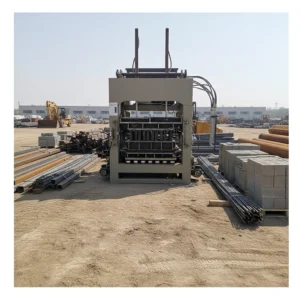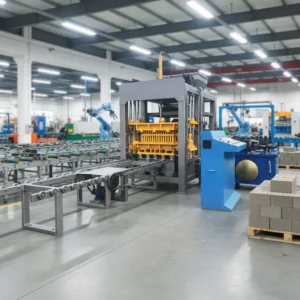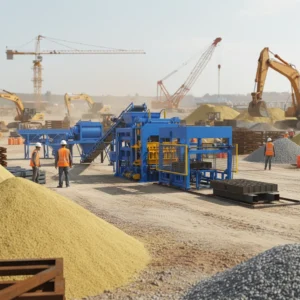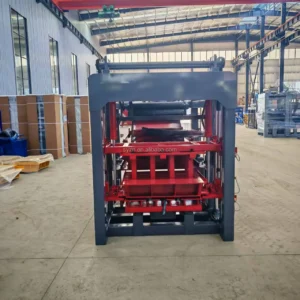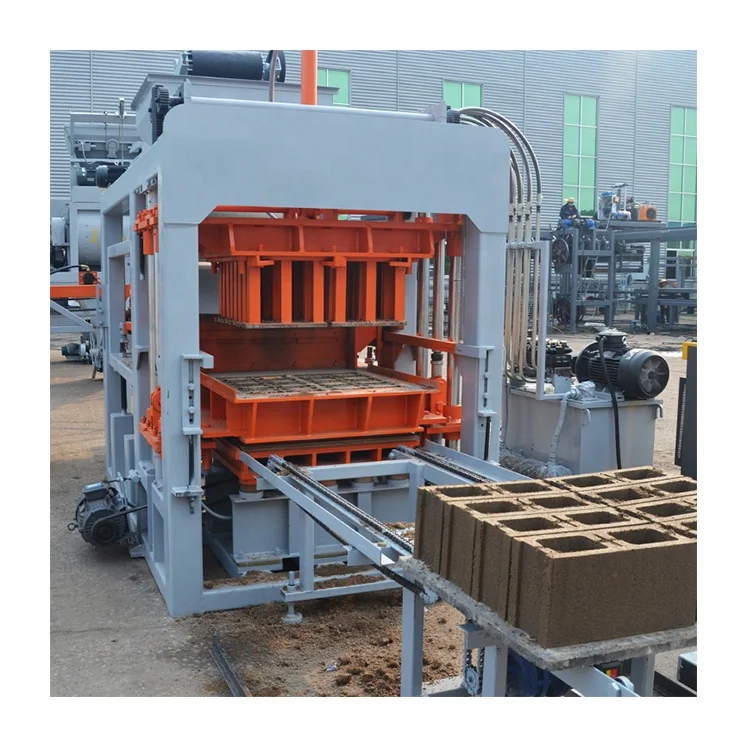
Coordinated Line Engineering — the QT6-15 is specified as part of a full concrete block making machine production line, where upstream mixers and downstream pallet handlers are matched to the press cycle so no station sits idle.
Technical Specifications
| Parameter | Value |
|---|---|
| Product Type | Hydraulic Concrete Block Making Machine |
| Model | QT6-15 |
| Overall Dimensions | 7400 × 1900 × 2660 mm |
| Molding Cycle | 15–25 s (basis to be confirmed per block format and mix) |
| Vibration Frequency | 4600 r/min |
| Vibration Force | 40–50 kN |
| Total Installed Power | 31.25 kW |
| Paired Mixer Model | JQ350 |
| Pallet Size | 850 × 550 × 25 mm |
| Total Weight | 7 T |
| Applied Products | Hollow block, solid brick, paver, curbstone |
| Raw Materials | Crushed stone, sand, cement, fly ash, dust |
| Control System | PLC control system |
| Hydraulic Station | Included |
| Automation Level | Semi-automatic (PLC, pallet feeder, brick conveyor, block sweeper) |
| Stacking Method | Manual hydraulic trolley included |
| Output — Hollow Block 400×200×200 mm | 1200–1680 pcs/h, 9600–13440 pcs per 8 hr shift (basis: 400×200×200 mm hollow block) |
| Output — Hollow Block 400×150×200 mm | 1800–2400 pcs/h, 14400–19200 pcs per 8 hr shift (basis: 400×150×200 mm hollow block) |
| Output — Solid Brick 240×115×53 mm | 3240 pcs/h, 16200–19440 pcs per 8 hr shift (basis: 240×115×53 mm solid brick) |
Application Suitability
| Application | Material or Output |
|---|---|
| Hollow block production plants | Crushed stone, sand, cement, fly ash blends for 400×150×200 mm and 400×200×200 mm formats |
| Solid brick manufacturing | Cement and fine aggregate mixes targeting 240×115×53 mm standard bricks |
| Paver and curbstone production | Dense aggregate mixes for interlocking pavers and kerbstones |
| On-site block production for housing projects | Locally sourced sand and crushed stone with portable cement silos |
| Concrete product manufacturers expanding format range | Multiple mould formats on a single line with pallet feeder and conveyor integration |
Why "Cycle Time" Means Nothing Without the Rest of the Line
A press that cycles in 15 seconds is only as fast as the slowest station around it.
Selling a concrete block making machine production line on cycle time alone is a common shortcut. I have walked onto plants where the press finished its cycle, then sat waiting because the pallet feeder was still retrieving a board from the stack, or the brick conveyor was backed up from a sweeper that could not keep pace. The operator ends up manually clearing blocks while the PLC shows the press is ready. That bottleneck is not in the spec sheet, but it shows up every shift. [NEED_CITE: production line bottleneck analysis in concrete block manufacturing]
The QT6-15 configuration addresses this by pairing the JQ350 mixer capacity, the pallet feeder retrieval speed, and the brick conveyor rate against the press cycle for the target block format. Every station is timed so the press is never the bottleneck — and more importantly, no downstream station is either.
Matching Station Throughput Across the Complete Line
When specifying a concrete block making machine production line, the press is the most visible piece, but the line lives or dies on how well the surrounding equipment keeps up. The JQ350 mixer must deliver a consistent batch volume at intervals that match the QT6-15 molding cycle. If the mixer batch size is too small, the press hopper runs low and the operator has to pause. If the batch arrives too quickly, mix sits in the hopper and begins to set before vibration compacts it properly.
The pallet feeder retrieves and positions boards at a rate synchronized with the press cycle and the brick conveyor extraction speed. When these three stations are timed correctly, the line runs continuously through a full shift without the operator intervening between cycles.
Pallet Handling: The Station Most Quotations Leave Out
The 850 × 550 × 25 mm pallet size on this line is not arbitrary — it must match the curing rack spacing and the forklift tine width already present in the buyer’s yard. [NEED_CITE: pallet dimension standards in concrete block curing operations] Sending the wrong pallet size means the buyer either replaces their entire curing rack inventory or handles blocks off the pallets by hand, which is exactly the scenario that turns a semi-automatic line back into a manual operation.
The manual hydraulic trolley included in this configuration moves wet blocks from the conveyor discharge to the curing area. For plants that plan to add automatic stacking later, the conveyor discharge height and trolley interface are positioned so the upgrade path does not require reconfiguring the entire downstream layout.
Reading the Specs That Actually Matter on the Shop Floor
Vibration force rated at 40–50 kN works together with the hydraulic station to compress the mix during molding. Higher vibration frequency at 4600 r/min helps consolidate finer aggregate blends, while the hydraulic pressure holds the mould box steady so the block holds its edges after demoulding. The balance between these two forces must be set against the buyer’s specific mix design and local aggregate gradation — a setting that works for river sand may produce weak blocks with crushed basalt.
Total installed power of 31.25 kW covers the press, vibration motors, hydraulic pump, and pallet feeder drive. This figure matters when sizing the dedicated electrical circuit and confirming the transformer capacity at the plant site. The PLC control system coordinates all station timing and can be configured with the operator display language before the line ships, avoiding the commissioning delays that happen when the control screen arrives in a language the local operator cannot read.
What Happens When Line Stations Are Not Specified Together
Plants that source the press from one supplier and the pallet feeder from another often discover timing mismatches during commissioning. The press PLC does not communicate with the third-party feeder controller, so synchronization has to be managed manually with relays and timers. [NEED_CITE: PLC integration challenges in multi-vendor block production lines] Shifts end with blocks stacked unevenly on pallets because the conveyor pulled them before vibration was complete. These are not machine defects — they are specification gaps that only appear once the line is running under production conditions.
Why Buyers Source the Full Line From One Configuration Point
Block machinery as a single focus means the QT6-15 is not sold as a standalone press but as the center of a coordinated line where the JQ350 mixer, pallet feeder, brick conveyor, and block sweeper are all specified against the same cycle time and block format. Configuration is set against the buyer’s actual mix design and local aggregate rather than a catalogue default, so the vibration force and hydraulic pressure are matched to materials the buyer can actually source.
Pallet size and material are confirmed against the buyer’s existing curing area and forklift before the order is finalized. The automation level starts at semi-automatic with a clear upgrade path, so a buyer can add automatic stacking later without replacing the press or reconfiguring the conveyor layout. Installation includes operator training that covers the full line, not just the press controls, so the team understands how station timing affects daily output.
Documentation & Verification
- Line layout drawing showing station positions and pallet flow path for the QT6-15 configuration
- Capacity calculation sheet stating the block format and cycle time assumed for each output figure
- Hydraulic and electrical schematic covering the press, mixer, pallet feeder, and conveyor as one system
- Voltage, frequency, and PLC display language confirmation signed off before production begins
- Factory test record run on the buyer’s target block format before dispatch
- Pallet specification sheet matched to curing rack dimensions and forklift capacity
Installation, Commissioning & Support
- Foundation plan sized for the 7400 × 1900 mm press footprint plus mixer and conveyor stations
- Dedicated circuit sized for the 31.25 kW total load with voltage and frequency confirmed per site
- Machine shipped in dismantled sections with reassembly sequence documented for the full line
- First-run commissioning covers press cycle, mixer feed rate, and pallet feeder synchronization together
- Operator training addresses PLC controls, mould change procedure, and daily station timing checks
- Wear parts list covers hydraulic seals, vibration motor bearings, and mould liner replacements
Before You Request a Quote
To size this concrete block making machine production line correctly, we need to know the block formats your market actually sells, the daily volume you plan to run, and the raw materials available locally including aggregate type and gradation. Share your existing curing area dimensions and forklift specifications so the pallet size can be matched. Confirm your site voltage, frequency, and the operator language required on the PLC display.
Frequently Asked Questions
Q: How is cycle time matched across the mixer, press, and conveyor so no station creates a bottleneck?
A: Each station is timed against the QT6-15 molding cycle for the target block format. The JQ350 mixer batch size and discharge interval are calculated so the press hopper never runs empty or overflows. The pallet feeder retrieval speed and brick conveyor extraction rate are set so the press is never waiting on upstream or downstream equipment during continuous production.
Q: What pallet size and material should be chosen for this line?
A: The standard 850 × 550 × 25 mm pallet must be confirmed against your curing rack spacing and forklift tine width before the order is finalized. Material choice — bamboo, PVC, or steel — depends on your curing environment humidity and the expected pallet lifespan. We specify pallets as part of the line so they arrive matched to the handling equipment already on your site.
Q: How is voltage and PLC language confirmed before the line ships?
A: Voltage, frequency, and PLC display language are documented and signed off during the configuration stage, before production begins. This covers the press, mixer, conveyor drives, and control panel as one system. Confirming these details early prevents the commissioning delays that occur when electrical components arrive configured for a different market standard.
Q: What supporting equipment is included versus what must be sourced separately?
A: This quotation covers the QT6-15 press, JQ350 mixer, pallet feeder, brick conveyor, block sweeper, and manual hydraulic trolley as a matched set. Curing racks, forklifts, and raw material silos are typically sourced by the buyer. We provide the interface specifications so your separately sourced equipment connects without timing or dimension conflicts.
Q: How does the JQ350 mixer capacity align with the press throughput?
A: The JQ350 batch volume and mixing cycle are calculated against the QT6-15 press consumption rate for the specific block format being produced. The mixer must deliver a fresh batch at intervals that keep the press hopper supplied without letting mix sit long enough to begin setting. This balance is verified during factory testing before the line ships.